

The application under review meaning is narrower than it sounds: your application is on file, still open, and no outcome has reached your status page. It does not tell you a person has read it. Indeed's closest status says the employer is reviewing applications "but has not reviewed yours yet" (Indeed), and at Auburn University, which publishes its iCIMS setup, a brand new application already shows Under Review (Auburn).
You will find the opposite claim in the search results. LoopCV's guide, from a company that sells an auto-apply service as we do, says the label means a recruiter has opened your application. It cites nothing for that. The primary sources below do not support it as a general rule.
What it means, in one line
The application exists, nobody has closed it, and the employer has not shown you anything more specific.
That is all the label can carry, because it is a setting. Workday's administrator material describes a configuration whose purpose is that candidates "do not receive internal terminology (e.g., Interview, Offer)" (Workday). Behind your two or three words sits a detailed internal pipeline that you are deliberately not shown.
Is it a good sign?
One question settles most of it: did the label change, or has it always said this?
- It has said under review since the day you applied. Neutral. You are looking at the default, and it carries no information about you.
- It replaced an earlier label, such as Applied, New or Submitted. A small good sign. Your record moved. SmartRecruiters draws this line in its documentation, with New as "Candidate Applied" and In Review as "Candidate is being reviewed by the hiring team" (SmartRecruiters). Even then, a move is not a verdict. One county's iCIMS guide tells hiring managers they "can move multiple people to the same bin at one time" (Larimer County, 2017).
The label is blunt in the other direction too. Auburn's non-faculty table shows four internal statuses that all read Under Review to the candidate: Application Received, Reviewed by Talent Acquisition, Screened by Talent Acquisition and Search Committee Review. Auburn uses Screened "when they complete a phone screen with candidate". So at that employer, someone who passed a phone screen and someone who applied this morning see the same two words.
What it means by system
These rows come from vendor documents and from guides that named employers wrote for their own staff. They are examples, and another employer on the same system can set them differently.
| System and source | What you see | What it is defined as | How to read it |
|---|---|---|---|
| Workday, University of Washington | In Progress | "Application is under review" | The early stage here. "Sent to Dept" comes after it. |
| Workday, UW-Madison | Submitted | The Review stage | You can be in review and never see the word. In Progress here means a later stage. |
| Greenhouse, named stages | In review | "Every setup starts with In review, which you can't remove" | The one stage every employer must keep. It maps to application review, and the document says nothing about a person opening your file. |
| Greenhouse, status only | Active | Applications are active by default | The closest match on this setup, and it is where everyone starts. |
| iCIMS, Auburn | Under Review | Everything from Application Received through Search Committee Review | Covers untouched files and phone-screened candidates alike. |
| SmartRecruiters | In Review | "Candidate is being reviewed by the hiring team" | A step after New, as documented for partners. |
| Indeed | Employer reviewing applications | "The employer is reviewing applications, but has not reviewed yours yet." | Set by Indeed, and Indeed says its own statuses show only in the mobile app. |
If your portal says "under consideration" instead, that label has its own post, and the Workday wording is worked through in Workday application status meaning. We found no vendor document that ranks the two phrases. At Auburn, Further Consideration begins at the interview phase, so there it is the stronger label, because Auburn chose it to be.
How long it can last
The label has no timer, so a table of how long "under review" lasts cannot be right across employers. LoopCV's guide offers ranges such as 3 to 7 days at startups and 3 to 8 weeks at enterprises, with no source on the page.
Here is what the documents show instead:
- Greenhouse: "A status may stay the same until the hiring team shares a new update" (candidate FAQ).
- UW-Madison: a frozen Workday requisition shows "The status they were in at the time".
- An HR technology consultant writing about iCIMS on 5 August 2026: "Candidates sit in 'under review' for months because what they see never got connected to what actually happened" (Integral Recruiting).
So watch the clock from the day you applied, and ignore how long the label has been up. That clock we can measure.
The numbers come from callback detection, which is rolling out with staffing teams first and is not part of self-serve accounts yet. Where it is switched on, a scanner reads a candidate's application inbox and labels likely replies. These figures cover about 29 candidates at one staffing team, for email received from 4 October to 8 November 2026. No person reviewed the labels, so these replies are found, not confirmed, and the time runs from the application, not from any interview.
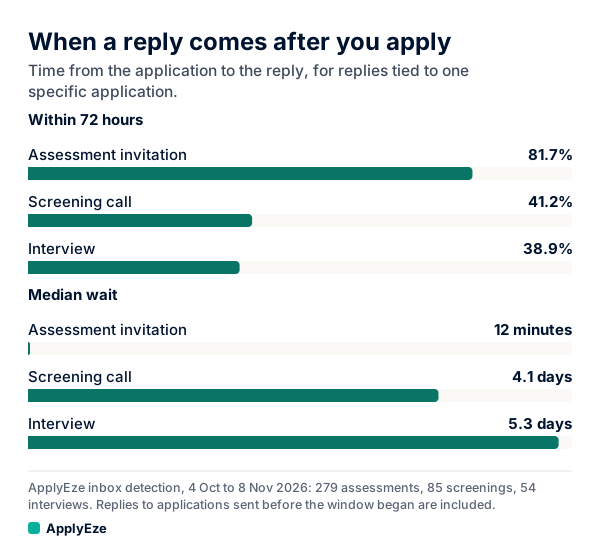
The chart shows replies tied to one specific application. A screening invitation came at a median of 98.1 hours, about 4 days, and an interview invitation at 126.8 hours, about 5.3 days. Assessment invitations came at a median of 12 minutes, and most of those are sent automatically, so they say little about review.
Recent applications in that set had less time to draw a reply, so we also read one group with time to mature: applications sent 12 to 23 October, with 58 human callbacks, meaning a screening call, an interview or an offer. In that group, 38% came within 72 hours and 74% within 7 days. That gives a working guide:
| Days since you applied | What the 58 callbacks show | What to do |
|---|---|---|
| 0 to 3 | 38% had arrived | Nothing. Silence means nothing yet. |
| 4 to 7 | 74% had arrived by the end of day 7 | Find a named person and draft a short note. |
| 8 to 14 | The other 26% came after day 7 | Send one note, only on roles you would take. |
| Past 14 | Not broken out in this read | Plan as if it is closed, and leave it open in your tracker. |
Every figure here describes applications that got a reply. None of it says how likely a reply is, and results for any one person will differ. The full math is in how long to hear back after applying.
When a removed posting matters
Your status can stay frozen while the posting itself changes, and the posting is something you can check yourself. Save the link on the day you apply. A posting that comes down while your label stays put has a few possible causes, and each one is documented somewhere:
| What happened | What the source shows | What you may see |
|---|---|---|
| Intake closed, review continues | Larimer County's guide: "best practice is to not decline until the position is no longer advertised" | Under review, then a rejection after the posting is gone |
| Someone is being hired | Auburn's workflow, at Offer Acknowledged: "All disposition emails will be sent" | No change until a finalist accepts |
| Requisition canceled | UW-Madison shows "Completed", the same word as a decline | A closed label, possibly with no email |
| Requisition frozen | UW-Madison leaves the status as it was. The University of Washington emails candidates about a freeze. | Nothing at all, at some employers |
UW-Madison is direct on that last point: changing a status or closing a requisition "does not send them any kind of notification/communication". So a missing posting is not a rejection, and it should change what you do. Send your one note now rather than waiting for day 8, and stop counting on that role.
What to do while you wait
- Save the posting text. It will disappear, and you will want it if a recruiter calls.
- Confirm the submission. Use the confirmation page or email rather than the label, as covered in what application received means.
- Look for tasks, not words. Workday puts a notification icon on Candidate Home when a task is pending, and Greenhouse says some companies share tasks in MyGreenhouse. An assessment or a scheduling link outranks any label.
- Send one note after the first week. Name the role and ask one question. Ask the employer and leave the vendor out of it: Greenhouse says its support "can't see a company's internal hiring decisions".
- Send the next application. A quiet status is missing information, and the useful response to missing information is to stop depending on it.
What it never means
- It does not mean you were shortlisted. Auburn shows it to every applicant from arrival.
- It does not mean you were rejected. On the systems above, a rejection has its own label, such as Application closed on Greenhouse or Not Selected at the University of Washington.
- It does not confirm a person read your resume. Indeed's wording says the opposite for its own status.
- It does not start a countdown. Nothing in these documents ties the label to a deadline.
- It does not speak for the employer's other roles. Each status belongs to one application.
We see these labels from the applying side: ApplyEze has delivered 94,207 applications since August, to 9,769 employers, and no one status page decides a search. So check the label once a week, send your one note, and keep applying. If you would rather spend your evenings on the roles worth a note, your first 50 applications are free, no card needed. You pick the matches and queue them in the desktop app, ApplyEze fills and submits each form while your computer stays on and awake, and you record employer replies on each application. Workday and Oracle jobs stay hidden until you connect an application inbox.