

Job application reply types come down to four that ask something of you: screening, assessment, interview and offer. Everything else that lands after you apply (receipts, webinars, status pings, rejections) either needs no answer or closes the matter. That is how ApplyEze sorts replies into cards, and the same tests work with your eyes on any inbox. In five weeks of email at one staffing team, 801 replies of those kinds were found, and the largest group was not interviews. It was assessments, at 465.
Here is how callback detection works where it is switched on. It is rolling out with staffing teams first and is not part of self-serve accounts yet. The definitions are worth having either way, because what you do next depends on the kind.
Sort any reply in four questions
Ask them in this order, and stop at the first yes.
- Does it offer you the job? It names the role and pay, or attaches an offer letter. That is an offer.
- Does it send you to a test, a take-home, or a video with nobody on the other end? That is an assessment, even if the subject says "interview".
- Does it ask to schedule or confirm a live conversation? If the voice is a recruiter, a sourcer or HR doing an intro or phone screen, that is a screening. If it is about a conversation on the job itself, that is an interview.
- None of those? It is not a callback, however warm it sounds.
The order matters. Question 2 comes before question 3 because one-way video tools often use the word "interview", and the thing they ask of you is closer to a timed test.
| Kind | What it asks of you | Median wait after applying | Replies found |
|---|---|---|---|
| Assessment | Finish something by a deadline | 0.2 hours (about 12 minutes) | 465 |
| Screening | Pick a time, prepare your basics | 98.1 hours (about 4.1 days) | 196 |
| Interview | Pick a time, prepare properly | 126.8 hours (about 5.3 days) | 140 |
| Offer | Read, negotiate, sign | Not counted here | Not counted here |
The waits cover only replies tied to one specific application, at one staffing team, from 4 October to 8 November 2026. Recent applications had less time to get a reply.
Why sorting replies matters
The clocks differ. An assessment can arrive while you are still on the careers page. A screening call takes days. If you check your email once, the day after applying, you can see the first and wrongly conclude the second is not coming.
The meaning differs. A 2022 SHRM survey found that 82 percent of organizations requiring work samples ask for them from applicants identified for further consideration. That is one reading of what a test means. Ours is narrower: a median of 12 minutes is too fast for most people to have read anything, so that invitation is mostly a system rule firing. It is a real step, and it says little about your chances. The SHRM figure is older, about work samples, and from a survey of HR professionals, so the two are not measuring the same thing.
Your reply rate depends on it. Counting assessments inflates it. In our data, screening plus interviews is 196 + 140 = 336. Adding assessments makes it 801, which is 801 / 336, or about 2.4 times as many. If you want to know whether your applications are reaching people, count the people.
Screening
As the cards use it: a recruiter, sourcer or HR intro or phone screen. Under the hood this is not its own AI category. It is an interview with a screening flag set, and a reviewer can move it to the other stage.
Sample email, written for this post.
Subject: Quick call about the Operations Analyst role
Hi Sam, I'm a recruiter at Marlow Freight. I'd like to set up 20 minutes by phone this week to go over the role, your work status and your pay expectations. What times suit you?
The tells are a recruiter's title, a short call and basic questions. Our guide to the phone screening interview covers what that call tests.
Assessment
As the cards use it: a test, take-home, coding challenge, work sample or one-way video.
Sample email, written for this post.
Subject: Next step for your Harbor Analytics application
Thanks for applying. Please complete this 60 minute online assessment within 5 days using the link below. You will need a quiet room and a webcam.
The tells are a link to a testing tool, a deadline and no named person. A recorded video belongs here too. See what a HireVue interview involves for that format, and the assessment email after applying for what the timing shows. ApplyEze does not take assessments for you.
Interview
As the cards use it: a request to schedule, or a scheduled conversation about a job.
Sample email, written for this post.
Subject: Interview with the analytics team
Hi Sam, thanks for your time last week. Dana and Luis on the analytics team would like to meet you for 45 minutes by video. Please choose a slot on the link below.
The tells are named people on the hiring side, a longer slot and talk of the work itself. A calendar invite can count too.
Offer
As the cards use it: a job offer.
Sample email, written for this post.
Subject: Your offer from Kestrel Foods
We are pleased to offer you the position of Category Manager, starting 1 February, at the base salary in the attached letter. Please review and sign by Friday.
A warm "we would like to move forward" with no role terms is not yet an offer, in our reading, so ask what the next step is.
Stage order is screening, assessment, interview, offer. A reminder about the same step folds into the card that exists, and a later stage opens a new one.
What gets no card, and why
A card exists to ask a person to do something. These get none.
| Sample wording, written for this post | What happens | |
|---|---|---|
| Receipt | "Thank you for applying" | Sender, subject and a short snippet are kept, never the email text. Matched to one application, it shows in that application's history as "Application received" |
| Webinar or newsletter | "Join our careers webinar" | Nothing kept |
| Status ping | "Are you still interested?" | Nothing kept |
| Recruiter outreach not tied to an application | "I came across your profile" | Nothing kept |
| Job board alert or verification code | "12 new jobs for you" | Dropped by rules before any AI sees it |
| Rejection | "We have moved forward with other candidates" | No card, no email text kept |
It does not track rejections. Rejection emails get no card. They ask nothing of the reader, and a card exists to ask. An unusually worded one under a receipt subject can still be kept as a receipt.
Two habits follow for anyone reading their own inbox. A recruiter's "are you still interested?" can be real and can need an answer the same day, so read those yourself. And no card on an application proves nothing in either direction. The list of what detection misses goes through this in more detail.
The real mix: 801 replies in five weeks
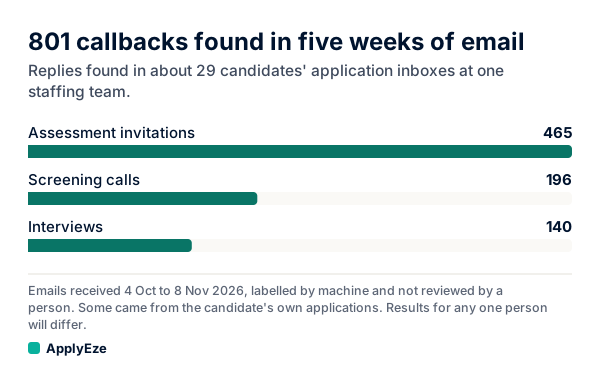
The chart shows 801 found replies, split into 465 assessment invitations, 196 screening calls and 140 interviews. As shares:
| Kind | Found | Share of 801 | Within 72 hours | Within 7 days |
|---|---|---|---|---|
| Assessment | 465 | 58.1% | 81.7% | 94.6% |
| Screening | 196 | 24.5% | 41.2% | 60.0% |
| Interview | 140 | 17.5% | 38.9% | 61.1% |
So more than half of what looks like employer interest was a test invitation, and most of those we could time arrived within three days. Human callbacks, the 336, are the slower and smaller part. On the rival pages we read on 9 November 2026, we found no one else publishing callback counts like these, with their denominators.
They are machine labels on emails received from 4 October to 8 November 2026, across about 29 candidates at one staffing team. They were found when the scanner first ran on 3 November and read back to 4 October, and no person reviewed them. That is why we say "found". The timing columns cover only replies tied to one application, and the within-7-days figures include replies to applications sent before the window began, which pulls them down. Some of these replies may have come from the candidates' own applications. Results for any one person will differ.
Use the same kinds on your own list
On a self-serve account you see every application ApplyEze sends, and you record employer replies yourself on each one. The choices are the same words: Rejected, Screening, Assessment, Interview or Offer. Your Heard back and Interviews counts come from what you record, so a zero means nothing has been recorded yet. It does not mean nobody wrote.
If you track by hand or in a spreadsheet, keep the same five values and keep assessments in their own column. Your rate then answers the question you meant to ask: how often a person wanted to talk.
Callback detection is not included in self-serve accounts yet, so these five values are yours to keep. To put them to work, you need applications going out. You queue the roles in the desktop app, which runs on your computer while it is on and awake, and ApplyEze fills and submits each form, with a resume built for each posting. Your first 50 applications are free, no card needed.