

A phone screening interview is a short first call, usually 15 to 30 minutes, in which a recruiter checks whether you meet the basics before anyone else spends time on you. It tests five things: work status, required credentials, location and schedule, pay, and whether you can explain yourself in about two minutes. The first four are closer to pass or fail than to a conversation. It is also a real filter: Ashby puts passthrough at recruiter screens at about 35%. And it tends to come later than people expect. In replies we found at one staffing team, screening invitations arrived a median of 98.1 hours after the application, about four days.
Below: which items can end the call, a script to adapt, the timing data, and what to do when the voice on the line is software. For a longer bank of questions and answers, see our guide to phone interview questions.
What a phone screen is for
The screen protects the hiring manager's calendar. Twenty minutes of a recruiter's time is cheaper than a round of interviews, so the recruiter's job is to stop the process early for anyone who could not take the job, for reasons that have nothing to do with skill. That is why much of the call feels like a form read aloud. In part, it is.
Ashby's numbers show where the pressure sits. Across more than 54 million applications and 93,000 jobs on its customers' systems, from January 2021 to March 2026, it reports about 35% passing recruiter screens. Later stages vary: its chart shows 24% at onsite, then 95% post-onsite and 81% at the offer stage. So on those jobs, about two in three screened candidates stop here (our arithmetic). Ashby sells recruiting software, its customers are not the whole labor market, and it does not say how many of those stops were logistics. Nobody we found publishes that split.
What gets checked
This is the part to prepare. The questions below are adapted from Northwestern University's published script for its own hiring managers. The knockout items match what 25 US recruiters told Enhancv, which is a small sample from a company that sells resume software. The "kind" column is our own reading of them.
| Check | How it is usually asked | Kind | What ends it here | Have ready |
|---|---|---|---|---|
| Work status | "Are you legally authorized to work in the United States?" and "Will you now or in the future require sponsorship?" | Pass or fail | A sponsorship need the employer will not meet | The same answers you gave on the form |
| Required credential | "Do you hold [license or degree]?" | Pass or fail | Missing or lapsed | Number, state, expiry date |
| Location and schedule | Commute, travel, shift pattern | Pass or fail | A mismatch neither side can move | Your real limits, in days and miles |
| Pay | "What are your salary expectations for this role?" | Range check | A number above the budget | A researched range and one reason for it |
| Start date and other processes | "When could you start?" "Where else are you interviewing?" | Information | Rarely ends it | Your notice period, and how far along the others are |
| Your story | "Walk me through your resume" | Scored | Rambling, or a story that does not match the resume | The two minute version below |
| Motive | "What caught your interest?" "Why are you looking now?" | Scored | Nothing specific about this job | One line from the posting |
| A skill probe | One or two questions on a required competency | Scored | No concrete example | One example with a number in it |
Use the table this way: answer the pass or fail items in one sentence and stop. Put your talking time into the scored ones. A long answer to a logistics question uses up a short call and adds nothing.
Before the call, open three things: the posting (save a copy, because postings close), the exact resume you sent, and the answers you gave on the form. The recruiter has them on screen, and a mismatch is harder to recover from than a weak answer.
How soon after applying it comes
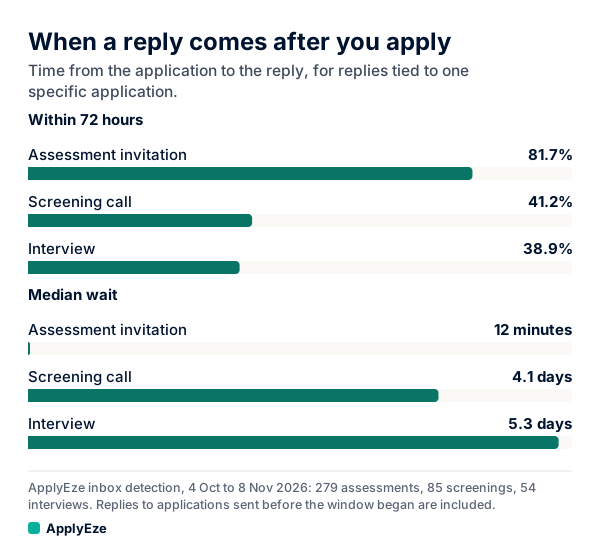
The chart shows how long replies took for those we could tie to one application. Assessment invitations came first, a median of 12 minutes after applying. Screening invitations came a median of 98.1 hours after applying, or 4.1 days, with 41.2% inside 72 hours and 60.0% inside 7 days. Interview invitations came a median of 126.8 hours after applying, or 5.3 days, with 38.9% inside 72 hours and 61.1% inside 7 days.
These come from emails received from 4 October to 8 November 2026 in the application inboxes of about 29 candidates at one staffing team, through an inbox scan that is rolling out with staffing teams first and is not part of self-serve accounts yet. They are machine labels that no person reviewed, so read them as found, not confirmed, and the timing covers the 85 of 196 screening invitations we could tie to one application. The clock starts at the application, and a recruiter who simply rings you is not counted.
These include replies to applications sent before the window began, which pulls the 7 day figures down. A fuller read, on applications from 12 to 23 October with time to mature, covers 58 screening calls, interviews and offers: median 116 hours, 38% within 72 hours and 74% within 7 days.
Three practical points come out of this. Keep your phone answerable for a week after applying to a role you want, and set a voicemail greeting that says your full name. Do not give up at day 7, because about one in four of the replies in that fuller read came later (100 minus 74, our arithmetic). And expect working hours: of 336 screening and interview invitations found, 90.5% arrived on weekdays and 167, or 49.7%, between noon and 5 p.m. New York time.
If a recruiter calls cold at a bad moment, do not take the screen in a parking lot. A sample line:
"Thanks for calling. I would like to give this my full attention. Could I call you back at [time] today, or [time] tomorrow?"
A two minute answer you can prepare
"Walk me through your resume" is the one question you can fully rehearse, and most of the scored part of the call hangs on it. Build it in four beats and then stop talking.
| Beat | About | What goes in it |
|---|---|---|
| Now | 20 seconds | Current or last role, level, field |
| First proof | 30 seconds | Work matching the posting's first requirement, with a number |
| Second proof | 30 seconds | Work matching its second requirement, with a number |
| Why this job | 20 seconds | One thing from the posting, and what you want next |
That comes to 100 seconds, which leaves room for a question inside two minutes. Here is a sample, written for this post. The person and every number are invented.
"I'm a logistics coordinator at a regional food distributor, four years in, and I run inbound freight for two warehouses.
Your posting asks first for carrier performance analysis. I built the scorecard we use for our fourteen carriers, first in Excel and then in Power BI. We used it to move about a fifth of our volume away from the two worst on-time performers, and late inbound loads fell by about a third over the next two quarters.
It also asks for someone who works well with warehouse teams. I run the Monday receiving meeting with both warehouse managers. When we changed dock schedules last spring, I wrote the plan with them, and it was running in three weeks with no extra overtime.
I'm looking at this role because I want analysis to be the whole job, not the part I fit around dispatch, and your posting says this team owns the scorecard for the whole network. Would it help to go deeper on the scorecard or on the dock change?"
Why it works: every sentence maps to something in the posting, the numbers can be checked against the resume, and it ends by handing the call back. Time yours aloud. If it passes two minutes, cut the second proof before you cut any number. Also keep a 30 second version, with one proof, for when they say "briefly". There is more on this answer in tell me about yourself.
Pay and work status questions
Either of these can end a call on the spot, so settle your answers before you dial.
Pay
A sample answer: "Based on the work and the location, I'm looking at [$X to $Y]. What has the team budgeted?" Give a range you have researched, and ask back. More scripts are in what is your desired salary.
Your rights depend on where the job is. California's Labor Commissioner says an employer cannot seek your salary history, and must give you the pay scale on reasonable request. If a recruiter asks what you earn now and you would rather not say: "I'd rather focus on the range for this role. What has the team budgeted?"
Work status
The US Justice Department's fact sheet for employers, revised April 2024, says: "Generally, an employer may ask job applicants if they have the legal right to work in the United States and if they will need sponsorship for an employment visa." A 2022 Justice Department letter gives the common wording of both questions, and says the office "has repeatedly cautioned employers against using pre-screening questions (beyond the two questions IER has deemed appropriate)". So those two are the ones to expect and to answer as asked. If a recruiter asks for more, such as your exact visa type, how much to say is your call.
| Your position | Sample answer, written for this post |
|---|---|
| No sponsorship needed, now or later | "Yes, I'm authorized. No sponsorship, now or later." |
| On OPT | "Yes, I'm authorized on OPT through [month and year]. I would need sponsorship in the future." |
| On H-1B with another employer | "Yes, I'm on H-1B now. You would need to file a petition for me to change employers." |
Say the same thing you put on the form. This is general information, not legal advice, and your school's international office or an immigration attorney can speak to your own case.
When the screener is an AI
This is no longer rare. In Greenhouse's survey released in October 2026, nearly half (48%) of 1,200 US respondents had taken an AI interview in the past year, 70% of those said it let them show their skills well, and only 7% would refuse one outright. A Greenhouse release from May 2026 said 63% had been interviewed by an AI, and that 70% were never clearly told upfront that AI would be evaluating them. The two figures ask differently, one about the past year and one with no such limit, and Greenhouse sells voice AI itself. Read them as "common", not as a precise share.
The strongest study we found is narrow. In a randomized working paper covering about 70,000 applicants for customer service roles in the Philippines, AI voice interviews increased job offers by 12%, job starts by 18% and 30-day retention by 17%. When given the choice, 78% chose the AI, and humans still made the evaluations. That is one setting and one kind of job, so it says little about yours.
What changes for you:
- Nobody reads the room. There is no nod to tell you to stop or a pause that invites more. Answer fully, in complete sentences, and then finish.
- Your words carry the weight. HireVue, for one, says it uses technology to "transcribe answers, which we then analyse to assess each competency". Other vendors may differ, but plan for a transcript. Say "Power BI" and "fourteen carriers" aloud, not "that tool" and "all of them".
- The pass or fail items do not change. The same work status and pay questions come up, so use the same answers as your form.
- Ask who reads it. The same Greenhouse survey found 49% want to know a person will review their responses, and 40% want to know how they will be evaluated. You can simply ask. HireVue says the "ultimate decision" always remains with the employer, so the employer is who to ask.
Some places give you more to work with. New York City's Local Law 144 requires notice to candidates who live in the city, at least 10 business days before a covered automated tool is used, and says the notice must "allow a candidate to request an alternative selection process or accommodation". Illinois amended its Human Rights Act to require employers to inform applicants about AI use in hiring from 1 January 2026, with details left to state rules.
A sample note to send before you take one:
Hi [Name],
I received the link for the AI screen for [Role]. Before I take it, could you tell me how my answers are evaluated and whether a person reviews them? [If needed: I would also like to ask for an accommodation: [what you need].]
Thank you, [Your name]
If the call drops or the tool fails, email the recruiter the same day and say what happened.
Questions to ask at the end
Northwestern's script closes by giving you the chance to ask questions, and most screens do. Ask three or four. These earn their place because only a recruiter can answer them:
- "What has the team budgeted for this role?" Skip it if you already settled that.
- "What are the next steps, and by when should I expect to hear from you?"
- "What does the hiring manager care about most that is not in the posting?"
- "Is there anything in my background that would give you pause?"
The last one feels uncomfortable, and it is the most useful, because it lets you correct a wrong assumption while you are still on the line. Our list of 20 questions to ask a recruiter goes further, with what each answer tells you.
Write down the range, the next step and the date before you do anything else. If that date passes, follow up once.
If software sent your application
A screen is where an automated application gets tested, so know what went out. With ApplyEze, your employers, job titles, dates, schools, degrees and certifications come from your own record, and code rejects a rewrite that adds a figure, employer, school or credential your record does not hold. In an audit of 84 sampled resumes on 4 November 2026, we found 0 invented employers, dates, degrees or numbers.
ApplyEze brings the posting's named skills and tools onto your skills line, even when your own record does not list them. There is no step to remove one before a live run, so use a dry run to see what it writes, and be ready to discuss anything on the page. A certification the posting asks for is not added unless you hold it.
Hard facts come from your profile. When a required question is not covered by your saved answers, ApplyEze still fills it rather than stopping the run, so that answer may not come from you. Fill in your saved answers, use dry run first, and read your receipts, which include the documents sent, so you can open the exact resume before the recruiter calls.
You queue the roles you want in the desktop app, and ApplyEze fills and submits each form while your computer is on. If you would rather spend your evenings rehearsing this call than typing forms, your first 50 applications are free, with no card needed.