

The questions to ask a recruiter are the ones only a recruiter can answer: how the process runs, what the budget is, whether the job is really open, and whether the company will sponsor you. Leave questions about the daily work for the people who do it. Here are 20 questions to ask a recruiter, grouped by what the answer tells you, with a note on what a weak answer sounds like. Some only work with an agency recruiter, and those are marked.
Twenty is a menu, not a script. If you have five minutes, ask these five:
- Number 2: when you should expect to hear, and when to assume it is a no.
- Number 7: what the hiring manager cares about that is not in the posting.
- Number 10: the approved pay range.
- Number 15: when they need someone in the seat.
- Number 18: whether they sponsor, if you need it. If you do not, swap in number 5.
Recruiter or interviewer: who to ask what
Most lists blend these together. They should not, because a recruiter's answer on the daily work is second-hand, and an interviewer's answer on budget is often a guess.
| You want to know | Ask | Why them |
|---|---|---|
| Steps, dates and number of rounds | Recruiter | They run the calendar |
| Approved pay range | Recruiter | They hold the number, and raising it is part of their job |
| Whether the role is funded and open | Recruiter | Interviewers often do not know |
| Sponsorship policy | Recruiter | There is one policy, and they can find it |
| What the first 90 days look like | Interviewer | They will live it with you |
| What is hard about the work | Interviewer | A recruiter has heard about it, not done it |
| How the manager gives feedback | Interviewer, and people who have worked there | This is not something a recruiter should be asked to judge |
We keep a separate list of questions to ask the interviewer.
It also matters who the recruiter works for. An in-house recruiter is employed by the company. An agency recruiter is paid by the company, often only if you are the one hired. So an agency recruiter may know less about the team and more about how this client has actually hired. How each kind is paid, and what that changes, is worth reading before your first agency call.
Questions about the process and timeline
1. "What are the steps from here, and how long does each usually take?" A recruiter running a real process names the rounds and gives rough dates. "We'll see how it goes" means either that they do not know or that the process has not been decided.
2. "When should I expect to hear from you, and when should I assume it is a no?" The second half is the useful part, because it gives you a date to stop waiting. If they name a date, write it down and follow up once when it passes.
3. "How many people are you speaking with, and how many go to the next round?" This tells you the odds at this stage. For comparison, Ashby reports about 35% of candidates pass recruiter screens on its customers' jobs, from January 2021 to March 2026. If a recruiter will not share numbers, that is normal. Ask for the rough shape instead.
4. "Who makes the final decision, and who else has a say?" You learn who you are really selling to. If nobody can say who decides, expect the process to run long.
5. "What usually knocks people out at the next stage?" This is the most useful question on the list. A recruiter who wants you to pass will tell you, because a strong candidate makes their job easier. A weak answer is "just be yourself".
Our own data gives you something to hold number 2 against, at least for a first reply.
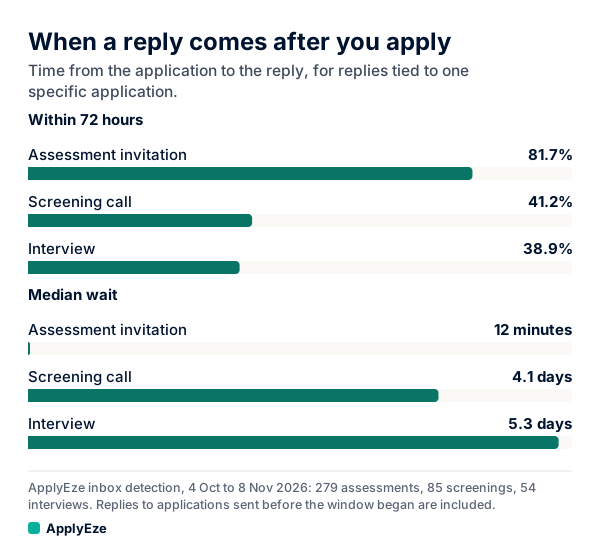
The chart covers replies found at one staffing team, from 4 October to 8 November 2026, and only those we could tie to one application. Screening invitations came a median of 98.1 hours after applying, or 4.1 days. Interview invitations came at 126.8 hours, or 5.3 days. Assessment invitations came at a median of 12 minutes. A fuller read, on applications from 12 to 23 October with time to mature, gave a median of 116 hours across 58 screening calls, interviews and offers, with 74% inside 7 days.
These are machine labels that no person reviewed, so read them as found, not confirmed. Recent applications had less time to get a reply. And the clock runs from the application, so these numbers say nothing about the gap between rounds. We have no figure for that, which is why you should ask.
Read it this way: a recruiter who says "you'll hear within a week" is in line with what we saw for a first reply. It is one team and not a self-serve result, and your employer may be faster or slower.
Questions about the team and role
6. "Why is this role open: new headcount or a replacement?" New headcount suggests growth. A replacement is fine too, and the good follow-up is what happened to the last person. A specific story is reassuring. A long pause is information.
7. "What does the hiring manager care about most that is not in the posting?" Postings are written once and edited by committee. The answer is what you should lead with in the next round.
8. "Has anything changed since the posting went up?" Scope drifts, and teams get reorganized. Better to learn now that "data analyst" has become mostly reporting.
9. "How long have people tended to stay on this team?" Recruiters know this even when it is not flattering. With an agency recruiter, ask instead: "Have you placed anyone on this team, and how did it go?"
Questions about pay
Some advice says to leave pay until later. We disagree, at least for the recruiter call. Pay is what this conversation is for, and a gap that appears after three interviews has cost everyone. You may also have a legal footing. California's Labor Commissioner says an employer must give an applicant the pay scale on reasonable request. Rules differ elsewhere.
10. "What is the approved range, and where in it do people at my level land?" The first half gets the number. The second half stops you from anchoring on a top figure nobody reaches.
11. "Is that base only? What are the bonus, commission and equity, and what was actually paid last year?" Target and actual can be far apart. In sales, also ask what share of the team hit its number last year.
12. "Is the level fixed, or could this role be leveled up or down?" Level often sets the range. If it can move, your answers in the next round can move it.
13. (Agency or contract) "Would I be a W-2 employee of your firm, of the client, or a 1099 contractor, and which benefits come with that?" The same hourly figure can mean very different take-home pay. Do not ask what fee they earn. It will not help you, and the answer changes nothing.
Is this role real and open?
The Congressional Research Service defines ghost job postings as "online job postings for positions that do not exist, or that employers are not planning to fill immediately". The most useful test you can run is on a live call. Most checks you can do alone, covered in our guide to ghost jobs, only tell you what a posting looks like. These tell you what a person will say.
14. "Is the requisition approved and funded today?" "Yes" is the answer you want. "It should be approved soon" is honest, and it tells you to keep looking while you wait.
15. "When do you need someone in the seat?" A real vacancy usually has a rough date. "Whenever we find the right person" is sometimes true, but it should lower how much time you spend here.
16. "How long has this been open, and has an offer gone out on it?" A declined offer is normal and often useful to know about. Many months with no finalist is worth asking about.
17. "Is there an internal or preferred candidate?" You may not get a straight answer, and a recruiter who gives you one is doing you a favor. With an agency recruiter, ask: "Is this a live brief from the client, or are you building a bench?" A bench is not dishonest, but it does mean no job is waiting.
One check overrides all of these. If anyone asks you to pay, stop. The FTC says "honest placement firms do not typically charge a fee to job candidates", and that if a firm asks for one, especially in advance, you should walk away.
Questions about sponsorship
This section is general information, not legal advice. Your school's international office or an immigration attorney can speak to your own case.
Check two public sources first, so your question can be sharper. The E-Verify Employer Search finds employers currently enrolled, though employers report that data themselves and a listing does not mean every site takes part. The USCIS H-1B Employer Data Hub shows petition data by employer, drawn from first decisions only.
18. "Does the company sponsor for this role, now and later?" The US Justice Department says employers may generally ask whether you will need sponsorship, so it will come up anyway. You lose little by raising it first. Ask about "later" as well, since a role can be fine on OPT and still end when OPT does.
19. "Has this team hired anyone on [OPT, STEM OPT or H-1B] in the past year?" This separates policy from practice. If you are on OPT with a STEM degree, add: "Is the company enrolled in E-Verify?" DHS requires an E-Verify employer for the 24-month extension.
20. (Agency) "Who would file the petition, your firm or the client?" In contract roles the firm may be your employer, so the answer is not obvious. If nobody can say, sponsorship may not really be on offer.
Ask, too, when the policy was last confirmed, because the rules have been moving. A presidential proclamation of 19 September 2025 attached a $100,000 payment to certain new H-1B petitions, and another, signed 18 September 2026, extended it until 21 September 2027. A federal court in Massachusetts vacated the agency guidance in June 2026, and on 30 September 2026 a federal court in California vacated the agency policies as well. The government appealed that order on 9 October, so this is still in litigation. A recruiter's answer may be months old. Our post on the fee has the detail.
What not to ask yet
None of these is forbidden. They just have a better moment or a better form.
| Not yet | Why | Do this instead |
|---|---|---|
| "Did I pass?" | They usually cannot say on the call, and it puts them on the spot | Ask number 2 |
| "What does the company do?" | A search answers it, and it tells them you did not look | Ask what the team is working on now |
| "What is your fee?" | It changes nothing for you | Ask number 13 if your pay structure is unclear |
| "Can you do [$X] above the range?" | Nothing is on the table yet | Get the range and hold your number for the offer |
| "Can I be the exception to the office policy?" | You are asking for a favor before they know you | Ask what the policy is and how strictly it is applied |
| Detailed questions about leave and benefits | Usually better at the offer stage | Ask early only if the answer would rule the job out for you |
That last exception matters. If health coverage has to start on day one for your family, or you cannot work the posted shift, ask now. Being polite does not justify three more rounds on a job you cannot take.
Getting to this call
Every question above needs a recruiter on the line, and that starts with an application. ApplyEze handles that step. You pick matches from a board ranked on your target titles and the requirements it reads out of each posting, and you queue them in the desktop app. It builds a resume for each posting and fills and submits each form while your computer is on, and you record each reply on its application. Print your five questions, and if you would rather spend your evenings on calls like this than on forms, your first 50 applications are free, with no card needed.