

To work well with a recruiter, start with who pays them. An agency recruiter is paid by the employer, an in-house recruiter is employed by one, and a reverse recruiter is paid by you. That one fact decides what you can reasonably ask for, how hard they will push on your behalf, and when they will stop calling. The rule that matters most runs the other way: nobody should send your resume to an employer until you have said yes to that employer and that role.
A disclosure: we make ApplyEze, software that applies to jobs, so we compete with part of what some recruiters sell. This post reads the written codes recruiters sign up to, which most advice on this subject skips, so you can see what you are actually owed. It also shows what judgement and reach each brought at one staffing team, measured side by side.
Three kinds of recruiter
| Agency recruiter | In-house recruiter | Reverse recruiter | |
|---|---|---|---|
| Who pays | The employer | The employer, as salary | You |
| How | Contingent: only on a hire. Retained: in stages as the search runs | Regular pay | Monthly or one-time, sometimes plus a share of your first-year salary |
| Works for | The client | That one employer | You, on the terms you signed |
| Can do | Put you in front of clients they know | Move you through their own company's process | Find roles, apply for you, and at the higher end reach out and coach |
| Cannot do | Find you a job outside their client list | Tell you about other employers' roles | Make an employer answer |
On the agency side, Cowen Partners, an executive search firm, quotes roughly 20% to 30% of first-year salary for contingent searches and about 30% to 35% for retained ones, though the same page also gives 25% to 35%. Treat those as one firm's figures. Fees vary, and you will rarely see them.
On the reverse side, as of November 2026, Find My Profession lists $3,000 a month, or $1,500 a month plus 8% of first-year salary. Careerify lists $150 a month for about 50 human-submitted applications. Scale.jobs lists $399 for 500 applications. Our reverse recruiter guide covers when that spending makes sense.
Who pays, and what that changes
You are not the client. Cowen describes contingent firms as paid only if the client hires someone they presented, so they are motivated to fill roles quickly. Expect attention while you are placeable and silence when you are not. It rarely means anything personal. A recruiter with no matching role has no reason to call.
Their incentive on your pay is weaker than it looks. A percentage fee sounds as if it lines up with you. Run the numbers at the low end of Cowen's range. A 20% fee on $100,000 is $20,000. If you push the offer to $105,000, the fee rises by $1,000, while the risk of losing a $20,000 placement rises too (our arithmetic). So a recruiter may well carry your counter, and may also advise you to take the deal. Hear that advice with the math in mind. Salary negotiation scripts still apply when someone else is relaying the message.
A fee to you changes everything. The FTC says "Honest placement firms do not typically charge a fee to job candidates", and that if one asks you for a fee, especially in advance, you should "walk away". New York City goes further: "Employment agencies cannot charge a fee before they place you in a job." A reverse recruiter is a paid service you chose, under a contract you can read. That is different from an agency recruiter who tells you, after a few calls, that there is a registration fee.
Consent before they submit you
The two written codes we found that address this directly agree. The National Association of Legal Search Consultants' Code of Ethics says: "Candidates shall be submitted to employers only with the candidates' express prior consent." The National Association of Physician Recruiters' code says a member refers a candidate "only with the Candidate's knowledge and permission". Paraform, a recruiter marketplace, tells its recruiters that "explicit consent from the candidate must be given prior to each unique submission". The American Staffing Association's search and placement code is looser. It asks firms to consider "the circumstances under which candidate information may be shared with clients", and it does not mention consent.
This is more than courtesy, because a double submission is a fee dispute with your name on it.
- On some systems, first in wins. Recruitee's agency tool says "The first agency to submit a candidate maintains ownership rights", and it blocks a second agency on the same job if the email, phone, name or LinkedIn URL matches.
- Others leave it to a person. Greenhouse does not auto-merge agency duplicates, "since there could be questions about whether the agency should get credit".
- Credit can last. Paraform's ownership runs 12 months from submission, per role.
- Strict employers may step back. Leon, a staffing firm, says double submission can trigger a blackout of 6 to 12 months at some strict employers. That is one firm's claim, and we could not check it against an employer's written policy.
The practical upshot is simple. An employer choosing between you and someone with no fee argument attached has an easy way out. So if you apply at volume, keep a list, and give it to your recruiter. That applies whether you apply by hand, through a service or with software. They cannot avoid a job they do not know about.
A sample reply, written for this post:
Thanks, [Name]. Yes, you may submit me to [Company] for [Role, requisition number if you have it]. This covers that role only. Please send me the version of my resume you submit, and check with me before sending it anywhere else.
Exclusivity and right to represent
A right to represent, or RTR, is a signed permission to submit you for a role. The NAPR code defines it as giving the firm the right "to represent the Candidate on an exclusive basis". A narrow one is normal. A broad one can box you in. Per Leon, position-specific agreements typically run 30 to 90 days and broad ones can run 6 to 12 months. A legitimate one names the end client, the role, the dates and what ends it.
Before you sign, ask:
- Which employer and which role does this cover?
- When does it end, and what ends it early?
- Can I still apply elsewhere, and work with other recruiters on other roles?
- Does anything stop me working with this employer directly later on?
If they will not name the client before you sign, do not sign. This is general information, not legal advice. If a long agreement matters to you, have someone qualified read it.
What to give them
They can only act on what you tell them, and vagueness costs you more than it costs them.
Give them:
- One current resume, and ask to see any edits before they send it.
- Your real pay floor. A number they can use beats a polite range they have to guess at.
- Location limits, start date and notice period.
- Your exact work status, including whether you will need sponsorship later.
- Every employer you have applied to in the last 12 months, with dates. Include anything a person or software applied to for you.
- Where other recruiters have submitted you.
- Employers that are off limits, starting with your current one.
Do not give them, before there is an offer: your Social Security number, date of birth or bank details. Leon lists those requests as red flags, along with references requested before any interview.
Then ask your own questions. We keep 20 questions for a recruiter, including the ones that only work with an agency.
What they owe you, and what they do not
Most advice on this is a matter of opinion. Some of it can be looked up, so we read the codes.
| You might expect | Is it owed? | Where that comes from |
|---|---|---|
| No discrimination | Yes, by law | EEOC's manual treats anyone "regularly undertaking with or without compensation to procure employees for an employer" as an employment agency. In April 2026 a staffing firm agreed to pay $155,000 after acting on a client's request for men only. |
| No citizenship status discrimination | Yes, by law, within limits | The Immigration and Nationality Act covers "recruitment and referral for a fee" for protected groups |
| Accurate information about the job | From members | NALSC: "the most accurate information known to the search firm". ASA: "dignity, honesty, candor, and respect". NAPR says "the burden of information verification lies with prospective Candidates", so check anyway. |
| Being asked before each submission | From members of NALSC and NAPR | Otherwise, only what you have agreed in writing |
| Hearing the result | From members | NALSC: "inform the candidate of the results of those submissions in a timely manner". NAPR: "maintain regular contact". |
| Confidentiality | Partly | NALSC protects what you share in confidence, "subject to the search firm's duties to the employer". So do not assume everything stays private. |
| No pressure | From members | NALSC bars "undue influence". NAPR bars attempts to "coerce". |
| Finding you a job | No | We found nothing that promises this. Their contract is with the employer. |
| Detailed interview feedback | No | ASA's "all information relevant to the hiring process" is the nearest thing, and it does not promise a debrief |
| A call back when nothing fits | No | Ask for it, but do not count on it |
| Bargaining hard for you | No | They work for the client. See the math above. |
One limit applies throughout: these codes bind members only, and plenty of recruiters belong to none. Membership means more where there is a way to complain. NALSC has an ethics complaint form and lists censure, suspension and expulsion as sanctions. To find members, see how to find recruiters.
What a person's judgement is worth, in data
We can measure this at one staffing team, where recruiters picked roles by hand and applied for their candidates, alongside applications sent through ApplyEze.
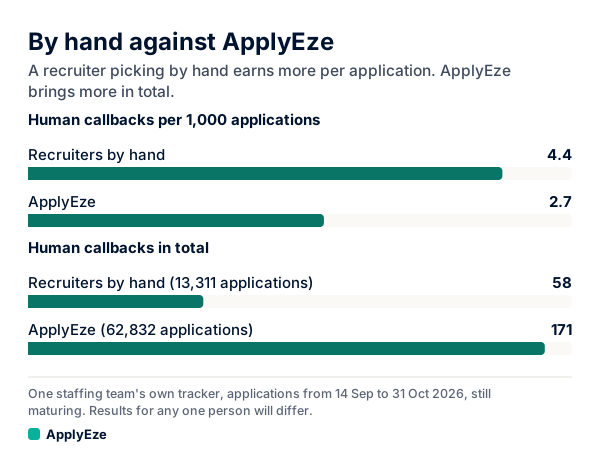
Across applications sent from 14 September to 31 October 2026, a recruiter picking by hand earned more callbacks per application, 4.4 against 2.7 per 1,000. Here is the whole table:
| Applied in | ApplyEze applications | Callbacks | Per 1,000 | By hand applications | Callbacks | Per 1,000 |
|---|---|---|---|---|---|---|
| 14 to 30 Sep | 5,245 | 8 | 1.53 | 7,429 | 39 | 5.25 |
| 1 to 15 Oct | 17,619 | 35 | 1.99 | 3,844 | 12 | 3.12 |
| 16 to 31 Oct | 39,968 | 128 | 3.20 | 2,038 | 7 | 3.43 |
| Whole window | 62,832 | 171 | 2.72 | 13,311 | 58 | 4.36 |
A human callback here means a screening call, an interview or an offer. Assessment invitations are not counted. Only recruiters' own applications count as by hand. Rows that exist only because an inbox reply was found, and candidates' own logged applications, are left out of both sides, because they would inflate a rate.
Judgement about which role to send is worth something measurable, and it is limited by how many roles a person can look at. Use a recruiter for judgement and access, keep applying on your own for reach, and do not let either one stand in for the other.
These are that team's own recruiters, not reverse recruiting services, which publish no rate. The numbers measure picking roles and applying, so they leave out what an agency recruiter adds through a relationship with a client. They come from one staffing team and not from self-serve accounts, and results for any one person will differ.
At that team, ApplyEze brought about three times as many callbacks in total, 171 against 58. And the gap narrowed as the fall went on. ApplyEze's rate rose from 1.5 to 3.2 per 1,000, and in the last two weeks of October the rates were close, 3.2 against 3.4, though that by-hand figure rests on 7 callbacks and October applications are still maturing.
When to move on
Ending it is normal, and you owe no long explanation. Move on when you see any of these:
- A fee request from a placement firm. Stop right there. In New York City you can check a license and complaint history through nyc.gov/dcwp or 311.
- A submission you did not approve. Say so in writing, and ask them to withdraw it.
- No named client after you have asked twice.
- Pressure to shade the truth about your experience or status.
- Roles that keep missing your stated pay, level or location after you have corrected them once.
- Silence after two follow-ups. That may only mean there is no match. Stay friendly, and stop waiting.
A sample closing note, written for this post:
Hi [Name], thanks for your help on this. I am going to continue my search without further submissions for now, so please do not send my resume to any new employers. If a role at [level] in [field] comes up, I would be glad to hear from you and decide then.
That keeps the relationship and removes the risk. If you are not exclusive, you do not need permission to send it.
Where software fits
ApplyEze is software, not a recruiter, and it covers the reach side of that split. If you are job hunting on your own, you can start with 50 free applications on sign-up, no card needed: you pick the matches and queue them in the desktop app, and ApplyEze fills and submits each form while your computer is on. Every run leaves a receipt with the documents sent, which makes it easy to give a recruiter the list they need to avoid a double submission.
On cost, ApplyEze lists Starter at $19 a month for 700 applications, or 2.7 cents each. As of November 2026, Careerify's $150 a month for about 50 is $3.00 each and Scale.jobs' $399 for 500 is 80 cents each (our arithmetic). Those are different services, since a person submits each of their applications.
Keep a good recruiter for judgement and access. If you would rather not type every other form yourself, your first 50 applications are free.