

To find recruiters in your field, run one search you can repeat rather than a one-off look: an exact-title string on LinkedIn, done by hand, then the trade directory for your field if there is one, then a short check of what each recruiter actually places. Most guides stop at typing "[industry] recruiter" into a search bar. That misses people titled talent partner or search consultant, and it tells you nothing about whether they place people like you. Below are the strings for the largest fields in our job pool, the directories we could open and what each one really offers, a note to send and a tracker to keep.
This is by-hand work, and it should stay that way, for reasons LinkedIn spells out below.
Agency, in-house or independent
Decide who you are looking for first, because the title words differ. Labels overlap, and companies use them inconsistently, so treat this as a starting list.
| Kind | Why contact them | Title words to search | Also found |
|---|---|---|---|
| Agency | Several clients, so they can move you between employers | Recruiter, staffing manager, account manager, recruitment consultant, search consultant | Trade directories below |
| In-house | Owns the hiring at one employer | Recruiter, talent acquisition partner, talent partner, sourcer | The People tab on a company's LinkedIn page |
| Independent | A narrow specialty and a small client list | Founder, owner or principal, plus recruiter or search | Trade directories, and referrals from people in your field |
If you have a list of target employers, go in-house first. If you are open on employer, go agency. How each kind gets paid changes what you can ask of them, so read that before you sign anything.
The search strings, by field
LinkedIn's Boolean search help page sets the rules. Type the string into the main search bar. AND, OR and NOT must be in capitals. Quotation marks hold an exact phrase, and parentheses are the only grouping symbols it recognizes. It does not support wildcards, and it says + and - are not officially supported. Precedence runs quotes, parentheses, NOT, AND, then OR, which is why every string below is wrapped in parentheses before anything is excluded.
To run one:
- Paste the string into the main search bar.
- Choose the People filter, so you get people and not job ads.
- Narrow by location. Add current company if you are after one employer.
- Open only the profiles that look right, and copy them to your tracker.
| Field | String to paste |
|---|---|
| Clinical healthcare | ("nurse recruiter" OR "clinical recruiter" OR "healthcare recruiter" OR "allied health recruiter") |
| Physicians | ("physician recruiter" OR "provider recruiter") |
| Sales | ("sales recruiter" OR "GTM recruiter" OR "go-to-market recruiter") |
| Operations | ("operations recruiter" OR "manufacturing recruiter" OR "industrial recruiter") |
| Finance and accounting | ("accounting recruiter" OR "finance recruiter" OR "CPA recruiter") |
| Marketing | ("marketing recruiter" OR "creative recruiter") |
| Customer success | ("customer success recruiter" OR "customer support recruiter" OR "call center recruiter") |
| Supply chain and logistics | ("supply chain recruiter" OR "logistics recruiter" OR "procurement recruiter") |
| Construction management | ("construction recruiter" OR "skilled trades recruiter") |
| Security | ("cybersecurity recruiter" OR "security recruiter" OR "cleared recruiter") |
| Legal and compliance | ("legal recruiter" OR "attorney recruiter" OR "compliance recruiter") |
| Software engineering | ("technical recruiter" OR "engineering recruiter" OR "software recruiter") |
Three variations are worth keeping:
- Drop the junior results: add
NOT (intern OR student OR coordinator)after the closing parenthesis. - Lean toward agencies: add
AND (staffing OR search OR agency). - Catch in-house titles that avoid the word recruiter: use
"talent acquisition" AND (nursing OR clinical), with your own field's words.
For one employer, open its LinkedIn page, go to People, and search there for recruiter or talent acquisition.
We built these from LinkedIn's documented rules. We have not counted what they return, and LinkedIn changes its search, so expect to adjust them.
Two limits to respect
The commercial use limit. LinkedIn's help page says reaching it suggests "you're likely using LinkedIn for commercial use", with hiring and prospecting as its examples. Profile searches count, and so do browsing People Also Viewed and viewing profiles on the People tab of a company page. Name searches in the top search box and browsing your first-degree connections do not. Free usage resets at midnight PST on the first of each month. LinkedIn does not show your remaining count, and support cannot remove the limit. So one tight string beats a dozen broad ones. Spread your looking across the month.
No tools. LinkedIn states "we don't permit the use of any third party software, including 'crawlers', bots, browser plug-ins, or browser extensions that scrape, modify the appearance of, or automate activity on LinkedIn's website", and that members risk having accounts restricted or shut down. Do this by hand. It is also how you notice who is actually a fit.
Directories and associations
A directory gives you what a title search cannot: a firm that has at least signed up to something. We opened each of these on 9 November 2026.
| Directory | Covers | How you can search | Open to you? |
|---|---|---|---|
| American Staffing Association | US staffing firms | Location, type of staffing service, occupational categories | Yes |
| TechServe Alliance | IT and engineering staffing | Six regional chapters, or an all-members search | Yes |
| NALSC | Attorney search | Keyword, state, city, practice area, and level such as associates or in-house | Yes |
| NATHO | Travel healthcare staffing | A public list of current members | Yes |
| AESC, through BlueSteps | Retained executive search, for director level through C-suite | Region, industry and function | Paid. BlueSteps lists a $398 first-year membership, as of November 2026, and says the directory is for Premium Services members |
| NAPR | Physician recruiting | Directory sits in a private portal | No. Portal access is for recruiter members |
Two more notes, and one gap.
Membership is a signal, not a recommendation. The American Staffing Association's job seeker page tells you to look for its member logo, which is what you would expect it to say. What membership buys you is a written standard. NALSC's code requires candidates' "express prior consent" before submission, with a complaint process behind it.
Forbes publishes annual lists of recruiting firms. They rest on more than 18,000 survey responses from recruiters, hiring managers and candidates, according to a release from a firm on the list. That is a fair source of names, but it says nothing about whether a firm places people in your field.
The gap. We did not find a comparable open directory for sales, operations, marketing, customer success, supply chain or construction recruiters. There may be regional ones. For those fields, the American Staffing Association's occupational categories and the LinkedIn strings above are the practical route. NALSC is also for attorney search, so it will not help a compliance analyst.
How to qualify a recruiter
A name is not a lead until it passes these. Most of them take a few minutes on a profile, and the second takes one question.
| Check | How | Keep if | Drop if |
|---|---|---|---|
| Field | Read their last ten posts or job ads | Mostly your field, level and region | Everything from nurses to forklift drivers, unless it is a branch you need |
| Placements | Ask: "What have you placed in the last six months at my level?" | They name titles, kinds of employer and a timeframe | "I work across all industries" |
| Money | Ask who pays them | The employer | Any fee to you. The FTC says "Honest placement firms do not typically charge a fee to job candidates", and to walk away if one asks |
| Client | Ask if they will name the employer before submitting you | Yes, every time | "I'll tell you once you sign" |
| Identity | Compare the firm's website, email domain and LinkedIn page | All three match | A free email address, or a firm you cannot find |
Where a local license exists, check it. New York City, for one, requires employment agencies to hold a license and lets you check license and complaint history through nyc.gov/dcwp or 311.
When you do get on a call, our 20 questions to ask a recruiter cover the rest.
A short first note
Say what they need to decide in ten seconds: what you are looking for, why you are worth their time, and an easy way to say no. Both samples were written for this post, so replace the brackets with your own facts.
Sample connection note:
Hi [Name], I see you place [field] roles in [region]. I'm a [title] with [number] years in [specialty], looking for [target role]. Would it be useful to connect?
Sample follow-up, once connected:
Thanks for connecting, [Name]. In brief:
- Target: [title], [level], [location or remote]
- Background: [years] in [specialty], most recently [one result with a number]
- Pay floor: [$X]
- Work status: [one line]
- Already applied at: [list, so nothing gets submitted twice]
Have you placed anyone like this in the last six months? If so, I would be glad to send my resume. If not, no need to reply.
The "no need to reply" line matters. It lets a busy person off the hook, and a recruiter who has nothing for you today can still remember you kindly. For more versions by situation, see how to reach out to a recruiter on LinkedIn. A recruiter is one route into a job among several, and networking tips cover the others.
Tracking who you contacted
A spreadsheet is enough. The column people skip is the last one, and it is the one that prevents a double submission. Rows below are invented.
| Name | Firm | Kind | Places | Found via | First note | Reply | Next touch | Submitted me to |
|---|---|---|---|---|---|---|---|---|
| Recruiter A | Firm 1 | Agency | Accounting, mid level, Ohio | LinkedIn string | 2 Nov | Call booked | 9 Nov | Employer X, approved 5 Nov |
| Recruiter B | Firm 2 | In-house | Finance roles at one employer | Company People tab | 3 Nov | None | 10 Nov | None |
| Recruiter C | Firm 3 | Independent | Controllers | ASA directory | 3 Nov | No fit today | February | None |
Here is a weekly routine that fits the LinkedIn limit:
- Rerun one string, and add up to five names who pass the checks.
- Send those five a connection note.
- Follow up once with anyone silent for a week, then leave them.
- Once a month, drop anyone who keeps sending roles that miss your stated pay, level or location.
That is the repeatable part. Five a week is our suggestion and not a measured number. What counts is that the list keeps moving.
Which fields have the most supply
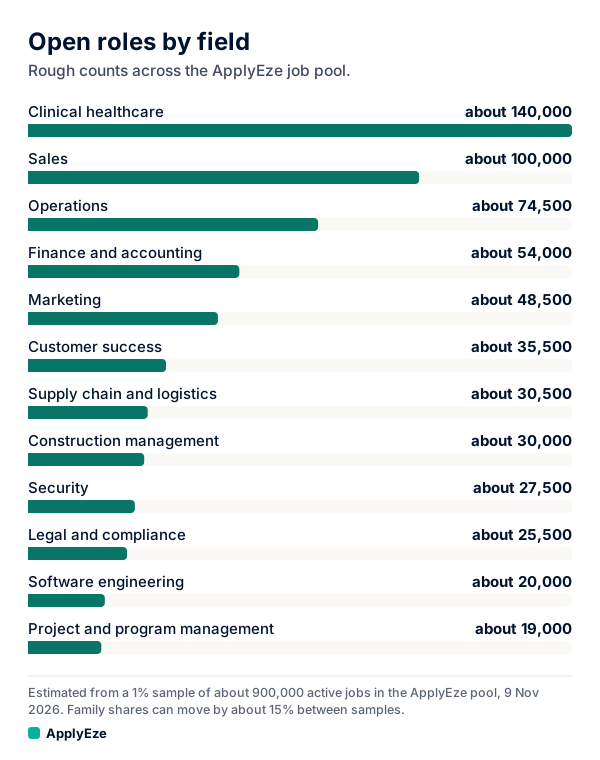
The chart shows rough counts of open roles by field in the pool we track: more than 100,000 employer boards polled directly, about 900,000 active jobs. It is built from a 1% sample taken on 9 November 2026, and a second sample differed by up to about 15% per field, so read these as rough sizes. The right-hand column of the table below is our own read of how these fields hire. It is not a measurement.
| Field | Roughly open roles | Where recruiters tend to be found |
|---|---|---|
| Clinical healthcare | 140,000 | Hospital talent teams, travel and per diem agencies on the NATHO list, physician search firms |
| Sales | 100,000 | In-house recruiters at software and services firms, small specialist firms, mostly via LinkedIn |
| Operations | 75,000 | Branch-based staffing firms (try the ASA occupational filter), plant and warehouse HR |
| Finance and accounting | 55,000 | Accounting divisions of national staffing firms, boutiques, in-house at larger employers |
| Marketing | 50,000 | In-house teams and creative staffing firms |
| Customer success | 35,000 | In-house teams, contact center staffing firms |
| Supply chain and logistics | 30,000 | Specialist firms, ASA directory, in-house at logistics companies |
| Construction management | 30,000 | Specialist search firms, contractors' own recruiters |
| Security | 27,000 | In-house teams, TechServe members, firms focused on cleared work |
| Legal and compliance | 25,000 | NALSC for attorneys, LinkedIn for compliance roles |
| Software engineering | 20,000 | In-house technical recruiters, TechServe members |
Two cautions. These count jobs, not recruiters, and nobody we found publishes recruiter counts by field. So more open roles does not promise more agency recruiters. A large field does mean you can afford to be picky: narrow by region and specialty, because a general "healthcare recruiter" may fill a hundred kinds of role and none of yours. In a small field, expect a short list, and treat each name as worth more of your time.
Run the application side alongside it
This search reaches people, and the postings still need applying to. ApplyEze ranks roles from those boards on your target titles and the requirements it reads out of each posting, and you queue the ones you want in its desktop app. It builds a resume for each posting and fills and submits each form while your computer is on. It applies automatically on systems holding roughly 62% of those jobs, with an application inbox connected for Workday and Oracle, because those sites email a code.
Add those employers to the "already applied at" line in your note, so no recruiter submits you to the same job. Then rerun your string this week, and if you would rather spend your hours on the recruiter search than on forms, your first 50 applications are free, with no card needed.