
To reach out to a recruiter on LinkedIn, pick one person who actually hires for the role, apply first if a posting exists, and send a connection note that names the role and one fact about you. On a free account you have very little room. LinkedIn's help page says "You can add a personalized message to up to three connection requests per month" and "Each message can be up to 200 characters". All eight samples below were written to those limits, and each one shows its character count.
The limits that decide what you can send
Most advice on this topic skips the rules, and some of it is out of date. One template page that ranks for this search calls 300 characters LinkedIn's "hard limit". On a free account, a note written to that length will not fit.
Here is what LinkedIn's own help pages say, read on 9 November 2026. We read the pages and did not test an account, so check what your own screen shows.
| Your situation | What LinkedIn allows | What to send |
|---|---|---|
| Already connected | A direct message | A message of up to about 50 words (samples 3 and 8) |
| Not connected, free account, notes left this month | An invitation with a 200 character note | A note (samples 1, 2, 4, 5, 6, 7) |
| Not connected, free account, notes used up | An invitation with no note. Free accounts cannot send InMail | A blank invitation, then a message if they accept |
| Premium | Unlimited notes, and InMail credits (Premium Career lists 5) | A note first, since credits run out |
LinkedIn's pages also disagree with each other. The page quoted above was updated about six months ago and says three notes a month. An older page, updated about three years ago, says five, and gives Premium members 300 characters. Plan on three.
Three a month matters more than it sounds. Huntr's Q3 2026 report puts the median at 102 days from the start of a search to a first offer, among 667 of its users who logged one. That is about 3.4 months (102 divided by 30.4), so at three notes a month a typical search gets about 10 notes in total (our arithmetic). You do not get to spray these. Decide who deserves one.
There is a second reason not to spray. LinkedIn says your account may be temporarily restricted from sending invitations if members report them as unwanted or spam.
Who to message
In rough order of how much a note is likely to do for you:
- Someone you already know at the company. This is not a recruiter message at all, and it usually does more than any of the others. Our guide on how to ask for a job referral covers it.
- The person listed on the job page. LinkedIn says job pages can show a Meet the Hiring Team section, and that this can include the job poster. When a name is there, you do not have to guess who owns the role.
- An in-house recruiter who covers your function. Search the company's people list for "recruiter" or "talent acquisition" plus your field. A recruiter who hires engineers will not move a marketing application. Our walkthrough on how to find recruiters gives a search you can repeat.
- An agency recruiter who places your field. Agencies are paid by the employer: the FTC notes that the hiring company pays them a fee and that honest firms do not typically charge candidates. So they can only help when you fit a search they hold. Ask about fit, not about finding you a job.
- The hiring manager. Worth it when you can say something specific about their team. Otherwise it reads as going around the recruiter.
Pick one person per role. Messaging two people at one company is fine. Five is a campaign.
Connection note or message
A note has one job: get the invitation accepted. Three parts fit into 200 characters: the role, one fact that matches it, and a small ask. Leave out your job search story, "I am looking for new opportunities", and any question that needs a long answer.
A message, once you are connected, can do more. Give the recruiter the requisition number and something they can answer in a line. If a recruiter has to open your profile to work out what you want, you have made the reply harder.
Names, numbers and roles in the samples are invented. They are filled in rather than left as brackets so that the counts are real. When you swap in your own details, recount. Counts include spaces.
Samples: you applied already
This is the strongest position. The recruiter can look you up, and you are asking for attention, not for a favor.
Sample 1. Note to a recruiter after applying (167 characters)
Hi Dana, I applied Monday for your Data Analyst role (R4471). Six years of SQL and Looker in retail pricing, which the posting asks for. Happy to send a short summary.
Sample 2. Note to the person who posted the role (158 characters)
Hi Marcus, I applied for the Support Team Lead role you posted. I run a 12 person support team and cut first reply time by a third last year. Glad to connect.
Sample 3. Message once they accept (269 characters, 50 words)
Thanks for connecting, Dana. I applied for the Data Analyst role on 2 November (R4471). The posting asks for pricing analysis in SQL, which has been my main work for six years. Could you tell me roughly when first screens will happen? No problem if that is hard to say.
Samples: you have not applied
Use these sparingly. If a posting exists and you want it, applying first is usually the better move, because many in-house recruiters will simply ask you to apply anyway.
Sample 4. Note checking a role before you apply (154 characters)
Hi Priya, your Payroll Specialist post fits my five years in multi-state payroll on Workday. Before I apply, is it still open? Glad to connect either way.
Sample 5. Note to an agency recruiter, no specific posting (173 characters)
Hi Tom, I see you place mechanical engineers in Ohio. I have eight years in HVAC design and a PE license, open to Columbus or Dayton. Worth connecting in case a search fits?
Samples: career changers and new grads
If your resume does not obviously match, say so before the recruiter has to work it out. A straight question gets a more useful answer than an inflated claim.
Sample 6. Note from a career changer (177 characters)
Hi Lena, I am moving from nursing into clinical informatics: ten years on Epic, two as a unit super user. Your team hires for this. Is a nursing background a fit or a long shot?
Sample 7. Note from a new grad (164 characters)
Hi Sam, I finish my accounting degree in May and have passed two CPA sections. I saw your firm hires an audit class each fall. When should I apply for the next one?
Sample 7 asks about timing on purpose. Campus and early career hiring often runs on a calendar, and "when" is a question a recruiter can answer in five words.
When to send
Send on a weekday, in the recruiter's working hours. Past that, do not fuss. We found no public study of when recruiters answer cold LinkedIn notes.
We do have data on the other direction: when employers contact candidates.
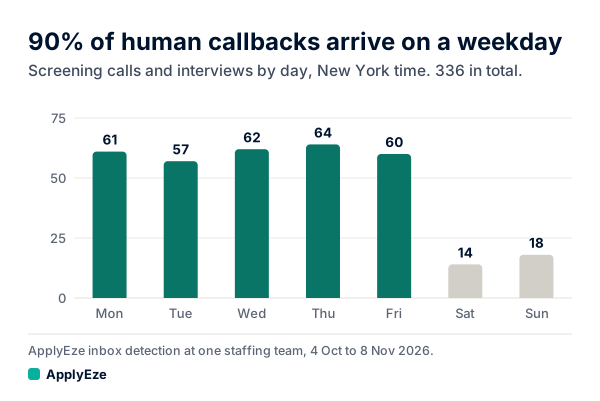
The chart counts 336 screening calls and interviews found in the application inboxes of about 29 candidates at one staffing team, in email received from 4 October to 8 November 2026. Monday to Friday each had between 57 and 64. Saturday had 14 and Sunday 18, so 90.5% arrived on a weekday. By hour, 167 of the 336, or 49.7%, landed from noon to 5 p.m. New York time.
These are machine labels on emails that no person reviewed, found by an inbox scan that is rolling out with staffing teams first and is not part of self-serve accounts yet. They measure when employers reach out, not when a recruiter answers a stranger, so they do not show that any day gets you more replies. They do show that no weekday stands out, which is a reason to stop looking for a magic Tuesday.
How to follow up once
Follow up once, about a week later, and only if you have a channel. The week is a judgment call, not a measurement.
- They accepted and did not reply. Send sample 8, then stop.
- The invitation is still pending. Leave it. Do not withdraw and resend: LinkedIn says that after withdrawing, "You won't be able to send a new invitation to the same member for up to three weeks." Try a different person at the company instead.
- They replied and went quiet. Treat that as a normal conversation and follow up once on what they said.
Sample 8. The one follow up (182 characters)
Hi Dana, a short follow up on my note last week about the Data Analyst role (R4471). If someone else handles it, a name would help. If it has closed, no need to reply, and thank you.
The line about closing gives a busy person a way to say nothing without leaving you waiting. If a reply does come, our samples on how to reply to a recruiter on LinkedIn pick up from there.
Why to do this by hand
LinkedIn's rule is plain. Its help page says "we don't permit the use of any third party software, including 'crawlers', bots, browser plug-ins, or browser extensions that scrape, modify the appearance of, or automate activity on LinkedIn's website", and that members who use them "risk having their accounts restricted or shut down".
So skip the extension that promises personalized outreach at scale. The account at risk is the one recruiters use to find you. And at three notes a month there is nothing to scale.
The forms are a different matter. ApplyEze does not apply through LinkedIn. It applies on employers' own application systems, such as Workday, Greenhouse and Ashby, and has delivered 94,207 applications since August, to 9,769 employers. You queue the roles you want in the desktop app, which runs on your computer while it is on and awake, and Workday and Oracle roles need a connected application inbox. Some employers ask applicants not to use AI or automation, and whether to apply there is your call.
Your next step is one note. Pick the role you want most this month, apply, and write sample 1 to the person on the job page. If you would rather spend your time on notes like that than on forms, your first 50 applications are free, once per email address with no card, and a credit is used only when an application is confirmed as submitted.