
What time do recruiters call? The densest stretch is noon to 4:59 p.m. New York time. That block held 167 of 336 screening and interview emails, or 49.7%, just under half, in replies found at one staffing team from 4 October to 8 November 2026. The busiest hours were 3 p.m. with 37 and noon with 36, and neither beats its neighbours by more than chance would. These are employer emails found in inboxes. They are not phone logs, and they are no guide to when you should ring a recruiter.
Most pages on this question say "business hours" and stop. That answer is roughly right and leaves out a lot: 109 of these 336 emails, or 32.4%, arrived outside 9 to 5 New York time. The reason may have more to do with geography than with habit.
The hour by hour answer
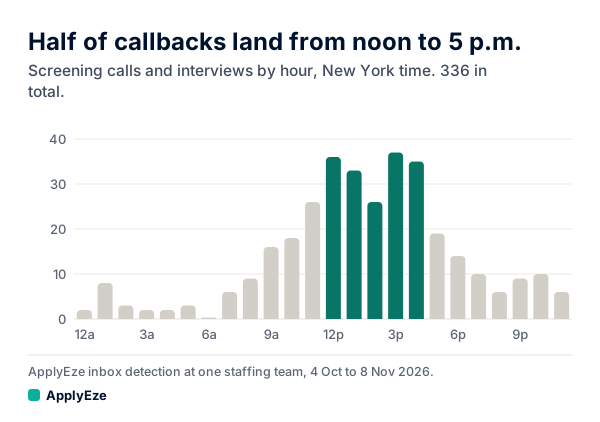
The chart shows almost nothing overnight, a climb from 9 a.m., and a plateau from noon until just before 5 p.m. Its heading rounds up, and the exact figure is 49.7%. Here is every hour:
| Hour starting | a.m. | p.m. |
|---|---|---|
| 12:00 | 2 | 36 |
| 1:00 | 8 | 33 |
| 2:00 | 3 | 26 |
| 3:00 | 2 | 37 |
| 4:00 | 2 | 35 |
| 5:00 | 3 | 19 |
| 6:00 | 0 | 14 |
| 7:00 | 6 | 10 |
| 8:00 | 9 | 6 |
| 9:00 | 16 | 9 |
| 10:00 | 18 | 10 |
| 11:00 | 26 | 6 |
Here is how callback detection works where it is switched on. It is rolling out with staffing teams first and is not part of self-serve accounts yet. A scanner reads a candidate's application inbox, and code and an AI model label the likely employer replies. It first ran on 3 November 2026 and read back to 4 October, covering about 29 candidates at one staffing team. The 336 are 196 screening invitations and 140 interview invitations. Assessment invitations are counted apart, because most are sent automatically. These are machine labels that no person reviewed, so we say found and not confirmed. Some could not be tied to one application and may have come from the candidates' own applications. It covers five weeks in the fall, and results for any one person will differ.
Noon to 5 p.m., with the math
36 + 33 + 26 + 37 + 35 = 167, and 167 / 336 = 49.7%. That is 5 of the day's 24 hours, or 20.8% of the clock, holding just under half the mail. An average hour in the block drew 33.4 emails, against 20.0 in the three hours before it and 14.3 in the three hours after.
Do not read a best hour into it. The gap between 3 p.m. (37) and 2 p.m. (26) looks meaningful, so we tested it. We dropped 167 emails at random onto five hours, 100,000 times. About 70% of runs produced a gap of 11 or more. The 2 p.m. dip is what noise looks like at this sample size, and the 3 p.m. peak is too.
Morning and evening hours
| Block, New York time | Emails | Share of 336 | Emails per hour |
|---|---|---|---|
| Midnight to 6:59 a.m. | 20 | 6.0% | 2.9 |
| 7 to 8:59 a.m. | 15 | 4.5% | 7.5 |
| 9 to 11:59 a.m. | 60 | 17.9% | 20.0 |
| Noon to 4:59 p.m. | 167 | 49.7% | 33.4 |
| 5 to 7:59 p.m. | 43 | 12.8% | 14.3 |
| 8 to 11:59 p.m. | 31 | 9.2% | 7.8 |
The shares add to 100.1% because of rounding.
Mornings are real but thin. Before 9 a.m. there were 35 emails, or 10.4%, and the climb through the morning is steep: 16, then 18, then 26.
Evenings are busier than "business hours" suggests. After 5 p.m. there were 74 emails, or 22.0%. The 5 p.m. hour alone had 19, about the same as the 10 a.m. hour.
The overnight count is small, and some of it is probably software. Pin, an AI recruiting platform, reports that emails delivered between midnight and 5 a.m. Eastern got a 6.67% reply rate against 4.81% at midday, across more than 4,000,000 messages from June 2025 to May 2026. That is a vendor's figure for cold outreach, not replies to applications. It does show recruiters have a reason to schedule mail for the small hours, so a 1 a.m. timestamp does not prove anyone was awake.
Why time zones blur this
Noon to 5 p.m. in New York is 9 a.m. to 2 p.m. in Los Angeles. If every office in the continental US keeps 9 to 5 local time, noon to 5 p.m. New York time is the only stretch when all four zones are open at once.
| Your zone | Noon to 4:59 p.m. New York time is | A 9 to 5 day there, in New York time |
|---|---|---|
| Eastern | Noon to 4:59 p.m. | 9 a.m. to 5 p.m. |
| Central | 11 a.m. to 3:59 p.m. | 10 a.m. to 6 p.m. |
| Mountain | 10 a.m. to 2:59 p.m. | 11 a.m. to 7 p.m. |
| Pacific | 9 a.m. to 1:59 p.m. | Noon to 8 p.m. |
That offers a plain explanation for the peak, with no theory of recruiter habits needed: it is when the most desks are staffed. Widen the window to the span in which at least one continental zone is at work, 9 a.m. to 7:59 p.m. New York time, and it holds 270 of 336, or 80.4%. The other 66 sit outside every continental office day.
The count does not record where each employer or recruiter sits, so treat the time zone overlap as a good fit and not as a finding. Another reading fits as well: recruiters clear their mornings and send invitations after lunch. Either way, a New York clock is a poor guide to any one recruiter's day. A 6 p.m. email may have come from someone in Seattle at 3 p.m.
Employers reaching out is not when to call them
This is the easy misreading, so here it is plainly. The count shows when employers send email to candidates. It does not show when a recruiter is free to pick up, when they read their inbox, or whether calling helps at all. A 3 p.m. peak in outgoing mail could just as well mean 3 p.m. is when they are busy sending it.
Phone advice on the other side comes with thin evidence. Bullhorn, which sells staffing software, says candidates are nearly twice as likely to pick up at 10 a.m. as two hours earlier, and that they stop answering after 4 p.m. The page gives no sample or date for those lines. They are a vendor's guidance to recruiters dialing candidates, and they do not tell you when to dial a recruiter. Whether to call at all is a separate question, covered in should you call after applying.
How to use this in your day
- Convert the block. Use the table above. If you are in Pacific time, the dense part of the day is your morning.
- Check at the end of the block, not all through it. By 4:59 p.m. New York time, 262 of 336 emails had arrived, or 78.0% of a day's mail, counting from midnight. By 7:59 p.m. it was 305, or 90.8%. One look just after 5 p.m. New York time and one before you stop for the evening cover nearly all of it.
- If you are at work, filter. Just under half of this mail lands inside a working afternoon. Gmail lets you search and then build a filter from the results. A sample search to adapt, which will miss some mail and catch some noise:
subject:(interview OR schedule OR availability OR "phone screen"). Star those messages or forward them to your phone. - Set a voicemail greeting that helps. Unknown numbers are hard to answer at a desk. A sample: "This is Sam Rivera. I am away from my phone. Please leave your name, company and a good time to reach you, and I will call back today." Then do it.
- Reply with two windows and your time zone. The same hour means different things to you and to the recruiter. A sample reply: "Thanks for reaching out. I can talk today after 4 p.m. Eastern, or tomorrow between noon and 2 p.m. Eastern. Does either work?" More on this in how to respond to an interview request.
- Stop looking at night. Only 31 of the 336 came after 8 p.m. New York time. We found nothing showing that a reply within ten minutes beats a reply the same day or the next morning, so do not build your evening around one.
The same count by day is in do recruiters call on weekends. The short version is that a weekend day got about a quarter of a weekday's mail.
Two checks a day leave your afternoon free. If you would rather not spend it on forms, your first 50 applications are free, no card needed. You queue the matches you want in the desktop app, keep the computer on and awake while they run, connect an application inbox if you want Workday and Oracle roles, and ApplyEze fills and submits each form. You can use the computer in the meantime, and on a self-serve account you record employer replies yourself.