
You usually should not call after applying for a job. For most applications, email one named person about a week after you apply, or send nothing. Call when the posting gives a number and invites it, when the employer is small enough that the person hiring also answers the phone, when you need a disability accommodation to apply, or when someone asked you to call. In the clearest survey we found, more than 300 US HR managers were asked the best way to follow up after sending a resume, and 64% said email while 21% said a phone call. That survey is from 2017 and came from a staffing company, so treat it as a lean and not a law.
Most pages on this question say to wait a week or two and then call or email. They skip two things: the answer changes with the employer, and no study we could find measures whether a call works. So here is a table that sorts your situation, a script to read aloud, and our own count of when employers contact candidates, with what that count does and does not show.
A table: call, email or wait
| Your situation | Do this | Why |
|---|---|---|
| The posting says no calls | Do not call | Postings often say how contact will work. A contributor to a 2022 GOBankingRates roundup puts it simply: "follow the rules accordingly." |
| You applied less than five days ago | Wait | In our count, the median screening email came 4.1 days after the application, so you would be calling before many replies were due. |
| The posting gives a number and asks you to call | Call | It is an instruction. |
| A small local employer with no recruiter and no email address: a shop, kitchen, contractor or farm | Call once, at a quiet hour | The phone may be how that employer hires. See the next section. |
| A company with a recruiting team and an online application | Email a named person, or wait | An email can be read later and forwarded to whoever owns the role. |
| A federal job | Use the contact on the announcement | OPM tells applicants to "communicate with the point-of-contact" listed for each announcement. |
| You need a disability accommodation to apply or interview | Call or write now, whatever the date | The EEOC says it is "best to let an employer know as soon as you realize" you need one, and that the request can be made "orally or in writing". |
| The application portal failed and a stated deadline is close | Call | The problem is real and a person can fix it. |
| A recruiter or manager left you a voicemail | Call back that working day | They chose the phone. The rest of this table no longer applies. |
| You know someone who works there | Message that person first | They can ask inside the company. A stranger on the phone cannot. |
| None of these | Wait a week, then email or move on | Most applications belong here. |
When a call helps
A call helps when the phone is how that employer actually runs hiring. The evidence here is advice, not measurement. We found no survey of trades or small employers on this question, so weigh it that way.
Small employers. AgHires, a job board for agriculture and food production, says those industries "tend to be smaller and tight-knit" and advises following up by phone or email after one to two weeks. The logic carries to any business where the owner reads the applications.
Trades. "Many smaller contractors don't post online," says CLIMB's guide to trade jobs, which tells readers to call or visit local shops. In Contracting Business in May 2026, a hiring adviser said most HVAC contractors default to email with applicants, that most technicians do not check it, and that texting works best. The piece also says managers who run operations are often overloaded. So in a shop, email may not be the local norm, and the person you want may be on a job when you ring. Leave one clear voicemail and do not wait by the phone.
Hourly work with a manager on site. Snagajob's advice is "Don't call a hiring manager during the busiest part of their day," naming lunch or dinner at a restaurant and Friday night in retail. That is the one timing rule here that needs no data.
When a number is offered. Robert Half says "If a phone number was provided as well as an email address, calling may have a bigger impact than emailing," and adds that "a phone call is more dependent on variables outside your control."
One test covers most of this. Would the person making the hire plausibly pick up this number? If it reaches a switchboard or a customer service line, the answer is no. As one career adviser put it in that GOBankingRates roundup, "Do not just call the customer service line."
When it hurts
At a company with a recruiting team, a call asks a busy person to stop, find your record and answer on the spot. Greenhouse's benchmarks put applications per recruiter at 4,890 in 2025, up from 1,610 in 2022. That is about 94 a week (our arithmetic). If one applicant in ten phoned, it would be nine calls a week about applications the recruiter may not have opened. Greenhouse's customers are not the whole market, but that is the desk you would be calling.
Practitioners disagree more than the ranking pages let on. In the same GOBankingRates roundup, one executive said "Never should they call the company after a job application," a resume writer called phone calls "a mixed bag", and that career adviser warned that a direct call may look like "trying to bypass the process." Against that, none of the HR managers in the Accountemps survey chose the option that candidates should not follow up at all.
Where they all agree is repetition. The Accountemps release says "Calling multiple times a day or cluttering the employer's inbox with numerous emails is annoying" and "Don't risk being removed from consideration for being too persistent."
Four calls to avoid:
- The second one. One call is the limit. If you got a voicemail, that was the call.
- The one that books your own interview. Saying you are ringing to schedule one is presumptuous. That decision is theirs.
- The one you could answer yourself. Check the employer's candidate portal and whether the posting is still live first.
- The one on a posting that said not to. It shows you did not read the posting, or read it and decided it did not apply to you.
A 30-second script
Before you dial, have the posting open with its job number, and pick the one fact that matters most for this role. The samples below are written for this post, with a fictional person, a fictional job number and a phone number reserved for fiction. Read yours aloud with a timer and cut anything that runs past 30 seconds.
Sample: someone picks up (about 70 words)
"Hi, this is Dana Reyes. I applied on Tuesday for your service technician opening, job number 4417. I hold an EPA 608 certification and have four years on residential systems, so I wanted to make sure it reached the right person. Are you still reviewing applications, or have interviews started?"
Listen. Do not fill the silence.
"Thank you. If I have a question later, is email the easiest way to reach you?"
Sample: voicemail (about 45 words)
"Hi, this is Dana Reyes, 555-0142. I applied Tuesday for your service technician opening, job 4417. I'm EPA 608 certified with four years on residential systems. No need to call back unless you'd like to talk. Again, Dana Reyes, 555-0142. Thank you."
Sample: a receptionist answers
"Hi, I applied for your service technician opening and have a quick question. Who handles hiring for that role, and do they prefer email or phone?"
Then stop. If they say "we'll reach out if there's interest," you have your answer. Thank them, write the date in your tracker and leave it alone.
When employers reach out, in our data
Our numbers come from callback detection, which is rolling out with staffing teams first and is not part of self-serve accounts yet. Where it is switched on, it reads a candidate's application inbox and labels likely employer replies. It first ran on 3 November 2026 and read mail back to 4 October, across about 29 candidates at one staffing team. It found 336 human callbacks: 196 screening invitations and 140 interview invitations. These are machine labels that no person reviewed, so we say found, not confirmed, and some may have come from the candidates' own applications.
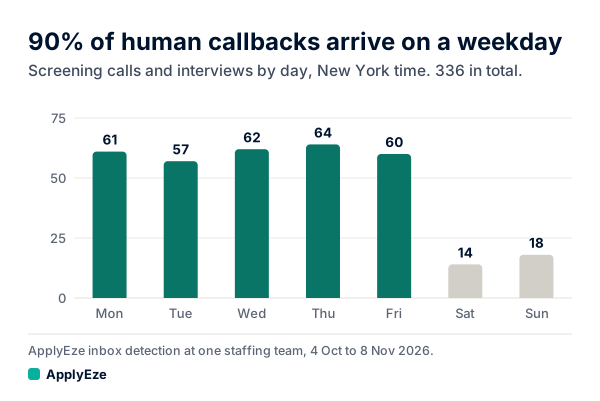
By day, New York time: Monday 61, Tuesday 57, Wednesday 62, Thursday 64, Friday 60, Saturday 14, Sunday 18. So 304 of 336, or 90.5%, arrived on a weekday, and no weekday stands out from the others.
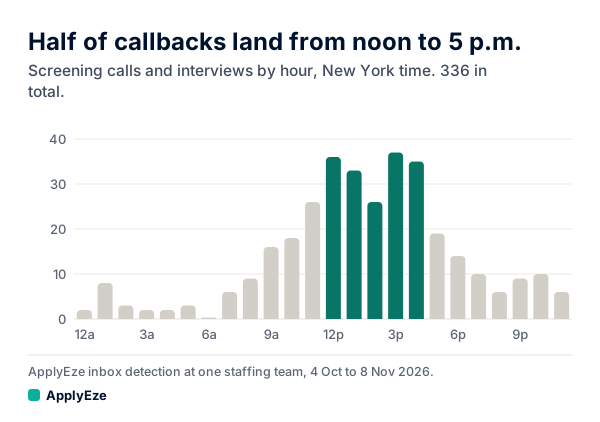
By hour, the densest span is noon to 4:59 p.m. New York time: 36 + 33 + 26 + 37 + 35 = 167 emails, or 49.7%.
This shows employers contacting candidates. It is not proof of when to call them. A recruiter sending invitations at 3 p.m. may be least available at 3 p.m. These are also emails, not phone calls, so do not use the chart to pick an hour to ring a recruiter. The full breakdown, with time zones, is in what time do recruiters call.
What the count does support:
- Do not rush the first week. For replies tied to one application, the median was 4.1 days for screening emails and 5.3 days for interview emails. A fuller read of applications from 12 to 23 October, which had time to mature, covers 58 human callbacks: median 116 hours, 38% within 72 hours and 74% within 7 days. A call on day two lands before most of the replies that were coming anyway.
- Be easy to reach on weekday afternoons. Keep your phone on and set a voicemail greeting that says your name. That is useful whatever you decide about calling.
- Do not plan around a weekend. Saturday and Sunday together drew 32 of the 336.
This is one team, five weeks in the fall, and results for any one person will differ.
What to do instead
Most people asking this question want to do something other than wait. At a company with a recruiting team, these make more sense than a call:
- Send one short email to a named person. Five samples and a way to find the address are in email to a recruiter after applying.
- Ask anyone you know inside. In a New York Fed staff report on one large firm, referred employees were 6 percent of applicants and 29 percent of hires, and referral recipients were "more than twice as likely to be interviewed" as job board applicants. It is one company and an older study, and a referral is a different thing from a call, but it is the stronger evidence. Our guide on how to ask for a job referral has the messages.
- Set one date and keep it. The timing and the stopping rule are in how to follow up on a job application.
- Spend the ten minutes on the next application. A call changes one application at most. If it does not fit the table above, that time probably has a better use.
A call is worth making on the few roles that pass the table above, and that part is yours. The forms for everything else are what eat your week, and that is the part ApplyEze handles: 94,207 applications delivered since August, to 9,769 employers. If you would rather save your time for the calls that matter, your first 50 applications are free, no card needed. You pick the roles and queue them in the desktop app, and ApplyEze fills and submits each form while your computer stays on and awake.