
An email to a recruiter after applying is worth sending only when you have a named person, you meet every hard requirement, and you can add one fact your application does not make obvious. Send it about seven days after you apply, on a weekday, and keep it under 90 words. Do not send it on day one. In our count at one staffing team, the median wait for a screening email was 4.1 days and for an interview email 5.3 days, so a day-one note asks about something that has barely had time to happen. If you cannot meet those three conditions, skip the email.
Most sample pages hand you a template and assume you should use it. This one starts with when not to, because a recruiter's inbox is where a good note and a pointless note look the same until they are opened.
When this email is worth sending
| Send it when | Skip it when |
|---|---|
| You meet every hard requirement and can prove it in a sentence | You are missing a stated requirement. A note does not fix that. |
| You have a named person, confirmed | The only address is a general inbox, or you would have to guess one |
| The posting is live and the portal does not show you as rejected | The posting is gone or your status has changed |
| You have something to add: a referral, a new credential, a result that matches the posting | All you have to say is "any update?" |
| It is one of a handful you are sending this week | You are about to send the same note to 40 companies |
| The posting says nothing against contact | The posting asks applicants not to follow up |
Know what this buys. It can put your name in front of a person once more and surface a timeline. It cannot make up for a poor fit, and we found no study that measures its effect on interviews.
The load on the reader is the reason to be choosy. Greenhouse's benchmarks show 4,890 applications per recruiter in 2025, or about 94 a week (our arithmetic), up from 1,610 a year in 2022. Gem reports recruiters carrying 13.4 open roles at a time. Both sell hiring software and measure their own customers, but those numbers explain why a vague note gets archived.
Finding the right person
Work down this list and stop at the first real name.
- The posting and your confirmation email. Some name a recruiter or give a reply address. Check who sent the confirmation before you reply to it: Greenhouse lists several no-reply addresses, such as no-reply@us.greenhouse-mail.io, for its automated candidate mail.
- The LinkedIn job page. A posting can show a "Meet the Hiring Team" section, and LinkedIn says members can "connect and message the entire team listed in this section, including the job poster."
- The tag at the bottom of the posting. Tags like #LI-MM "often represent the recruiter or hiring manager responsible" for the job, according to one job board's help guide. Not every employer uses them, so treat the initials as a lead. Search the company's people on LinkedIn for a recruiter with those initials who covers your function or location.
- A public address. Some recruiters publish their address on a careers page, an event listing or a post about the role. If the person has put it out in public for candidates, it is fair to use.
If none of that works, do not guess. Guessing first.last@company.com may land with a stranger, may bounce, and tells you nothing either way. Send a LinkedIn message instead, and spend it carefully: LinkedIn's help page says free members can add a note to up to three connection requests a month, up to 200 characters each. Our guide on how to reach out to a recruiter on LinkedIn has versions that fit. If you cannot identify anyone, the email is not worth sending.
The subject line rule
Role, requisition number, one proof. In that order, and nothing else.
A recruiter with 13 open roles needs to know which one you mean before anything else, and the number lets them find you in their system in one search. The proof gives a reason to open it.
| Weak | Why | Better |
|---|---|---|
| Following up on my application | Which one? | Senior Accountant, req 20418: CPA, NetSuite close |
| Quick question | Reads like a sales email | Data Analyst I, req 9120: May 2026 grad, SQL capstone |
| URGENT: application status | Their urgency is not your deadline | Referred by Lena Park: Product Designer, req 7731 |
If you have an existing thread with this person, reply in it instead of starting a new subject.
Sample: strong match
All five samples are written for this post. The people, employers and numbers are fictional. Swap in your own true details, and do not send a number you cannot defend.
Subject: Senior Accountant, req 20418: CPA, NetSuite close
Hi Priya,
I applied on 3 November for the Senior Accountant role. Your posting asks for someone to shorten the month-end close on NetSuite. At Harbor Foods I took ours from nine days to five over two quarters, and I have held my CPA since 2022.
Is the role still in review? If someone else handles it, please point me to them.
Thanks, Sam Okafor, 555-0117
(66 words.) It works because it quotes the employer's stated problem and answers it with one number. The last line makes it easy to respond even if she is the wrong person.
Sample: referral
Tell your contact you are writing, so nobody is surprised. This is the one note that can go within a day or two of applying, because the reason to write is the referral and not the silence.
Subject: Referred by Lena Park: Product Designer, req 7731
Hi Marcus,
Lena Park on your payments team suggested I write. She submitted a referral for me for the Product Designer role, and I applied through your site on Monday. Lena and I worked together for two years at Brightline, where I led the checkout redesign.
I can send three work samples if useful. Otherwise, thanks for taking a look.
Best, Ana Ruiz
(63 words.) The name does the work, so it goes in the subject and the first line. For what to ask of the contact first, see how to ask for a job referral.
Sample: career changer
A parser and a tired reader both see your old title. Use the email to translate it, once, in the employer's terms.
Subject: Customer Success Manager, req 3052: 140 accounts, 96% retained
Hi Tom,
I applied last week for the Customer Success Manager role. My resume says teacher, so here is the translation: for eight years I managed 140 families a term, ran the check-ins that kept 96% enrolled year to year, and built the onboarding plan my school still uses.
Would that background get a look for this role? A one-line answer helps either way.
Thanks, Rachel Stone
(67 words.) It names the objection before the reader does. Asking whether the background will get a look is a question a recruiter can answer honestly in a line, and a no saves you weeks.
Sample: new grad
You have little history, so lead with the closest thing to the work and offer something a recruiter can schedule around.
Subject: Data Analyst I, req 9120: May 2026 grad, SQL capstone
Hi Renee,
I applied on Tuesday for Data Analyst I. I graduated in May with a statistics degree. My capstone used SQL to clean two million transit records and found a 12% gap in reported ridership. The write-up is here: [link].
When does the team expect to start first-round calls? I can start any time after 1 December.
Thank you, Malik Evans
(62 words.) One link and no attachment. A start date is useful to a recruiter filling a seat, and most student emails leave it out.
Sample: visa needs stated
Volunteering this is your choice. Some people prefer to raise it only when asked, and the form will often ask anyway. If you do, one factual sentence beats a paragraph. This is general information, not legal advice. Talk to your school's international office or an immigration attorney about your own case.
Subject: Software Engineer, req 5521: Python, 3 years in payments
Hi Grace,
I applied on 4 November for the Software Engineer role and spent three years building payment reconciliation services in Python, the core of your posting.
To save you a question: I am on F-1 OPT through June 2027 and eligible for a STEM extension if the employer uses E-Verify. I would need H-1B sponsorship after that.
Is that workable for this team?
Thanks, Wei Zhang
(67 words.) The details in that sample come from a real rule. USCIS says eligible F-1 STEM students "may apply for a 24-month extension", and the employer must be enrolled in E-Verify and sign Form I-983 (page reviewed 30 January 2026). Naming E-Verify tells a smaller employer exactly what it would need. Whatever you write must match your answers on the form. Sponsorship costs have also moved since a September 2025 proclamation, and part of that is in court, so read our post on the H-1B $100K fee before you describe them to anyone.
When to send
Not on day one. Our timing comes from callback detection, which is rolling out with staffing teams first and is not part of self-serve accounts yet. Where it is switched on, it reads a candidate's application inbox and labels likely employer replies. It first ran on 3 November 2026 and read mail back to 4 October, across about 29 candidates at one staffing team. These are machine labels that no person reviewed, so we say found, not confirmed. Timing runs from the application and covers only replies that could be tied to one application: 85 screening emails and 54 interview emails.
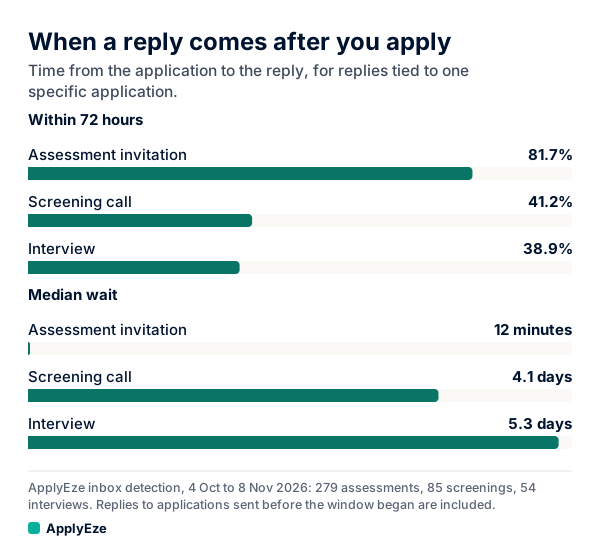
The chart shows three different clocks. Assessment invitations had a median of 12 minutes, because software sends most of them. Do not read one as a recruiter noticing you. Screening emails had a median of 4.1 days, with 41.2% inside 72 hours. Interview emails had a median of 5.3 days, with 38.9% inside 72 hours. Recent applications had less time to get a reply, so a fuller read of applications from 12 to 23 October is the better guide: 58 human callbacks, median 116 hours, 38% within 72 hours and 74% within 7 days.
About day seven. By then, most of the replies that were coming quickly have come. It also keeps you ahead of the posting's end. In a study of 125 million applications on Dice.com, the median posting lasted seven days and "only 26 percent stay active for more than two weeks." That data is older and heavy on tech, so it is a caution and not a rule. Still, it is a reason to prefer one week over the two that many guides suggest. In the 2017 Accountemps survey of more than 300 US HR managers, 29% said to wait less than a week and 36% said one to two weeks. If the posting gives a closing date, wait until just after it.
Any weekday. Here is the count of 336 human callbacks found by day, New York time.
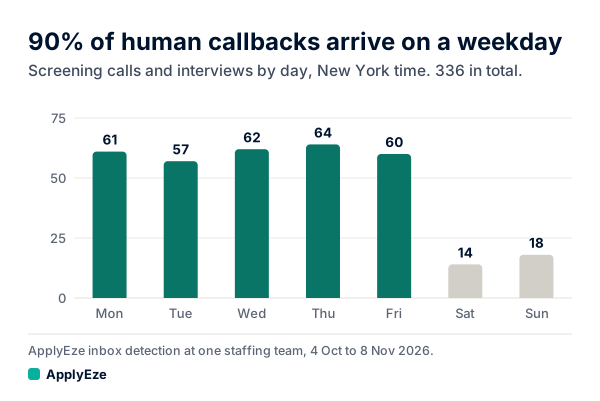
Monday 61, Tuesday 57, Wednesday 62, Thursday 64, Friday 60, Saturday 14, Sunday 18. So 90.5% landed on a weekday, with a gap of only seven between the busiest and quietest. This counts employers reaching out. It is not proof of when they read mail or when to contact them. It gives no support to the idea of a magic day. One guide says to send Tuesday through Thursday and offers no data for it. Pick a weekday and stop thinking about it. If you finish on a Saturday, schedule the send for Monday.
After you send it
- Log the date. Put the role, the person and the send date in your tracker. Everything below depends on it.
- Do not double up. Skip the matching LinkedIn message on the same day. One channel at a time.
- If they reply with a question, answer the same day if you can, and give two time windows with your time zone if they want to talk.
- If they say to wait or that it is all in the portal, that is an answer. Thank them in one line and stop writing.
- If you hear nothing, send one more at most, about a week later, with something new in it. The wording by stage is in how to ask a recruiter for an update.
- Then stop. A third message rarely changes the answer, and your next application is a better use of the time.
This email is yours to write, and it is worth doing by hand on the few roles you care about. Those few get better when you are not also retyping your history into forty forms. ApplyEze builds a resume for each posting, fills and submits the form, and leaves a receipt for every run, and it has delivered 94,207 applications since August, to 9,769 employers. If you would rather spend the hour on three good emails, your first 50 applications are free, no card needed. You pick the roles and queue them in the desktop app, which runs while your computer is on and awake.