

To become a product manager, most people move sideways into the job rather than apply into it: an internal transfer, a move from engineering or design, an associate program, or a founder or side-project route. Cold applications rarely do it alone, and the reason can be counted. We read 539 live US product manager postings from 114 employers on 9 November 2026. Four carried a new-grad, university or associate product manager title. Among the 387 that stated required experience, the median was 6 years, and 8 started at two years or fewer. This post sets out what each path needs, how it usually fails, and what a first application has to show.
| Path | Fits you if | What it needs | How it usually fails |
|---|---|---|---|
| Internal transfer | Your employer has product managers | A sponsor, one product problem you can own, a date to decide | You do the work for a year and never get the title |
| From engineering or design | You already ship with PMs | Evidence on value and business viability | You stay the technical voice and never own a decision |
| Associate program | You are a student, a recent graduate, or rarely a switcher | Catching a short window, plus something you built | Few seats, and the deadline passes unnoticed |
| Founder or side project | You can get real people to use something | Users, a metric, a decision you changed because of them | A demo nobody used |
How we counted. We pulled live postings from public boards on Greenhouse, Lever and Ashby, which lean toward technology companies, and searched the career sites of 29 large employers on Workday, such as banks, insurers, health care, defense and manufacturing companies. We kept US locations, removed repeats, and capped each employer at 10. Years are the first figure a posting states, and term counts include any mention, even a company describing itself. It is a hand-picked sample, so read it as a map, not a census.
What a product manager is hired to do
A product manager is hired to be right about what is worth building. Marty Cagan of SVPG breaks product risk into four: value (will people buy or use it), usability (can they figure it out), feasibility (can engineers build it), and business viability (does it work for the rest of the business). He makes the product manager "responsible for the value and viability risks." Those two are the job. Keeping a release on schedule sits closer to program management, which is a different career.
The postings agree. Roadmap appeared in 80.5% of our sample, stakeholders in 52.1%, metrics, KPIs or OKRs in 50.5%, go-to-market in 30.6%, and A/B testing or experiments in 30.1%.
One warning before you pick a path. Cagan also separates feature teams from product teams. A feature team gets a prioritized list, and value and viability rest with whoever asked for the feature. A product team is given problems to solve and is measured on outcomes. Both kinds of job carry the same title. A first PM role on a feature team is still a way in, but know which one you are taking.
Path 1: internal transfer
This is the most common route in the one survey we found, though the measurement is thin. In a 2021 survey by product practitioner Robert Drury, 50% of product managers said their first product opportunity came from an internal transition, and networking was second at 23%. He does not state the sample size, so treat it as a direction. We found no larger public study.
The mechanism makes sense without the survey. A transfer skips the screen that stops most applicants. Nobody has to infer from a resume whether you understand the customers, the data and the engineers, because they have watched you work with all three. No single background feeds it, either. Pragmatic Institute's 2021 survey asked what other roles product people had held: technical or development 32%, product marketing 25%, sales 21% and marketing communications 20%, with customer success, UX, business analysis and project management also named. Its respondents skew older, with 7% under 30.
What it takes:
- Find a problem nobody owns. Support, sales and operations see these first. Bring a count, not an anecdote.
- Write one page. Who has the problem, how often, what it costs, what you would test, and what would prove you wrong.
- Get a PM to sponsor it. You need someone who will say your work was real when the role opens.
- Ship it with the team and measure it. This gives you the first line of a product manager resume.
- Set a date. Agree when you will discuss a move. Without one, this path turns into free labor.
A note to copy and adapt:
Sample, not a real message. Hi [name], I run [support escalations] and I keep seeing [problem]. It accounted for [N] of our last [N] tickets. I wrote one page on what I think causes it and what I would test. Could I work with [PM] on this for one quarter, alongside my current job, with [metric] as the measure? If it goes well, I would like to talk about a move into product in [month]. If it does not, you still have the analysis.
The wider mechanics of moving fields are in our career change guide.
Path 2: from engineering or design
Postings name this background more than any other. In our sample, 158 of 539 (29.3%) mentioned a technical degree or engineering background, against 9.1% for an MBA, and 20 had "technical" in the title. Justworks asks for two years of product management "or equivalent experience in software engineering, data science, or business analytics."
Cagan's four risks show what has to change. As an engineer you already work on feasibility. As a designer you already work on usability. The new job hands that risk to someone else and gives you the two you have not been held to, value and viability. So technical depth will not carry the application. What you have to add:
- Customer evidence. Join calls, read tickets, and write down what you learned and what you changed because of it.
- A business case with numbers. What the work would earn or save, and what it would cost in engineering time.
- A decision you made and could have lost. Especially something you argued not to build.
The usual failure is staying the technical voice in the room. If your manager still describes you by what you build, ask to run the planning for one project, then see the transfer steps above. Designers have the same gap, with a head start on research. We found no public count of how many designers make this move.
Path 3: associate programs
These programs exist to turn people with little experience into PMs. They are also rare. Only a handful appeared among our 539 postings, and timing decides most of what you can do about them. Details below are as of 9 November 2026 and change every cycle.
| Program | Who it says it wants | Timing |
|---|---|---|
| Google APM | Its 2026-start posting asked for a degree program in product management, computer science or engineering, plus internship or teaching assistant experience in a technical field | That window ran 30 September to 28 October 2025. Simplify reports the next posting went live on 15 September 2026 |
| Meta RPM | Simplify reports no technical background is needed, with 18 months across three rotations | Opens in late summer, per Simplify |
| Databricks APM, new grad | Graduating in Fall 2026 or Spring 2027 in computer science or related engineering, with some SQL or Python | Live on our sample date, for a 2027 start |
| Stripe, new grad accelerator | New grad or 0-2 years, with a CS or engineering degree | Live on our sample date |
| Adobe, MBA university graduate | In a full-time MBA, graduating December 2026 to June 2027, with 2+ years of experience | Live on our sample date |
| Shopify Apprentice PM | "No degree or prior PM title required." 12 months | The window open on our sample date closes 9 November 2026, so watch for the next |
| LinkedIn APB | One third-party guide reports a 60-second demo, six short answers, no resume, and having "built and shipped a product or feature used by real users" | Same guide: one window, 2 to 7 September 2025, and none posted by 5 October 2026 |
Three things follow. First, put these on a calendar now, because a window can be days long. Second, expect long odds at the famous ones. Simplify reports roughly 40 Google spots against about 8,000 applicants and roughly 60 at Meta. The companies do not publish these numbers, so read them as reports, not facts. Third, notice where it is going. LinkedIn scrapped its APM program for an Associate Product Builder program, per a December 2025 podcast with its chief product officer. Stripe says in its posting: "We care more about what you've built (through internships, personal projects, or school) than years of specific experience." That pushes every early-career applicant toward path 4 as well.
Path 4: founder and side projects
Having run your own product counts for something in writing. Nine of our 539 postings named founder experience. Stripe lists "6+ years of product management or product-focused founder experience" as a minimum. Okta calls startup founder experience "a significant plus," and Calendly gives bonus points for it. Most of these are senior roles, so this does not make a weekend project a shortcut.
The test is users. Something only you have used is a demo. To count as product work, a side project needs:
- People who are not your friends using it, with a number attached, even a small one.
- A metric you watched, such as how many came back in week two.
- A decision that metric changed. Something you cut, repriced or rebuilt.
- An honest ending. If it failed, say why. A clear account of why nobody paid is more useful in an interview than a vague claim of traction.
How small this field is
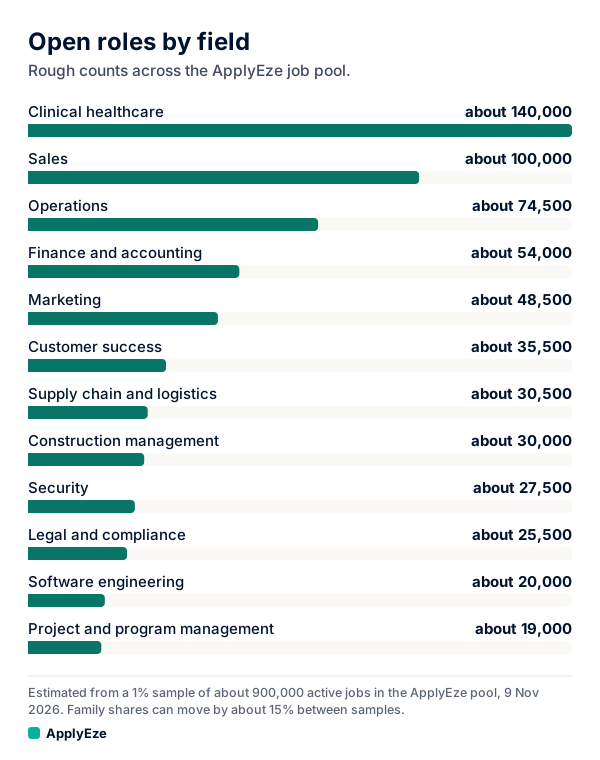
Product management is not on this chart. The chart lists the 12 largest fields in our job pool, and its last bar is project and program management at about 19,000. Product management came to 54 rows in the same sample of 9,474, which means a few thousand open roles. Marketing, for comparison, had 487 rows, or roughly 48,500. The base is small and our field labels are imperfect, so hold the exact size loosely. The gap is not subtle.
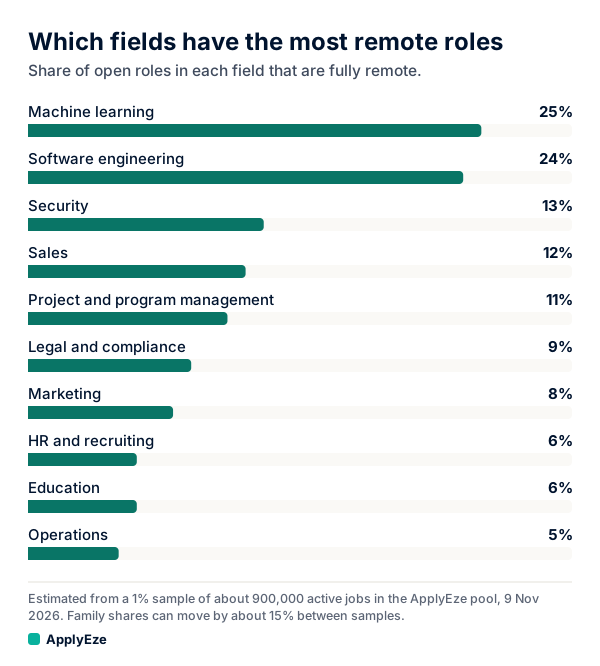
Product management is missing here too, because this chart covers only fields with a larger base. In that small sample, 18 of 54 roles were fully remote, about 1 in 3, which would sit above the top bar of 25% if the base could bear it. The median advertised pay in those 54 rows was about $205,000, among those that state pay. Do not read that as a market figure. It rests on very few postings, and many of them are senior.
Put the two facts together. With a few thousand open roles asking for a median of 6 years, evidence decides who gets read. That is why the four paths above come first, and why each posting you do reach deserves a resume built for it.
What your first PM application must show
When you do apply, the application has to do what a transfer does automatically: show a reader that you already work this way. Five things:
- A decision you made, with what you decided against.
- A metric before and after, with how it was measured.
- Evidence you talked to customers, with a count.
- Work with engineers, as a partner rather than a requester.
- The commercial side, even a small one: pricing, launch or what sales needed.
A referral helps more here than almost anywhere, because the pool is small and people know each other. Our guide on how to ask for a referral has the scripts.
Aim beyond software, too. Experience asked differs by employer type in our sample.
| In postings | Technology-leaning boards (400) | Large employers on Workday (120) |
|---|---|---|
| Median years asked, where stated | 6 (279 stated) | 5 (93 stated) |
| Start at four years or fewer, where stated | 15.1% | 24.7% |
| Agile or Scrum | 6.3% | 38.3% |
| MBA | 5.5% | 22.5% |
| Product requirements documents | 13.5% | 25.0% |
| A/B testing or experiments | 33.8% | 16.7% |
| SQL | 14.3% | 3.3% |
The gap is modest and the two groups were sampled differently, but it points somewhere useful: product roles at banks, insurers and health companies can sit closer to reach than the ones at software companies. Capital One's Senior Associate role, for example, asks for at least 2 years in product management.
Skip the certificate as a shortcut. Only 3 of 539 postings named one, though 85% of Pragmatic's 2021 respondents held at least one professional certification (our sum of its 1 to 3, 4 to 6 and 7 or more groups). People collect them. Postings do not ask.
When you are ready to apply
The paths above get you the evidence. Once you have it, a small field rewards coverage: you want to see each product role as it opens and send a resume built for that posting. ApplyEze polls more than 100,000 employer boards directly, about 900,000 active jobs, and keeps matching new postings to your profile through the day.
You pick the roles from a board ranked on your target titles and the requirements it reads out of each posting. A role doing your work under a title you did not list ranks low, so list several, such as product manager, associate product manager, technical product manager and product owner. The order is real: first listed ranks first. You queue them in the desktop app, and it applies in Chrome on your computer, so keep the computer on and awake until the queue finishes. Many large employers are on Workday, and Workday and Oracle jobs stay hidden until you connect an application inbox, because those sites email a code. ApplyEze applies automatically on systems holding roughly 62% of the jobs it tracks with an inbox, and roughly 23% without.
For each application, an AI model reads that posting and your real history and writes a resume for it. A certification the posting asks for is not added unless you hold it. ApplyEze brings the posting's named skills and tools onto your skills line, even when your own record does not list them. There is no step to remove one before a live run, so use a dry run to see what it writes, and be ready to discuss anything on the page. Hard facts on forms come from your profile. When a required question is not covered by your saved answers, ApplyEze still fills it rather than stopping the run, so that answer may not come from you. Fill in your saved answers, use dry run first, and read your receipts.
So pick the path that fits and get your first outcome line this quarter. When you have it, your first 50 applications are free, once per email address with no card, and with a pool this small, 50 may cover your whole list.