

A product manager resume fails when it lists features shipped. A feature tells the reader what the team built, and everyone on that team can claim it. An outcome tells them what changed because of a decision you made, which is the thing a product manager is hired to do. Marty Cagan of SVPG draws the same line between feature teams and product teams: the first are handed a roadmap of features, and the second are "focused on and measured by outcomes (rather than output)." This post rewrites a feature line step by step, deals with the credit question that every interview will test, and gives three labelled samples. All sample figures and employers are invented.
Features against outcomes
Here are five lines of the kind that fill PM resumes, and what each could become.
| Feature line | Outcome line (sample) |
|---|---|
| Launched in-app onboarding checklist | Raised 7-day activation from 31% to 38% (A/B test, 4 weeks) by cutting setup from 9 steps to 4 |
| Built new pricing page | Moved self-serve upgrades from 2.1% to 2.9% of trials after testing three pricing layouts |
| Shipped mobile app redesign | Reduced checkout drop-off on mobile by 14% with a redesign scoped from 30 user sessions |
| Managed product roadmap | Cut the roadmap from 14 items to 5 after sizing each against retention; 3 of the 5 moved their target metric |
| Worked with engineering on API | Opened a partner API that 12 customers adopted in 6 months, including 2 renewals the account team tied to it |
The right column is longer, and that is fine. It contains things a teammate could not claim by default: a decision, a number and a method.
Rewriting a line, step by step
Take "Launched in-app onboarding checklist" and ask five questions.
- Who had the problem? New workspace admins, who were signing up and not coming back.
- What was the number before? 31% finished setup within 7 days.
- What did you decide, and what did you decide against? Cut setup from 9 steps to 4, and did not build the guided tour sales had asked for.
- What was the number after, and how do you know? 38%, in a 4-week A/B test.
- What did it lead to? Fewer setup tickets for support, if someone measured that. Leave it out if nobody did.
Then drop the words a reader can infer, and lead with the result.
Sample. Raised 7-day activation for new admins from 31% to 38% (A/B test, 4 weeks) by cutting setup from 9 steps to 4, after support data showed most drop-off at step 3.
If you cannot answer question 2 or 4, you have three honest options. Use a weaker measure and name it: "before and after, no control." Use a different kind of evidence: customers interviewed, deals won or teams adopting. Or describe the decision alone, and be ready to say the team did not measure it. Confidential numbers can become percentages or ratios. Do not estimate a figure and hope.
Who gets the credit
Product managers rarely build anything themselves, so every outcome is shared. This is where a resume gets tested, and sample resumes tend to skip it. Amazon says so outright. Its guide to interview mistakes warns, "It's difficult to assess a candidate's skill if they are consistently saying 'we'." An Amazon recruiting manager recalls making "the mistake of focusing on 'we' instead of 'I' which resulted in confusion of ownership," and advises: "Let us know what you actually did."
The resulting rule has two halves. Claim the decision, because that was yours. Share the build, because it was not. Choose the verb to match what an interviewer will ask next.
| Verb | What it claims | The follow-up question |
|---|---|---|
| Led, owned | You made the call and carried the result | Who disagreed, and how did you decide? |
| Proposed, made the case for | The idea was yours, someone else approved it | What evidence moved them? |
| Partnered with | Real shared ownership | Which part was yours? |
| Supported, contributed to | Someone else led | What would have gone differently without you? |
| Drove, spearheaded | Nothing specific | Replace it with one of the above |
A useful test: would the engineer on that project agree with your line if they read it? The field is small, so some day one might.
Claiming only wins is its own credibility problem. Ron Kohavi, writing on Microsoft's Bing blog, reported that in controlled experiments "less than a third move the metrics they were designed to improve, and in an optimized domain like Bing, that number is lower." Those are older figures from one company, but experienced PMs know the pattern. A line such as "Ran 11 experiments on the upgrade path: 3 won, 6 flat, 2 lost; shipped the 3 and rolled back the 2" tells them you run real tests and report them straight.
Sample: associate PM
Sample. Associate Product Manager, B2B payments software, 2 years.
- Raised 7-day activation for new merchants from 31% to 38% (A/B test, 4 weeks, about 6,000 accounts) by cutting setup from 9 steps to 4.
- Interviewed 22 merchants who abandoned setup; the top reason, bank verification, became the team's next quarter of work.
- Wrote specs for 6 releases with 4 engineers and a designer, under a senior PM's roadmap.
- Stopped a seventh release after a prototype test with 8 merchants showed none would use it, saving about 3 engineering weeks.
- Built the weekly funnel dashboard in SQL that the team still uses.
"Under a senior PM's roadmap" is doing honest work. An associate rarely sets strategy, and saying so makes the lines you do claim more believable. The stopped release shows judgment without needing a win.
Sample: mid-level PM
Sample. Product Manager, analytics software, 5 years in product.
- Own pricing and packaging for a mid-market product with about $18M in annual recurring revenue; team of 7 engineers, 1 designer and 1 analyst.
- Moved usage limits into the Pro plan; net revenue retention rose from 104% to 109% over 3 quarters, though a separate price change accounts for part of it.
- Ran 11 experiments on the upgrade path: 3 won, 6 flat, 2 lost; shipped the 3 and rolled back the 2.
- Made the case against an on-premises version by modeling 14 enterprise deals; leadership agreed, and it saved 2 engineering quarters.
- Partnered with sales on launch messaging for 2 releases; I owned the rollout plan and adoption targets.
Notice the scale in the first line, the caveat in the second and the decision not to build in the fourth. A reader can picture this person's job and ask sharp questions about it.
Sample: engineer moving to PM
Sample. Senior Software Engineer, infrastructure software, moving into product.
Summary: Backend engineer moving into product. Four years building data tools for enterprise customers, and two quarters running planning and customer calls for my team.
- Proposed audit log export after hearing the same request on 5 customer calls I asked to join; the account team tied it to 2 stalled renewals worth about $400K.
- Wrote the brief, ran a beta with 6 customers, and cut scope by half when the beta showed scheduled exports went unused.
- Ran quarterly planning for 6 engineers for 2 quarters while the PM role was open.
- Reduced API response time from 420 ms to 180 ms, which removed the top complaint in enterprise support tickets.
Keep your real title. "Product Engineer" or "Acting PM" is fine only if your employer used it. The summary states the move outright, so the reader does not have to guess, and our resume summary examples show other ways to write one. Only the last line is about engineering. It stays because it ties the work to a customer complaint. If you are still deciding how to make this move, see how to become a product manager.
Keywords and tools
We read 539 live US product manager postings from 114 employers on 9 November 2026, from public boards on Greenhouse, Lever and Ashby and the Workday sites of large employers, keeping US locations and capping each employer at 10. Counts include any mention, including a company describing itself. It is a hand-picked sample.
| Term | Technology-leaning boards (400) | Large employers on Workday (120) |
|---|---|---|
| Roadmap | 82.3% | 73.3% |
| Metrics, KPIs or OKRs | 51.3% | 51.7% |
| Stakeholders | 49.5% | 59.2% |
| AI or machine learning | 86.5% | 47.5% |
| A/B testing or experiments | 33.8% | 16.7% |
| Go-to-market | 32.8% | 25.0% |
| Technical degree or engineering background | 27.8% | 36.7% |
| Product requirements documents | 13.5% | 25.0% |
| SQL | 14.3% | 3.3% |
| Agile or Scrum | 6.3% | 38.3% |
| MBA | 5.5% | 22.5% |
| Jira | 1.8% | 5.8% |
| Amplitude, Mixpanel, Looker or Tableau | 3.0% | 2.5% |
Three things stand out. Tool names barely matter: no named product tool reached 6% in either column. Agile and MBA are large-employer words, so a resume aimed at a bank needs them where true, and one aimed at a software company mostly does not. AI is now everywhere on technology boards, though many of those mentions are companies describing themselves, so name what you built with it, if anything.
Resumes list tools far more often than postings ask for them. Huntr reports that across 150 PM resumes that reached interviews, 31% listed SQL, against 10% of the PM postings it checked. Our 11.5% across all 539 postings is close to its figure. List SQL if you can use it, because it may help in an interview, but do not expect the word itself to do much. The method for picking terms from one posting is in our resume keywords guide. Only 3 of the 539 named a product management certification, so a certificate line adds little.
Why every line has to hold up
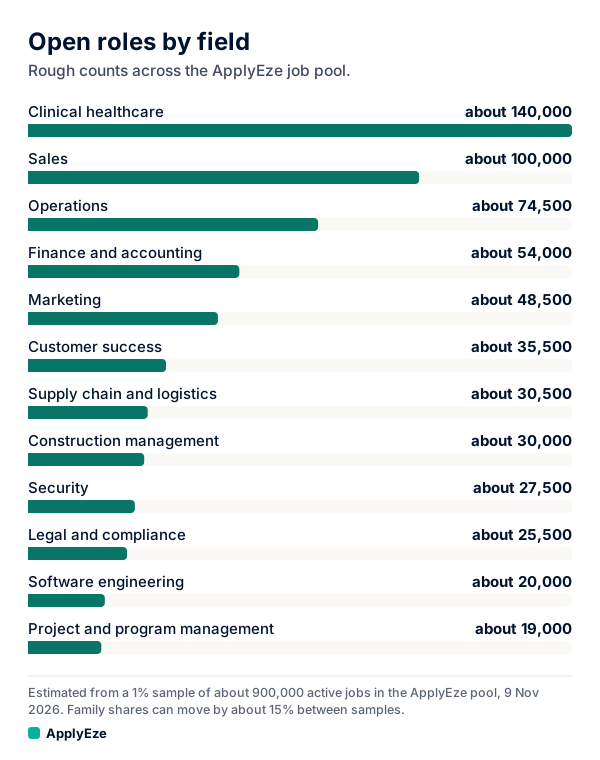
Product management is absent from this chart of the 12 largest fields, which ends with project and program management at about 19,000. ApplyEze polls more than 100,000 employer boards directly, and that pool of about 900,000 active jobs holds only a few thousand product roles, from a rough 1% sample on 9 November 2026. The practical meaning is simple. In a pool this size, each application has to survive a careful reader.
If you apply through ApplyEze, an AI model reads each posting and your real history and writes a resume for it. Your employers, job titles, dates, schools, degrees and certifications come from your own record, and code rejects a rewrite that adds a figure, employer, school or credential your record does not hold. An audit of 84 sampled resumes on 4 November 2026 found 0 invented employers, dates, degrees or numbers. So your outcome lines belong in the resume you upload, with their numbers and methods. The skills line works differently. ApplyEze brings the posting's named skills and tools onto it, even when your own record does not list them. There is no step to remove one before a live run, so use a dry run to see what it writes, and be ready to discuss anything on the page.
Hard facts on forms come from your profile. When a required question is not covered by your saved answers, ApplyEze still fills it rather than stopping the run, so that answer may not come from you. Fill in your saved answers, use dry run first, and read your receipts. You pick the matches and queue them in the desktop app, and it applies in Chrome on your computer, so keep the computer on and awake until the queue finishes. Workday and Oracle jobs stay hidden until you connect an application inbox, because those sites email a code.
Take your three weakest feature lines and run them through the five questions above. Then your first 50 applications are free, with no card, and ApplyEze builds a resume for each posting.