

To find a job after graduation, run a loop instead of a sprint: pick a small set of titles in fields with real supply, apply steadily to roles you could do, talk to people every week, and check your numbers every two weeks. The plan below takes 60 days and sends about 120 applications. It does not promise an offer by day 60. In current data, 57% of the Class of 2026 left school with no offer, and the median search to a first offer ran 102 days. What day 60 should give you is evidence: which titles get replies, which do not, and what to change.
The 60 days at a glance
| Weeks | Goal | By the end you have |
|---|---|---|
| 1 and 2 | Choose fields and titles from real supply | 2 fields, 3 titles each, 40 named employers |
| 3 and 4 | Build the resume and start | One base resume, a version per title, 40 applications logged |
| 5 and 6 | Add people to the forms | 20 messages sent, at least 3 conversations, 40 more applications |
| 7 and 8 | Measure and change one thing | Your interview rate, one change made, 40 more applications |
The application target is 20 a week from week 3, or about 3 a day. Lower it if quality falls. Huntr's comparison of the same people across their own weeks found that in their busiest weeks the interview rate fell from 9.5% to 5.6% while interviews per month rose from 0.7 to 2.9, so more is usually still more, at a cost.
Where the market really stands
| What was measured | Number | Who, and on whom |
|---|---|---|
| Unemployment, recent graduates | 5.2%, Q3 2026, lowest in more than a year | New York Fed, ages 22 to 27 with a bachelor's or higher |
| Underemployment, same group | 42.5%, Q3 2026 | New York Fed. Working in a job that typically does not require a degree |
| Offer in hand before graduating | 43%, or 55% for paid interns who applied | NACE, 1,860+ Class of 2026 seniors, spring 2026 |
| Working or in further study within six months | 85.7%, with slightly under 55% in full-time jobs | NACE, Class of 2024, 363 institutions |
| Unemployment in the first October after the degree | 15.3%, October 2024 | BLS, new bachelor's recipients ages 20 to 29. The latest release we could open |
| Employers' hiring plans | Up 5.6% for the Class of 2026 | NACE, 185 employers, median, spring 2026 |
| Entry-level openings, applications, hires | Up 18%, down 9%, up 3%, April 2026 | iCIMS customers. Openings led by manufacturing and retail |
| Interview rate per application | 3.9% for entry-level titles, 6.4% for senior | Huntr, self-tracked users, 2026 |
| Median time to a first offer | 102 days, Q3 2026 | Huntr, 667 job seekers of all ages who logged one |
Two things follow.
The first months look worse than the market does. The BLS figure for people who just finished, 15.3%, is about three times the New York Fed's 5.2% for ages 22 to 27. The dates and definitions differ, so do not read that as a precise fall. It does show why comparing yourself in July with someone who has been out for three years tells you little.
Sixty days is short for this funnel. Here is the math, which is ours. 120 applications at 3.9% gives about 4.7 interviews. Published rates for an interview turning into an offer run from 7.3% for technical roles and 10.4% for business roles at Ashby's customers to 27% at small businesses on CareerPlug. That makes about 0.3 to 1.3 offers. It is an average from people unlike you in many ways, not a forecast, and it fits Huntr's 102 days. Plan your money and your mood for longer than two months.
Weeks 1 and 2: pick fields and titles
Start with where the jobs are, because a well-written application to a thin field still has to beat everyone else in it.
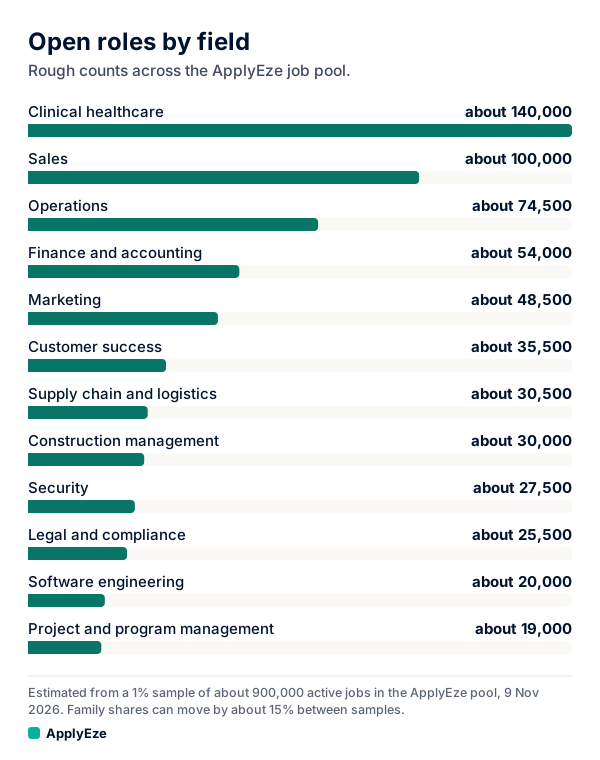
The chart shows rough counts of open roles in the job pool ApplyEze tracks, from a 1% sample on 9 November 2026. Clinical healthcare leads at roughly 140,000, then sales at roughly 100,000, operations at 74,000, finance and accounting at 54,000, and marketing at 49,000. Software engineering is roughly 20,000.
Now set that beside your major. The middle columns are the New York Fed's outcomes by major for 2024. The last column pairs each major with fields in our pool. Those pairings are our judgment, and the counts cover all experience levels, because our sample does not separate entry-level roles.
| Major | Unemployed | Underemployed | Fields to look at, open roles roughly |
|---|---|---|---|
| Nursing | 2.1% | 12.8% | Clinical healthcare, 140,000 |
| Accounting | 2.6% | 21.2% | Finance and accounting, 54,000 |
| Finance | 2.8% | 27.8% | Finance and accounting, 54,000; sales, 100,000 |
| General business | 4.3% | 50.4% | Sales, 100,000; operations, 74,000 |
| Marketing | 4.4% | 49.3% | Marketing, 49,000; sales, 100,000 |
| Communications | 3.9% | 53.0% | Marketing, 49,000; customer success, 35,000 |
| Psychology | 5.0% | 48.3% | Customer success, 35,000; HR and recruiting, 12,000 |
| Computer science | 7.0% | 19.1% | Software, 20,000; security, 27,000 |
| Mechanical engineering | 4.4% | 20.1% | Construction management, 30,000; manufacturing, 12,000 |
| Civil engineering | 2.3% | 15.6% | Construction management, 30,000 |
| Fine arts | 7.7% | 58.9% | Marketing, 49,000; operations, 74,000 |
| All majors | 4.2% | 39.4% |
Read the two rate columns together. Computer science shows high unemployment and low underemployment: fewer land, and those who do tend to land in degree-level work. Fine arts is high on both. If your major points to a small field, add a larger neighbor as your second field.
Then do this by day 14:
- Read 20 postings for each field and count what they ask for. Count the years too. In an iCIMS survey, 54% of entry-level job seekers believed employers now expect mid-level experience. Your 20 postings will show how true that is for your titles.
- Choose three titles per field, using the exact words employers use. Beginner roles often carry words like associate, coordinator, junior, analyst I, trainee or graduate.
- Note the skills that keep coming up. Huntr found 13.7% of saved entry-level jobs named an AI skill in 2026, up from 7.1% in 2025. Add such a skill only if you have used it.
- List 40 employers that hire those titles, and bookmark their careers pages.
Weeks 3 and 4: resume and first applications
Write one base resume, then a version per title. Lead with your closest evidence, and our recent graduate resume guide has three samples to work from.
Three facts should shape where you apply:
- Employer sites beat job boards. In Huntr's data, the same 5,855 people got interviews on 6.2% of applications through employer career sites against 4.9% through job boards.
- Big employers' entry-level portals are not dead ends. In an experiment that sent over 83,000 fictitious applications to entry-level jobs at 108 very large firms, 24% were contacted within 30 days. It is a narrow setting and it counts contact, not offers.
- Postings move fast. On Dice.com, 45% of applications went to postings under 48 hours old, and the median posting lasted seven days. We found no rigorous study of whether being early raises your odds, but checking your 40 employers twice a week keeps you from missing the window.
Keep a log from the first application: date, employer, title, where you found it, and the stage it reached. Everything in week 7 depends on it.
Weeks 5 and 6: people, not forms
Keep sending 20 applications a week, and add 10 messages a week. Most interviews still start with a form. In Huntr's October 2026 survey of 271 people with an interview, 58% got their latest one by applying online, 18% from a recruiter who reached out first, 13% through a referral and 11% through networking. So referrals and networking account for about a quarter of those interviews in a small survey, and a New York Fed staff report on one large company found referred candidates were more likely to be hired.
Alumni are the easiest people to approach, because they remember being where you are. Write to graduates of your school who hold your target title, ideally two to five years out, so that what they tell you is still current. A sample, written for this post:
Hi Priya, I graduated from Northfield in May with a degree in economics, and I saw you moved from there into operations analysis at your company. I am applying for analyst roles now. Could I ask you three questions over 15 minutes this month? I would like to know what your first-year team looks for and what you wish you had done differently. If email is easier, that works too.
Do not ask for a job in the first message. Ask for a referral only after you have talked and the role fits, and our guide on how to ask for a referral has wording for that step. Also ask your school's career office whether it still serves you as a graduate and which employers recruit there.
Weeks 7 and 8: review what is working
By the end of week 6, you should have about 80 applications logged. At 3.9%, the expected number of interviews is about 3. If every application were an independent draw, the chance of zero would be about 30% after 30 applications, about 4% after 80, and under 1% after 120 (our arithmetic). So do not judge early, and do not ignore zero at 80.
| At about 80 applications | What it points to | Change this one thing |
|---|---|---|
| No interviews | Titles or the top third of your resume | Rewrite your summary and first section against 10 postings you want, and replace your weakest title |
| 1 to 4 interviews | About what the average predicts | Keep going, and put more volume into whichever title got them |
| 5 or more interviews, no second rounds | Interview answers, or roles that do not fit | Practice aloud with someone in the field, and review what each first call asked |
| Second rounds, no offers | Late-stage fit or competition | Ask interviewers for feedback, and add employers in your stronger field |
| Interviews from one field only | That field wants you | Drop the other and put all 20 a week there |
Change one thing at a time, so that you can tell what worked. If the first row is you, the why am I not getting interviews checklist goes further.
If you are already behind
The feeling is common, and the data does not support much of it. A majority of the Class of 2026 left school without an offer. The figure closest to a finish line, NACE's 85.7%, is measured at six months and counts further study as well as work, and only slightly under 55% of that class reported a full-time job by then.
The best evidence on what a gap does is a resume audit by Nunley, Pugh, Romero and Seals, published in 2017, which sent fictitious resumes for recent graduates to employers. It found "no statistical evidence linking unemployment spells of different durations to employment opportunities." The study is about a decade old and it only measures callbacks. Still, it is a controlled test, and the fear it tests is exactly this one.
If months have already gone by, compress the plan:
- This week: do weeks 1 and 2 in three days, then count your past applications if you have them. If you have sent 80 or more with no interviews, start with your titles and resume.
- Fill the present tense. A project, a course with a deliverable, freelance work or volunteering gives you a current line to write, and gives you something to talk about.
- Say it plainly. A sample answer, written for this post: "I took time after graduating to narrow what I wanted, and since August I have been building a sales forecast model for a local nonprofit. That is why I am applying for this analyst role." Use it only if it is true.
What to do about underemployment
Be clear about what the numbers measure. The New York Fed's 42.5% counts graduates aged 22 to 27 in jobs that typically do not need a degree, and it notes that many of those jobs are "fairly skilled and well paid" and that people "transition into better roles after gaining some work experience."
The longer view is less comfortable. Talent Disrupted, from the Burning Glass Institute and Strada, followed career histories and found 52% underemployed a year after graduation and 45% ten years on. People who started underemployed were 3.5 times as likely to be underemployed a decade later as those whose first job was at college level. A graduate with an internship had a 48.5% lower chance of it. The definitions differ from the Fed's, and these are associations, since people who take a non-degree job may differ in other ways. The same 2017 audit adds a causal piece: underemployed applicants got callback rates 30% lower than adequately employed ones, and an internship "substantially reduces" that penalty.
Set against the gap result above, that gives an awkward finding: in that study, a non-degree job hurt callbacks and a gap did not. Rent does not care. So use this table, which is our judgment from that evidence.
| Your situation | Do this |
|---|---|
| You need income now | Take the job. Keep at least 5 to 10 targeted applications a week going |
| You can choose among non-degree jobs | Pick the one nearest your field, such as a bank teller role if you want finance, or an office role at an engineering firm |
| You can afford a few more months | Search full time, with a project or part-time work that gives you a current line |
| You have no internship | Look at paid internships open to recent graduates. The research above covers internships during college, so a later one is untested, but it gives you a relevant line. See how to get an internship |
On your resume, put relevant projects and internships above a current non-degree job, and keep that job short and truthful.
Where ApplyEze fits in this plan
The plan asks for 120 applications in six weeks. If filling in forms is what is using up your weeks, ApplyEze can take that part once you have chosen your titles. It polls more than 100,000 employer boards directly, about 900,000 active jobs, so your 40 named employers are a starting point and not the limit. You pick roles from a ranked board and queue them in a desktop app. Applications run on your computer while the app is open, so keep it on and awake until your queue finishes. Workday and Oracle jobs stay hidden until you connect an application inbox, because those sites email a code.
For each application, an AI model reads that posting and your real history and writes a resume for it. Your employers, job titles, dates, schools, degrees and certifications come from your own record, and in an audit on 4 November 2026 of 84 sampled resumes we found 0 invented employers, dates, degrees or numbers. ApplyEze brings the posting's named skills and tools onto your skills line, even when your own record does not list them. There is no step to remove one before a live run, so use a dry run to see what it writes, and be ready to discuss anything on the page. Hard facts come from your profile. When a required question is not covered by your saved answers, ApplyEze still fills it rather than stopping the run, so that answer may not come from you. Fill in your saved answers, use dry run first, and read your receipts.
If you would rather spend weeks 5 and 6 writing to alumni than retyping your history, your first 50 applications are free, once per email address with no card, and a credit is used only when an application is confirmed as Submitted.