

A recent graduate resume should lead with the evidence closest to the job you want: education near the top, then an internship in the field if you have one, or a project written up like work if you do not. There is unusually good evidence for this. A resume audit of 9,400 fictional applicants for entry-level jobs found that an internship raised the interview rate by 14%, and that business degrees did not improve prospects, even for business-related openings. So the degree name opens less than people assume, and what you did with the degree opens more. This guide covers what to lead with, what to do about your GPA, and three samples, because an arts graduate, a business graduate and an engineering graduate have different problems to solve.
What to lead with
Pick the row that matches your strongest evidence. It decides the order of your page.
| Your strongest evidence | Order on the page | Section heading to use |
|---|---|---|
| An internship in the target field | Education, Experience, Projects, Skills | Experience |
| A capstone, thesis or client project with a result | Education, Projects, Experience, Skills | Projects, or Engineering Projects |
| A portfolio of real work | Link in the header, Selected Work, Education, Experience | Selected Work |
| Part-time jobs and coursework only | Education with one course project, Experience by outcome, Skills | Experience |
Two findings from that audit are worth knowing. The return to an internship was larger for nonbusiness majors and for applicants with high academic ability, so an arts or humanities graduate gains more than most from showing one. And employers appear to be reading it as a signal, which the authors name as the likeliest explanation. A signal has to be seen. An internship on line 25 does little for you.
The numbers also explain why skills evidence belongs high up. In NACE's Job Outlook 2026, 70% of 183 employers hiring new graduates said they use skills-based hiring, and 65% of those use it at the screening stage. A list of adjectives does not help a screener doing that. Something you built does.
Education placement and GPA
For your first year or so out, keep education near the top. Handshake's new graduate guide puts it right below your objective. Give the school, the degree, the major, and the month and year. Our guide to listing education on a resume covers the edge cases, such as a degree in progress or a degree from abroad.
GPA has changed the most. NACE reports that nearly three-quarters of employers, 73%, screened candidates by GPA in 2019, and that just 42% do now. That leaves it optional for most jobs and still decisive for some. The common rule of listing it at 3.0 or above, which Handshake also uses, is a convention. We found no study that tests that line. The audit above only tested a 3.9: among applicants with an internship, showing the 3.9 raised the interview rate 28% over not showing a GPA. And a 2018 audit by Natasha Quadlin, covering 2,106 applications to 1,053 entry-level openings, found GPA had little effect for men, and that women did better with moderate grades than with high ones, so a high figure does not help everyone equally.
From that evidence, here is our judgment:
| Your situation | On the resume |
|---|---|
| 3.5 or above | List it |
| 3.0 to 3.49 | List it when a posting asks for it or sets a minimum you meet. Otherwise it is your call |
| Below 3.0, but your major GPA is clearly higher | "Major GPA: 3.4", labelled as exactly that |
| Below 3.0 | Leave it off and lead with projects |
| A form asks for it | Give the exact figure, whatever you did on the resume |
Why not to round up
A recent graduate has little on the page, so every small stretch feels justified. Some are also easy to check. Schools report degree and attendance records to services such as the National Student Clearinghouse, whose own FAQ says "most degree requests are confirmed instantly." It gives GPA as an example of data schools do not send there, so a GPA usually surfaces later, through a transcript, if at all. That is not a reason to inflate it, since one mismatch makes people doubt the rest of the page.
| Tempting | Write this instead |
|---|---|
| 3.46 written as 3.5 | 3.46, or leave it off |
| "BS, May 2026" when the degree is conferred in December | "BS, expected December 2026" |
| A June to August internship stretched to May to September | The real months |
| "Analyst" when your title was "Analyst Intern" | The real title |
| "Led a team" when you were one of four | "Worked in a team of 4, and owned the pricing model" |
Projects as experience
Coursework reads as work when it has a deliverable, a user and a result. A list of course titles has none of these, so use one only when a posting names a subject you cannot show any other way.
The formula: what you made or ran, for whom, under what constraint, and what happened. If you have no result, say who used it. These lines are samples, invented for this post.
| Course version | Work version |
|---|---|
| Marketing Research, group project | "Surveyed 212 students on campus dining, found that hours mattered more than price, and presented 3 recommendations to the dining director." |
| Data Structures, final project | "Built a course-planning tool in Python that 40 classmates used to check prerequisites, with tests covering all 12 degree tracks." |
| Thesis: Labor Migration in Ohio | "Analyzed 15 years of census data in R for a 60-page thesis, and presented the findings to 30 people at a department conference." |
| Film Production II | "Directed a 12-minute short with a crew of 9 and a $1,500 budget, delivered 2 days ahead of the festival deadline." |
Check each line with one question: would a stranger know what you delivered? Then read it aloud and ask whether you could talk about it for two minutes.
Internships and part-time jobs
Describe an internship by what changed because you were there, not by what you were assigned. "Assisted the finance team with reporting" says nothing about you. "Rebuilt the weekly cash report in Excel, cutting preparation from 3 hours to 40 minutes" (sample) does.
Part-time jobs count, and they show different things: reliability, money handled, people trained, and volume. "Trained 5 new hires and closed alone 3 nights a week" (sample) tells a hiring manager something a transcript cannot.
Order matters if you are working in a non-degree job right now. A 2017 audit in the ILR Review found that underemployed graduates had callback rates 30% lower than adequately employed ones, and that "internship experience obtained while completing one's degree substantially reduces the negative effects." So put relevant internships and projects first, and keep the current job short and below them. Be truthful on any form that asks for your full history.
Sample: arts graduate
The problem is translation. In the New York Fed's outcomes by major for 2024, fine arts graduates aged 22 to 27 had 7.7% unemployment and 58.9% underemployment, and performing arts 7.0% and 63.9%. Most employers cannot picture what a stage manager does. This sample targets a marketing or operations coordinator role, so it leads with a portfolio and writes production work as project management.
SAMPLE, written for this post. Every name and number is invented.

JORDAN ELLIS
Columbus, OH | jordan.ellis@example.com | example.com/jellis

BFA, Theatre Arts, Northfield State University, May 2026

SELECTED WORK
Stage Manager, The Crucible, Northfield Theatre, Fall 2025
- Ran a 6-week schedule for a cast and crew of 31 and a $9,000 budget.
  Opened on time and $400 under budget.
- Wrote nightly reports for 8 department heads. The format became the
  template for the next season.

Social Media Lead, Student Theatre Company, 2024 to 2026
- Raised average seats sold across 4 shows from about 60% to 85%, using a
  posting calendar and an email list of 1,200.

EXPERIENCE
Box Office Assistant, part-time, Riverside Arts Center, 2023 to 2026
- Handled about 200 ticket orders a week and resolved refund requests
  with no manager on site.

SKILLS
Google Workspace, Canva, email marketing, budget tracking
There is no GPA because it adds nothing here, and no course list. The word "theatre" stays, because hiding it would be odd, but each line would make sense to a manager who has never been backstage.
Sample: business graduate
The problem is sameness. The same Fed table shows how much the label matters: general business graduates had 50.4% underemployment and business management 52.6%, against 21.2% for accounting and 27.8% for finance. The audit found no premium for a business degree on its own. So this sample picks a function, operations, and proves it with a named outcome.
SAMPLE, written for this post. Every name and number is invented.

TAYLOR BROOKS
Austin, TX | taylor.brooks@example.com | linkedin.com/in/example

BBA, Business Management, Lakeshore University, May 2026 | GPA 3.6

EXPERIENCE
Operations Intern, Harbor Supply Co., Summer 2025
- Mapped the returns process across 3 warehouses and removed 2 approval
  steps, cutting average handling from 6 days to 4.
- Built an Excel model of carrier costs that the team used in a contract
  renewal.

Shift Lead, part-time, Corner Market, 2023 to 2026
- Trained 5 new hires and reconciled about $4,000 in daily sales.

PROJECTS
Capstone consulting project, Eastside Food Bank, Spring 2026
- Analyzed 14 months of delivery data and proposed 3 new routes, projected
  to cut mileage 12%. The food bank adopted 2 of them.

SKILLS
Excel (pivot tables, lookups), SQL basics, Tableau
The GPA is listed because it clears 3.5. The internship comes first because it is the strongest signal on the page, and a capstone with a real client backs it up.
Sample: engineering graduate
The problem is proof of method. Engineering outcomes look better on underemployment (mechanical 20.1%, civil 15.6%), but not uniformly on unemployment, with computer engineering at 7.8%. A hiring engineer reads for how you tested something, so numbers need a method beside them, and tools need to be ones you used. If you took the FE exam, say so. NCEES describes it as generally your first step toward becoming a licensed professional engineer, designed for recent graduates and students close to finishing an EAC/ABET-accredited degree.
SAMPLE, written for this post. Every name and number is invented.

SAM OKAFOR
Denver, CO | sam.okafor@example.com | example.com/sokafor

BS, Mechanical Engineering, Ridgeline University, May 2026 | GPA 3.4
FE exam passed, October 2026

ENGINEERING PROJECTS
Senior design: drone landing gear, team of 4, 2025 to 2026
- Led structural design in SolidWorks. Cut mass 18% while holding a safety
  factor of 2.0.
- Checked the design with ANSYS FEA and 3 physical drop tests. Measured
  loads came within 7% of predicted.

EXPERIENCE
Manufacturing Engineering Intern, Tri-County Fabrication, Summer 2025
- Redesigned a welding fixture on 2 lines, reducing scrap from 6.2% to
  4.8% over 10 weeks.

SKILLS
SolidWorks, ANSYS, MATLAB, GD&T, Python (basic)
The word "basic" beside Python is doing real work. An interviewer will test any tool you list, and an engineer who admits a limit reads as someone who knows the difference.
What stays fixed, whoever writes it
Whether you write each version yourself or use software, the same line applies: you can reword and reorder your record, and you cannot change its facts. If you use ApplyEze, this is how it treats that line.
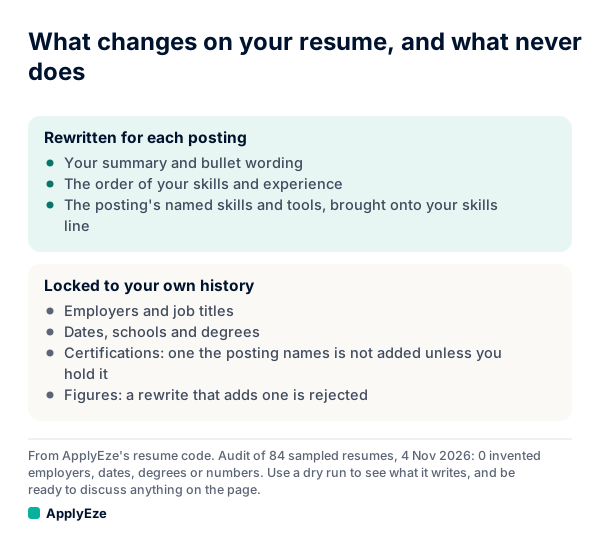
The chart shows two lists. For each posting, the summary, bullets, order and the posting's named skills can change. Your employers, job titles, dates, schools, degrees and certifications come from your own record, and code rejects a rewrite that adds a figure, employer, school or credential your record does not hold. In an audit of 84 sampled resumes on 4 November 2026, we found 0 invented employers, dates, degrees or numbers. ApplyEze brings the posting's named skills and tools onto your skills line, even when your own record does not list them. There is no step to remove one before a live run, so use a dry run to see what it writes, and be ready to discuss anything on the page. A certification the posting asks for is not added unless you hold it.
Forms ask things a resume does not, so save your real GPA along with your other answers. Hard facts come from your profile. When a required question is not covered by your saved answers, ApplyEze still fills it rather than stopping the run, so that answer may not come from you. Fill in your saved answers, use dry run first, and read your receipts.
To run it on your own record, you upload a PDF, review what we read from it, and queue the roles you pick from a ranked board. Applications run in a desktop app on your computer, so keep it on and awake until your queue finishes. Workday and Oracle jobs stay hidden until you connect an application inbox, because those sites email a code. For a first draft without any software, our first job resume guide has more layouts, and the 60 day graduate job plan shows where this resume fits in a search.
Get one version of this page right first. Then, if you would rather spend your evenings on projects and interview practice than on the next 50 versions, your first 50 applications are free, with no card, and ApplyEze builds a resume for each posting.