

To get a job in human resources, pick one path first and aim at its entry titles: HR coordinator or assistant for generalist work, recruiting coordinator or agency recruiter for talent acquisition, benefits coordinator for total rewards. Then decide about a certification by counting what your local postings ask for, and rewrite your resume so it shows HR work in numbers. A certification can help, but it does not replace experience. SHRM-CP and the aPHR require no HR experience to sit, and the PHR does. BLS says HR specialists typically need a bachelor's degree and that "some positions require" relevant experience, which is where most new entrants get stuck.
The usual advice is to get a degree, get a certification and network. That is true and not much use. HR is several jobs with different doors, the certification decision has a price and a calendar, and the people reading your application do this for a living.
Which HR path you mean
BLS counts recruiters and generalists together as "human resources specialists", so BLS gives no separate national wage for them. It still helps to see the jobs side by side.
| Path | What the job is | Entry titles to search | National median pay |
|---|---|---|---|
| Generalist | "all aspects of human resources work", in BLS's words: onboarding, policy, employee relations, compliance | HR Assistant, HR Coordinator, People Operations Coordinator | $50,610 for HR assistants (2025). $75,940 for HR specialists (May 2025). |
| Recruiting | Filling roles, whether inside one employer or at an agency | Recruiting Coordinator, Talent Acquisition Coordinator, Sourcer, Agency Recruiter | $75,940 for HR specialists, the group recruiters sit in |
| Benefits and pay | Enrollment, leave, job evaluation, pay structure | Benefits Coordinator, Compensation Analyst | $78,210 for compensation, benefits and job analysis specialists |
| Training | Onboarding programs, courses, learning systems | Training Coordinator, L&D Coordinator | $69,280 for training and development specialists |
| Labor relations | Union contracts and grievances | Labor Relations Assistant or Specialist | $95,420 for labor relations specialists |
Pay figures other than the HR assistant's are the 2025 medians listed on the BLS page. They cover all experience levels, so do not read them as starting wages.
Two facts in the federal data change the plan. First, the bottom rung is shrinking while the next one grows. O*NET projects a decline for HR assistants of at least 1% from 2025 to 2035, while BLS projects 6% growth for HR specialists over the same years, with about 73,700 openings a year. So do not search for "HR Assistant" alone. Second, the door is not always in an HR department. BLS shows 13% of HR specialists work in employment services, meaning staffing and recruiting firms, tied for the largest share with professional, scientific and technical services. Healthcare and social assistance has 11%, and government 10%.
First titles and where they lead
| First title | What year one looks like | Where it tends to lead | What to count from day one |
|---|---|---|---|
| Recruiting coordinator | Scheduling interviews, keeping the applicant tracking system clean, candidate email | Recruiter, then talent acquisition lead | Interviews scheduled per month, time to schedule |
| Agency recruiter | Sourcing, cold calls, placements, usually on commission | In-house recruiter, senior agency roles | Placements, submittals per hire |
| HR coordinator or assistant | Onboarding paperwork, Form I-9, HR system entry, employee questions | Generalist, then HR business partner or manager | Hires onboarded, audit results, tickets closed |
| Benefits coordinator | Open enrollment, leave tracking, carrier issues | Benefits specialist, total rewards | Employees enrolled, errors resolved |
| HR systems or people operations analyst | Reports, data cleanup, system changes | HR systems lead, people analytics | Reports built, hours saved |
Recruiting and generalist work are different jobs. Recruiting is closer to sales: outcomes are countable, the pace is set by open roles, and it follows the hiring cycle. Greenhouse's benchmarks show recruiters per organization falling from 10.43 in 2022 to 4.62 in 2025, a 56% drop, while applications per recruiter rose from 1,610 to 4,890 a year. Those are Greenhouse customers, not the whole market, but they tell you what the seat feels like now: fewer people and much more volume. If you like closing things and can stand rejection, it is often a quicker way in, because agencies tend to hire for drive over background. Our guide on how to work with a recruiter shows how that business is paid.
Generalist work is closer to compliance and judgement. Employees bring you their problems, and at a small employer you may be the only HR person in the building. Being able to state these three rules is an easy way to stand out in a first interview. This is general information, not legal advice.
- Form I-9. The employer must complete Section 2 "within 3 business days" of the date of hire. Someone who starts on Monday needs it done by Thursday.
- FMLA. An employee is eligible after 12 months and 1,250 hours of service, at a location with at least 50 employees within 75 miles. It allows up to 12 workweeks of leave in a 12-month period for most reasons.
- EEO-1. The annual filing applies to private employers with 100 or more employees, and the EEOC's page also lists federal contractors with 50 or more that meet certain criteria.
SHRM and HRCI certifications
The two bodies sell competing credentials. All prices below are as of November 2026, from each organization's own pages.
| Credential | Who can sit | Cost | Exam | Latest pass rate | To keep it |
|---|---|---|---|---|---|
| aPHR (HRCI) | "No HR experience is required" | $300 exam + $100 application = $400 | 65 scored and 25 pretest questions, 1 hour 45 minutes | 71%, as of 31 Dec 2025 | 45 credits in 3 years, or retake |
| SHRM-CP | No degree or HR experience needed. Basic working knowledge recommended. | $399 member, $499 nonmember at standard rates. Students $199 and $299. | 134 questions, 3 hours 40 minutes, in person at a test center | 69%, May to July 2026 | 60 credits in 3 years plus a fee, or retake |
| PHR (HRCI) | 1 year of professional HR work with a master's, 2 with a bachelor's, or 4 with no degree | $395 exam + $100 application = $495 | 90 scored and 25 pretest questions, 2 hours | 72%, as of 31 Dec 2025 | 60 credits in 3 years, or retake |
| SHRM-SCP | At least 3 years of strategic-level HR work | Same as SHRM-CP | Same as SHRM-CP | 56%, May to July 2026 | Same as SHRM-CP |
Pass rates cannot be compared across the two bodies, because different people take each exam. They do tell you that a real share of candidates fail, so these are worth preparing for.
Check dates, too. If a guide tells you the SHRM-CP needs prior HR experience, go to SHRM's page, which now says candidates "do not need a degree or previous HR experience to apply". And the calendar matters. HRCI says you can apply and test throughout the year. SHRM runs two windows: the next is 1 December 2026 to 15 February 2027, standard applications close on 24 December 2026, and the early bird rate for that window ended on 31 August.
Does it help you get hired? The best evidence we found is old. A 2012 study in Human Resource Management found 15.6% of job announcements required or preferred PHR or SPHR, up from 1.4% in a 2002 sample, and 25.1% for managerial HR roles. Demand rose with experience, education and title level. It counted only HRCI credentials and we found no current independent count, so anyone quoting a number today should show their method. BLS says certification is "usually voluntary" and that some employers prefer or require it.
So run your own count. It takes about 20 minutes and beats any article, including this one.
- Pull 20 postings for your target title within commuting distance, or remote if that is real for you.
- For each one, mark SHRM-CP, aPHR, PHR or none, and whether it says required or preferred.
- Note every HR system named and the years of experience asked for.
Our rule of thumb: if a quarter or more name a credential, and especially if they say required, it is probably worth the money. If most say nothing, keep the $400 to $500 and put the time into getting experience. If postings say "SHRM-CP or PHR", you have a free choice. With no HR experience, choose between the aPHR and SHRM-CP based on your count, the calendar and the price. With a year or two of professional-level HR work, the PHR is also open to you.
Do not list a credential until you hold it. "SHRM-CP, exam scheduled for January 2027" is accurate and useful. "SHRM-CP" is not, and an HR reader may check.
Moving in from recruiting, admin or operations
BLS names the usual feeders: experience can come from work as human resources assistants or customer service representatives, or in related occupations. Here is how to frame the move.
| Coming from | What already counts | The gap to close | First title to try |
|---|---|---|---|
| Agency or staffing recruiting | Applicant tracking systems, screening, offers | Employment law, employee relations | In-house recruiter, then HR generalist |
| Office manager or administrator | Onboarding, records, payroll inputs, time off, confidentiality | Saying it in HR's language | HR Coordinator, HR Administrator |
| Operations or shift supervisor | Hiring, attendance, write-ups, scheduling, safety | Policy and documentation discipline | HR Coordinator at an employer in your own industry |
| Customer service | Handling difficult people, ticket systems, volume | HR content and systems | HR service center or helpdesk roles, Recruiting Coordinator |
The first step costs nothing: ask for HR work where you are now. Offer to run onboarding for your team, write the next job posting, sit in on interviews or tidy the attendance records. Three months of that gives you resume lines and someone who can vouch for you. The wider plan is in our career change guide.
What a first HR resume must show
HR readers review resumes all day, so they notice what most people would not. Three things in particular.
Volume and accuracy, in numbers. These lines are samples written for this post, not anyone's real resume. Use the pattern only with your own true figures.
- From an admin role: "Completed onboarding and Form I-9 for 140 hires across 3 sites in 2025, each Section 2 within 3 business days."
- From coordination: "Scheduled about 60 interview loops a month in Greenhouse, cutting average time to schedule from 4 days to 2."
- From benefits: "Ran open enrollment for 220 employees and resolved 35 carrier discrepancies before the deadline."
- From operations: "Hired and onboarded 18 associates as shift supervisor and documented attendance cases under company policy."
The systems by name. Your 20-posting count will show which ones matter locally: Workday, ADP, UKG, BambooHR, Greenhouse and so on. List only those you have used. If you only entered data, say that, because the first question in the interview will find it out.
Discretion. Never describe a real complaint, investigation or termination in identifying detail. An HR reader treats your resume as a sample of how you handle confidential information. "Handled employee relations" is a phrase they will probe, so use it only if you really did. Three worked versions, for generalist, recruiter and partner roles, are in our sample HR resume.
What the numbers say about the field
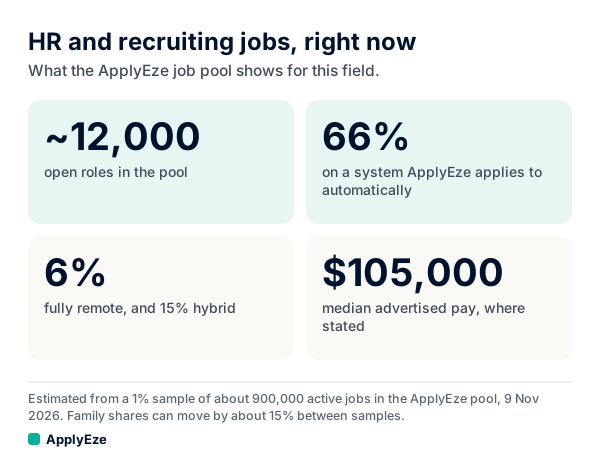
In a 1% sample of the roughly 900,000 active jobs we track, taken on 9 November 2026, 123 rows were HR and recruiting roles, which suggests roughly 12,000 open roles. That sample is small. A second sample differed by up to about 15% per field, so treat every number here as rough.
- On site is the norm. About 6% were remote (7 of 123) and roughly 15% hybrid (18 of 123). Plan a local search. A remote-only HR search is a much smaller one.
- About two thirds are on a system ApplyEze applies to (81 of 123). The other third you would apply to by hand in any case.
- The $105,000 is not an entry wage. It is the median midpoint of advertised pay among postings that state it. Across our pool only about 15% do, so the figure is thin, and it likely skews to senior roles. Compare it with the federal numbers above: $50,610 for assistants and $75,940 for specialists, against $149,280 for HR managers, a job that typically asks for five years or more of related experience. Use those to set your expectations.
How to apply in this field
Applying for HR work is odd, because the reader knows exactly what you are doing. They run these forms. They know which questions are knockouts, what a generic cover letter looks like and how a pasted answer reads. Use that in two ways.
Treat your application as a work sample. Spelling, consistent dates and careful answers matter here, because accuracy is the job. And keep notes on your own search. When an application eats most of an hour or you get no reply for a month, you are learning what candidates feel. Asked in an interview how you would improve the candidate experience, you will have real answers. Greenhouse found 81% of US candidates were rejected in the past year without speaking to anyone at the company. Soon you may be on the other side of that number.
Respect the volume they are drowning in. In a March 2026 Robert Half survey, 67% of US HR leaders said reviewing AI-generated applications has slowed hiring. SHRM reports that 39% of organizations have implemented AI in HR, with recruiting the main use at 27%, so plenty of these readers are still working through it by hand. So send applications you would defend. And find the local community: SHRM has a chapter locator for local professional and student chapters, and a chapter meeting is a place to meet the people who hire in your own city. One of them may also be willing to refer you.
Search titles, plural. The same job appears as HR Coordinator, People Operations Coordinator, HR Administrator and Talent Acquisition Coordinator. O*NET also lists HR Associate and Personnel Clerk as reported titles for assistant work. Build your list from your 20 postings.
If you want help with the forms. An HR search means many titles and many forms, and ApplyEze is built for that part. It polls more than 100,000 employer boards directly, about 900,000 active jobs, and has delivered 94,207 applications since August, to 9,769 employers. You pick the roles from a board ranked on your target titles and the requirements it reads out of each posting, then queue them in the desktop app, for macOS and Windows x64, which runs in Google Chrome on your computer. Keep the computer on and awake until the queue finishes. Title counts most in that ranking, and a role doing your work under a title you did not list ranks low, so list several, with your first choice first.
For each application, an AI model reads that posting and your real history and writes a resume for it, with a cover letter when the form asks. Your employers, job titles, dates, schools, degrees and certifications come from your own record, and code rejects a rewrite that adds a figure, employer, school or credential your record does not hold. In an audit of 84 sampled resumes on 4 November 2026, we found 0 invented employers, dates, degrees or numbers. A certification the posting asks for is not added unless you hold it, which matters when a posting says "SHRM-CP preferred". ApplyEze brings the posting's named skills and tools onto your skills line, even when your own record does not list them. There is no step to remove one before a live run, so use a dry run to see what it writes, and be ready to discuss anything on the page. An HR interviewer will ask.
Hard facts come from your profile. When a required question is not covered by your saved answers, ApplyEze still fills it rather than stopping the run, so that answer may not come from you. Fill in your saved answers, use dry run first, and read your receipts. Some employers ask applicants not to use AI or automation. Whether to apply there is your call. Workday and Oracle jobs stay hidden until you connect an application inbox, because those sites email a code. Across all fields, ApplyEze applies on systems holding roughly 62% of the jobs we track with an inbox connected and roughly 23% without.
Your next step is the 20-posting count, which tells you which path, which titles and which credential to go after. Then write by hand to the employers you care about most, and let the software carry the forms for the rest. If you would rather spend your evenings on SHRM-CP material than on retyping your history, your first 50 applications are free, once per email address, with no card, and a credit is used only when an application is confirmed as submitted.