

How to get a medical sales job starts with a choice most guides blur: device or pharma. They are different hiring markets. Device reps stand in operating rooms, take call and often start as paid associates. Pharma reps drive a territory, call on prescribers and often need two years of sales already. We read 85 live US postings on 9 November 2026, from Stryker, Medtronic, BD, Smith+Nephew, Pfizer, AstraZeneca, Novartis and GSK, to see what each side asks for. This post covers that split, what a brag book holds and what to leave out of it, how to move in from nursing or B2B sales, and how to answer the territory and travel questions honestly.
Device against pharma
These employers' public career sites gave us 67 device postings and 18 pharma postings with sales, territory or clinical specialist titles. It is a small read from large employers, and word counts are rough. The differences are still plain.
| Device | Pharma | |
|---|---|---|
| Where you work | Operating rooms and procedure labs. Stryker's associate will "attend surgeries" | Offices and hospitals, calling on prescribers |
| First rung | Associate Sales Representative, Sales Associate, Associate Territory Manager, Associate Clinical Specialist | Sales representative, or an associate level at some employers such as Novartis |
| Education | Stryker takes a bachelor's, or an associate's or medical certification such as CST with 2 years, or high school with 4 years, or 4 years of active duty | GSK takes a bachelor's "or equivalent experience". Novartis requires a bachelor's |
| Hours | 23 of 67 mentioned on-call, nights, weekends or after hours. Medtronic's neurovascular associate is on call "20-40% of the time" | 0 of 18 mentioned them |
| Physical | 18 of 67 named lifting, usually up to 50 pounds | 1 of 18 |
| Driver's license named | 32 of 67 | 18 of 18 |
| Pay range in the posting | Stryker associate $72,000 to $90,000. BD associate $66,700 to $106,700. Smith+Nephew associate $50,000 to $60,000 plus commission | GSK Brooklyn $117,000 to $195,000. Novartis associate $77,000 to $143,000 |
| Rules you work under | AdvaMed Code, effective 1 June 2023 | PhRMA Code, effective 1 January 2022 |
The pay structures differ more than the headline figures. RepVue's self-reported medians, updated 7 November 2026, show device reps at $65,000 base and $175,000 on-target from 310 ratings, so base is about 37% of on-target pay. Pharma reps show $100,000 base and $155,000 on-target from 84 ratings, or about 65%. Those are small samples, but they fit the postings: device pays more on results, and pharma more on salary. The BLS does not separate medical from other technical selling. Its median for reps selling technical and scientific products was $104,920 in May 2025.
The rules shape the daily work. AdvaMed says company reps "should enter and be present in the clinical setting only at the request of and under the supervision of a Health Care Professional". The American College of Surgeons says a rep "should not scrub in or be involved in direct patient contact". On the pharma side, the 2022 PhRMA Code tightened meals: incidental ones "must be modest as judged by local standards". If you picture steak dinners, update the picture.
Credentialing, the part guides skip
Device reps need clearance from each hospital before they can enter, and pharma reps calling on hospitals may too. GHX, a credentialing vendor that works with more than 9,300 facilities, lists what is commonly required for clinical areas:
- Background: annual criminal background check, sex offender registry check, general liability insurance, W-9.
- Immunizations: hepatitis B, influenza, MMR, varicella, pertussis, TB, and COVID-19 if mandated.
- Training: annual HIPAA, bloodborne pathogens, operating room protocol and infection control, plus competency on your product.
Hospitals set these standards themselves, so the list varies by facility. Postings carry this through. BD's requires you to "meet and maintain customer/medical facility access requirements", and 46 of the 67 device postings mentioned COVID-19. Decide now whether you will meet these, because no amount of selling gets you past a hospital door you cannot enter.
What hiring managers look for
Evidence that you sell, and a reason to think you will handle clinical detail. Stryker's associate posting prefers "medical related fields or B2B sales experience", a sales or marketing internship, and collegiate leadership such as student athletics. GSK sets a minimum of 2 years in pharmaceutical or business-to-business sales. Badger Maps sums up the common advice as education, experience and connections, with at least a year of B2B sales in something like copiers, payroll or uniforms. A University of Florida panel said many people start in entry-level sales, sometimes outside healthcare, and that contract sales firms such as Syneos often hire new grads.
If you have no sales record, build one first. How to get into sales covers making a first number, and the account executive resume guide covers how those lines get checked.
Do not buy your way in. None of the 85 postings mentioned CNPR, the paid certificate from the National Association of Pharmaceutical Sales Representatives, and BLS describes professional certification for these reps as optional.
The brag book
A brag book is a short binder or PDF of proof that you bring to interviews. Candidates carry one because nearly every claim in sales can be documented, and because recruiters in this field tell them to. Sales Talent Agency, a recruiter, says "sales managers often use brag books as a way to break a tie" and suggests leaving a copy with each interviewer. That is a recruiter's experience, not a measured result, and we found no data on how much it moves a decision.
Here is a sample layout, built on that list. Ten pages is plenty.
| Page | What goes there | Note |
|---|---|---|
| 1 | One-page number sheet: attainment by year, rank, biggest wins | The page you open to. Same figures as your resume |
| 2 | Resume | |
| 3 and 4 | Ranking sheets and quota certificates | Black out other people's names |
| 5 | Awards, plaques, President's Club | Photos are fine |
| 6 | Reviews and manager comments | Pick the ones with specifics |
| 7 | Letters from customers or recommenders | Ask permission first |
| 8 | Research on this company and its product | Rewrite it for each interview |
| 9 | Product material, for a role-play sales call | From public sources only |
| 10 | Driving record, if the job comes with a car | Sales Talent suggests putting this at the back |
The advice that ranks rarely says what to take out, and in this field it matters more than anywhere. Remove:
- Patient information. A case story with a name, a date or a record number has no place here. HHS's de-identification list includes names, all elements of dates except the year, and medical record numbers. Nurses need to be especially careful, since your best stories are about patients. Describe the type of case and nothing that could identify the person.
- Other reps' names and numbers. A ranking sheet shows everyone. Keep your own row and the total count.
- Your employer's confidential material. No customer pricing, internal strategy decks or CRM exports. A manager who sees you hand over your last employer's documents will assume you would hand over theirs.
Ride-alongs and interview rounds
Two different things share the name. The first is a day you arrange before applying, to see the job. Badger Maps calls it "the best way to know if medical device sales is right for you" and says to get to know the reps who visit your clinic or hospital, then ask to shadow one once you have a relationship. Facility rules can limit where a visitor may go. The American College of Surgeons says a rep's own presence in the room is "at the discretion of the operating surgeon", so do not count on seeing a case. Ask the rep what they do all day that is not in the room, and what they would do differently about getting hired. Then name that conversation in your application.
The second is a field day during hiring, when a manager watches how you handle the job. Some employers use this and some do not, and you should not plan around a fixed sequence. CleverPrep reviewed Medtronic's and Boston Scientific's public material and found neither publishes a list of interview stages, and it advises treating any round count you read elsewhere as unverified. So ask the recruiter on the first call. Then prepare for what postings and guides do point to:
- A product demonstration, rehearsed to about ten minutes, with an objection in the middle.
- A role-play sales call. Sales Talent suggests keeping product material in your book for this.
- Your number, line by line. Expect to walk through how quota was set.
- For device: a question on how you would behave in an operating room when a case goes wrong.
- Pre-employment checks. Boston Scientific's field listings, as CleverPrep quotes them, call the role safety-sensitive and include a drug test.
Moving in from nursing or B2B sales
The two routes have opposite gaps. A nurse has the clinical credibility and needs sales evidence. A B2B rep has the numbers and needs clinical fluency.
From nursing. The usual door is clinical support, not a sales title. Medtronic's Associate Clinical Specialist in Mountain View lists $70,000 to $79,000, with residence in the area and weekend, holiday and after-hours coverage. RepVue's self-reported median for clinical specialists is $90,000 base and $130,000 on-target, from 133 ratings. Compare that to your current pay and your shift differentials before assuming it is a raise, and search for field clinical specialist as well as sales titles.
Translate clinical work into what the job does. A sample, with invented figures:
Registered Nurse, cath lab, regional hospital, 2019 to 2026
- Supported 6 to 9 procedures a day across coronary and peripheral cases in a 6-room lab.
- Trained 14 new staff on hemostasis devices and led in-services for 3 device rollouts.
- Sat on the value analysis committee, reviewing 11 product trials and recommending 4 for purchase.
The last line matters most, since it shows you know how a hospital buys. Our nursing resume guide covers the clinical side of the page.
From B2B sales. Keep your numbers and add a reason a clinician would trust you. A sample, with invented figures:
Territory Sales Representative, uniform services, 2022 to 2026
- Closed $1.23M against a $1.1M quota in FY2025 (112%), ranked 2 of 19 reps.
- Converted 34 accounts from a competitor, each after a side-by-side trial on site.
- Finished an anatomy course and two [device maker] product webinars while applying to medical roles.
Competitive conversion is the phrase to carry over, because device managers ask about it. If you already sell for a competitor of the employer, read any non-compete you signed before you apply. Terms differ, and this is general information, not legal advice.
Territory and travel on forms
Medical sales forms and postings lean on yes or no filters that other sales jobs do not use. Here is what we saw, and what to check before you answer yes.
| Ask | Real wording | Check first |
|---|---|---|
| Where you live | Novartis: within territory or "50 miles from the territory border". GSK: "live within or near". 12 of 18 pharma postings had such a line | Measure from your address, not your city |
| Relocation | BD: "willing to relocate to fill an open Territory Manager position" | Whether you would really move, and who pays |
| Travel | BD 80% with overnights. Novartis 60 to 80%. Smith+Nephew 2 to 4 overnights a month. Across postings naming a figure, 10% to 80% | Childcare, pets, and the map of the territory |
| On call | Medtronic: "24/7 for emergent cases" on one rep role | Whether you can leave within the hour |
| Driving | BD: 3 years of consecutive driving history. Medtronic: "must be insurable" | Your record, since it may be monitored each year |
| Physical | Stryker: lift up to 50 pounds, handle instruments that may be contaminated with blood | Honest ability, or ask about accommodation |
Answer these truthfully, since a false yes comes back at the driving check or the credentialing step, after you have put weeks in. If you apply through ApplyEze, save these answers first.
Hard facts come from your profile. When a required question is not covered by your saved answers, ApplyEze still fills it rather than stopping the run, so that answer may not come from you. Fill in your saved answers, use dry run first, and read your receipts.
Where to apply
Go to employer career sites, not only job boards. Every US posting we read at these eight employers ran on Workday, so expect to create an account with each one and to receive a verification code by email. Search these titles, because the entry rung is rarely called "sales rep": Associate Sales Representative, Sales Associate, Field Sales Associate, Associate Territory Manager, Surgical Onsite Specialist, Associate Clinical Specialist, Territory Account Specialist.
Be careful with independent or 1099 rep roles at distributors. GHX's list includes a W-9 and general liability insurance, so check who pays for those, and whether any base pay exists at all. The US Department of Labor's outside sales exemption covers both minimum wage and overtime.
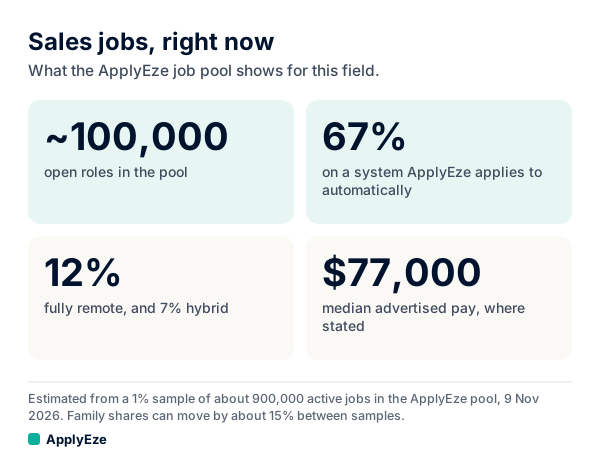
That chart covers all sales roles in the ApplyEze pool: roughly 100,000, from a 1% sample on 9 November 2026, with a median of about $77,000 among postings that state pay. Our data has no separate medical sales row, so do not read it as a device or pharma figure. Roughly 67% sit on systems ApplyEze applies to, and that count relies on connecting an inbox, because Workday and Oracle jobs stay hidden until you do. Those sites email a code.
Workday is also where ApplyEze does the most work. On ApplyEze Autopilot, 12,488 Workday applications went in during the 14 days to 9 November 2026. That was 81.5% of the Workday runs settled in that window, at a median of 4.5 minutes an application. Those are team runs, not a free account's result. Autopilot is set up today for staffing and recruiting teams that work with ApplyEze. If you are job hunting on your own, you can start with 50 free applications on sign-up, no card needed. You pick the matches and queue them in the desktop app, and ApplyEze fills and submits each form.
On that path, a credit is used only when an application is confirmed as Submitted, and the app runs in Chrome while your computer stays on and awake. List each of the titles above as a target, since a role doing your work under a title you did not list ranks low. Code rejects a resume rewrite that adds a figure, employer, school or credential your record does not hold, and a certification the posting asks for is not added unless you hold it. ApplyEze brings the posting's named skills and tools onto your skills line, even when your own record does not list them. There is no step to remove one before a live run, so use a dry run to see what it writes, and be ready to discuss anything on the page. ApplyEze does not take assessments for you, so if an employer sends one, it is yours to do.
Your next step is the choice. Pick device or pharma, build the one-page number sheet, and ask one rep for a day in the field. For the applications themselves, your first 50 are free, with no card, and ApplyEze builds a resume for each posting, which leaves your evenings for the brag book.