
To get a new grad nurse job, run two tracks at once: apply to residency programs inside their fixed windows, and apply to ordinary new-graduate RN postings as they appear. The residency track runs on a calendar that can catch you out. Windows can last one week and may close months before you graduate. Meanwhile, hospital forms ask for a license state and number you may not have yet. This post gives you dated windows from real programs, a backward calendar, the license and compact answers forms need, and a plan for the wait. It covers the application itself, the part a job listing leaves to you.
New grad roles and residency programs
A residency is a paid RN job with a structured first year. One widely used model is the Vizient/AACN Nurse Residency Program, a one-year curriculum of monthly seminars that its 2023 fact sheet says is used by more than 675 hospitals and health systems. The same sheet reports 87.2% retention against a 67.2% national average. Those are the program's own figures, so weigh them as such. If accreditation matters to you, the American Nurses Credentialing Center's PTAP accredits RN residencies for nurses with less than 12 months of experience, and it keeps a list you can search.
Your new-grad status also runs on a clock, and each employer sets it differently:
- Baptist Health in Florida defines a new graduate as licensed for 12 months or less.
- Children's Hospital Colorado wants you graduated within the 12 months before the cohort starts.
- UC Davis Health rules you out if you have ever worked as an RN, and accepts ADN applicants who are enrolled in a BSN program.
An ADN does not always close the door. St. Jude and Children's Colorado ask for a bachelor's, while Baptist gives ASN and ADN hires five years after accepting an offer to earn a BSN.
Application windows and how to track them
These are the windows as we read them on 9 November 2026. They change, so confirm each one on the employer's page. The point of the table is the spread, from one week to all year:
| Employer | Window | Cohort start | Also asks for |
|---|---|---|---|
| St. Jude | May 2027 graduates: Jan 1 to Feb 1, 2027 | End of June 2027 | BSN, GPA 3.2 or higher, transcripts, a reference letter addressed to the program, a statement of 300 words at most |
| Baptist Health, Florida | Oct 26, 2026 to Jan 18, 2027, hiring day Dec 4 | Feb 1, 2027 | Active Florida RN license 2 weeks before start |
| Children's Colorado | August 2027 cohort closes March 5, 2027 | August 2027 | BSN, an application and a questionnaire, cover letter and resume as one file |
| UC Davis Health | One week per posting | See its site | Offer withdrawn without a California license by start |
| WakeMed | Typically Sept to Nov for spring, Jan to March for summer | Spring, summer | Must use the resident posting: staff nurse applications are not considered |
| Saint Alphonsus | Dec 1 and July 1 cycles, with a two-week window for ED, critical care and periop | See its site | Residencies are subject to availability |
| UAMS | Year-round | Three a year | Miss one and you wait for the next cohort |
| Hoag | Any time, as openings post | Monthly | California RN license, AHA BLS |
| VA Houston | Fall 2026: Oct 5 to 23, 2026 | See its site | U.S. citizen, BSN, faculty letter, submitted through a REDCap link |
To track them, keep one spreadsheet row per employer with six columns: opens, closes, cohort start, license deadline, documents, status. Check each career page monthly. Then work backward, since the process can run long. UC Davis says application to offer may take three to five months, with contingent offers typically about five weeks before the start date.
Here is that calendar for a hypothetical May 2027 graduate, using the dates above:
| When | What to do |
|---|---|
| Now to December 2026 | Build the sheet. Ask two faculty members for letters, since St. Jude wants one addressed to its program and VA Houston wants one on letterhead. |
| Before Feb 1, 2027 | Decide whether to complete NCLEX registration now. NCSBN's notice says the fee rises to $350 on that date, the current fee is $200, and the registration date decides which you pay. Ask your board about order first: there are no refunds, and the board must make you eligible within 365 days. |
| Jan 1 to Feb 1, 2027 | St. Jude's window. Upload everything before you submit, because the application "is not accessible after submission". |
| By March 5, 2027 | Children's Colorado's August cohort closes at 11:59 p.m. MST. Both steps must be done. |
| May 2027 | Graduate. Your board makes you eligible, then the ATT arrives. |
| June to July 2027 | Sit the NCLEX. Book it at least eight weeks before your earliest start date (our arithmetic: official results take up to six weeks, plus time for the license to post). |
The cost of a missed window is real. UC Davis says applications cannot be updated after the posting closes, and St. Jude says incomplete applications will not be considered.
License, state and compact questions
This is general information and not legal advice. Boards decide, so confirm with yours.
Forms ask what license you hold, in which state, and whether it is multistate. The choice starts before graduation. NCSBN's factsheet for new graduates says you may apply for licensure by exam in only one state, that it need not be your school's state, and that you can sit the exam at any Pearson VUE site. A multistate license depends on your primary state of residence, not where the hospital is. These rows follow that factsheet's scenarios:
| Your home state | Where you will work | Apply by exam in | What you get |
|---|---|---|---|
| Compact state | Compact state | Your home state | Multistate, if you meet the requirements |
| Going home to a compact state after school elsewhere | That state | That state, not your school's | Multistate, if you meet the requirements |
| Compact or noncompact state, moving | Noncompact state such as California | The noncompact state | Single-state |
| Noncompact state | Compact state | The state where you will work | Single-state, valid only there |
Three checks to run before you commit:
- Is your state really in? The compact's map lists 43 jurisdictions as having enacted it. Pennsylvania implemented on July 7, 2025 and Connecticut on Oct 1, 2025. Massachusetts, Guam and the U.S. Virgin Islands show dates to be determined, with no compact license until full implementation. California, New York, Illinois, Michigan, Minnesota and Oregon are not on the list as of this writing.
- Do your papers match? The compact's FAQ ties residence to documents such as a driver's license, voter registration or federal tax filing, and they must be issued by the same state.
- Do you meet the uniform requirements? The compact's application page lists fingerprint-based state and federal background checks and a valid U.S. Social Security number, among others.
Employers read this differently, which is why the page matters more than the map. St. Jude takes a Tennessee license, or one from your home state if it is a compact state. Children's Colorado takes a Colorado or multistate compact license. UC Davis wants a California license and encourages out-of-state graduates to apply for one at the time of their NCLEX.
If you move to another compact state later, the compact's home page says you must apply there within 60 days.
Credentials and what happens if you lack one
BLS is the common one. Hoag asks for "Current BLS certification awarded by the American Heart Association", and the AHA's eCard lasts two years, so check that yours outlasts your first months on the unit.
Advanced cards follow the unit. Hoag says ACLS, NIHSS, NRP and PALS "are required in specific areas" and must be obtained before the start date. Incredible Health wrote in 2022 that most employers give 3 to 6 months, so the two can disagree. If a posting needs a card you lack, answer "no", add a booked class date where the form allows a note, and ask the recruiter whether that will do.
If you lack the degree or GPA a program sets as its floor, move on to one that takes you. St. Jude prints its floor plainly: 3.2, with 3.5 "strongly preferred".
What hospital forms ask that others do not
Our guide on how to fill out a job application covers general fields. These are the ones specific to this job:
| Field | What to have ready | Watch for |
|---|---|---|
| License state, type, number | Your board's exact record once issued | The number can be checked. Nursys QuickConfirm is a free service that lets employers and recruiters retrieve license and discipline records from participating boards |
| License pending | The state you applied to, your ATT date and test date | If the field is required and numeric, do not invent a number. Contact HR, or use the free-text note if there is one |
| Temporary permit | The permit's type and expiry | Not every employer accepts one, as below |
| Multistate status | Yes only if the license is issued as multistate | Applying in a compact state is not the same as holding the license |
| BLS and other cards | Issuer and expiry month | Name the issuer the posting names |
| Unit or specialty | The units you would truly accept | Saint Alphonsus runs a separate window for ED, critical care and periop |
| GPA and transcripts | A real figure and an unofficial transcript | St. Jude and VA Houston ask for transcripts |
| Assessment | Time set aside | Relias sells video-based assessments for screening and placing nurses before hire, so one may follow the form |
| Background, physical, drug screen | Nothing yet | UC Davis lists these after offer acceptance |
For the resume that goes with the form, see our nursing student resume guide if you are not yet licensed, and our nursing resume guide once you are.
Applying at volume against applying to a residency
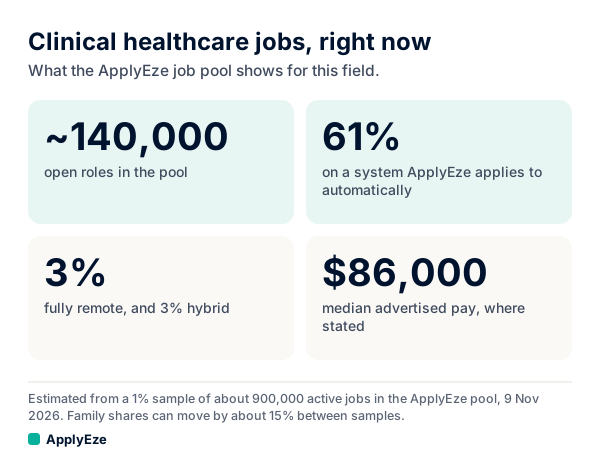
Clinical healthcare is the largest field in our job pool, at roughly 140,000 open roles, ahead of sales at roughly 100,000. These counts come from a 1% sample of about 900,000 active jobs on 9 November 2026, and a field's count can move by about 15% between samples. Roughly 3% are fully remote, so your commute range sets your list. The $86,000 median advertised pay spans every clinical role that states pay, so it is not a new graduate figure.
Roughly 61% of these roles sit on a system ApplyEze applies to, assuming a connected inbox. A residency seat does not work like a posting, so here is how we would split your time:
| Good for a queue | Why |
|---|---|
| Staff RN, clinic and home health postings open to new graduates, on supported systems | Standard forms, and speed matters more than prose |
| Aide or tech roles while you wait for a license | Same reason |
| Do by hand | Why |
|---|---|
| Any residency asking for letters, a statement or a separate questionnaire | St. Jude, VA Houston and Children's Colorado all do, and your own words count here |
| A program with a short, single window | One week at UC Davis leaves no room for a mistake |
| An employer's own portal or link | VA Houston uses REDCap, for example |
| Clinical postings on other systems | The 61% above leaves these to you |
Titles need care. WakeMed will not consider a staff nurse application for its residency, and it wants its "Clinical Nurse, Resident" posting. So list the titles employers use for this, such as new graduate RN, RN resident, nurse resident and clinical nurse I.
ApplyEze takes the queue half. It polls more than 100,000 employer boards directly and has delivered 94,207 applications to 9,769 employers since August. New accounts get 50 free credits, once per email address, with no card. A credit is used only when an application is confirmed as Submitted, and forms that could not be finished cost nothing. You pick the matches from a board ranked on your target titles and each posting's requirements, and queue them in the desktop app, which needs Chrome and your computer on and awake. It covers 12 systems on this path: Greenhouse, Lever, Ashby, Workday, Workable, SmartRecruiters, Oracle, JazzHR, BambooHR, Rippling, Pinpoint and Recruitee. Workday and Oracle jobs stay hidden until you connect an application inbox, because those sites email a code. Across all fields, it applies on systems holding roughly 62% of the jobs we track with an inbox, and roughly 23% without one.
A hospital form turns on your license status and GPA, so save those first. Hard facts come from your profile. When a required question is not covered by your saved answers, ApplyEze still fills it rather than stopping the run, so that answer may not come from you. Fill in your saved answers, use dry run first, and read your receipts. A certification the posting asks for is not added unless you hold it. ApplyEze brings the posting's named skills and tools onto your skills line, even when your own record does not list them. There is no step to remove one before a live run, so use a dry run to see what it writes, and be ready to discuss anything on the page. ApplyEze does not take assessments for you.
What to do while your license is pending
- Protect your ATT. NCLEX's FAQ says you must test within its dates, the average length is 90 days, and the dates "cannot be extended for any reason". Miss them and you reregister and pay again.
- Learn each employer's deadline. Baptist wants an active Florida license 2 weeks before the start date. WakeMed says licensure must be listed on the board's website before the start date. St. Jude allows 120 days from hire to pass. Children's Colorado makes employment contingent on passing and holding a Colorado or multistate license.
- Do not assume a permit counts. Texas gives a GN up to 75 days, not renewable, under the direct supervision of an RN, with no charge or supervisory role. A failing result ends it, and you must tell your employer immediately. UC Davis says of California's interim permit: "UC Davis Health does not accept Interim Permits."
- Keep your status line current. Change it on your resume and in your saved answers the day it moves.
- Earn while you wait, within the law. An aide or tech job keeps you on a unit. Do not use the RN title in it.
- Have a next window ready. If you miss a cohort, expect what UAMS says: you wait for the next one. Since new-grad status can expire at 12 months, keep the sheet going until you start.
Your next step is the spreadsheet: one row per employer, started this week. When the staff RN, clinic and tech postings pile up beside it, your first 50 applications are free, with no card, and ApplyEze builds a resume for each posting, which leaves your evenings for the residency essays that need you.