
A nursing student resume has a job that a licensed nurse's resume does not: it has to show what you can do before anyone can look you up in a license database. Build it around three things a recruiter can check. List clinical rotations by unit and hours, write one plain line that names your exact stage in the NCLEX process, and show the cards you hold today. This post gives you a status line for every stage from first semester to license issued, a rotation format to copy, and two labelled samples. Once your license is issued, move to our nursing resume guide.
What a nursing student resume must prove
A recruiter reading a student's page is working through four questions:
- Can you legally do this job on this date? For an aide or tech role, that means your program status and, in some settings, a nurse aide listing. For an RN role, it means your license date.
- What have you actually touched? Units, patient populations and hours.
- Will you be there? Your graduation date, your remaining clinical schedule and the shifts you can work.
- Is the paperwork in order? Mostly, that means BLS.
Paid nursing experience is not on that list, because nobody expects it. The two mistakes we would fix first are vagueness ("clinical rotations at various hospitals") and overreach ("BSN, RN" in the header in March, before graduation).
Clinical rotations: the core of the page
Pepperdine's career office calls this the most essential part of a new grad resume, and its instruction is short: "Clearly list the unit (e.g., Telemetry, Psych, Pediatrics), the hospital system, and the number of hours completed." Here is a format that does that, with placeholders:
CLINICAL ROTATIONS
Capstone Preceptorship, Telemetry, 28-bed unit, [Hospital System]
[Term Year], 180 hours
- Carried [3 to 4] patients under one RN preceptor by week [6]
- Interpreted telemetry strips with the preceptor and escalated changes
- Completed admission and discharge teaching, charted in [system]

Adult Med-Surg, [Hospital], [Term Year], 90 hours
Pediatrics, [Hospital], [Term Year], 45 hours

SIMULATION AND SKILLS LAB (not patient care)
[School] simulation center, [Term Year], 24 hours
The rules that make it hold up:
- Name the unit, not the course. "NUR 340" tells a hiring manager nothing. "Telemetry" tells them your exposure.
- Take hours from your program's log. If the program reports hours by course, ask your clinical coordinator for the split by unit instead of estimating.
- Keep simulation apart. It is useful, and it is not the same as patient care hours. If you state a total, add the lines first and make sure they match it.
- Order by relevance, after the capstone. Applying to a pediatric unit, move pediatrics up even if it was your second semester.
- Be exact about who did what. You worked under an instructor or preceptor, and saying so reads as maturity, not weakness.
- Keep patients out of it. No names, room numbers or stories that could identify someone.
The same material, weak and strong. These lines are samples written for this post:
| Weak | What is missing | Stronger |
|---|---|---|
| Completed clinical rotations at [Hospital] | Unit, hours, scope | Adult med-surg, 32-bed unit, [Hospital], 90 hours |
| Provided excellent patient care | Anything checkable | Assessed and charted on 2 to 3 post-operative patients per shift under RN supervision |
| Administered medications | Your level of independence | Gave oral and IM medications with instructor co-sign |
| Proficient in Epic | A student's real access | Charted in Epic on two rotations with student access |
Stating license and NCLEX status
NCSBN's 2026 candidate flyer lays the path out in eight steps: apply to one nursing regulatory body, register and pay, receive an acknowledgement, get made eligible by the board, receive the Authorization to Test (ATT), schedule, sit the exam, and receive official results from the board, usually within six weeks. Your resume line should name the last step you actually finished. Each line below is a sample with placeholders:
| Where you are | Write this | Not this |
|---|---|---|
| More than a year from graduating | BSN expected May 2029, with no license line at all | RN candidate |
| Final year, nothing filed | BSN expected May 2027. NCLEX-RN planned after graduation | NCLEX scheduled |
| Applied to your board and registered | Licensure by exam application filed, [State] Board of Nursing, [Month Year] | License pending, before anything is filed |
| ATT in hand | Authorization to Test received. NCLEX-RN scheduled [Month Year] | NCLEX-eligible, with no date |
| Tested, waiting | NCLEX-RN taken [Month Year], result pending | NCLEX-RN passed |
| Quick Results shows a pass | NCLEX-RN passed (unofficial result), [State] license pending | RN |
| Temporary authorization issued by your board | GN temporary authorization, Texas Board of Nursing, valid through [date] | RN |
| License issued | The license line from our nursing resume guide |
Two of those rows need a word of explanation.
Quick Results. NCLEX's FAQ says official results come only from the boards. Where a board takes part in the Quick Results Service, you can pay to see an "unofficial" result 48 hours after your exam. So label it unofficial.
The letters RN are protected. This is more than a style point. Texas law bars anyone without a license from using "Registered Nurse", "Graduate Nurse" or "R.N." with their name. California's code makes it unlawful for anyone not licensed or certified to use "registered nurse", "R.N." or the words "graduate nurse". Texas also has a temporary authorization for a GN, which is why that row applies only if your board has issued one. Other states have their own wording, so read yours. Until then, your header is your name, plus BSN once the degree has been conferred.
Name the right state, too. NCSBN's factsheet for new graduates says you may apply for licensure by exam in only one state, and it need not be the state your school is in. Leave "multistate" off until a multistate license exists. Our new grad nurse job guide covers how to choose the state.
A status line need not cost you. UC Davis Health says you may apply to its residency "without having sat for or passed the NCLEX", as long as you have proof of passing by the program start date. St. Jude asks you to pass within 120 days of hire. These programs expect a status line.
Certifications forms ask for
Postings name the issuer, and a card only helps if it is still valid on your start date, so give both on the resume and keep the same two facts ready for the form.
BLS is the one to have. The American Heart Association
says its BLS course is built for healthcare professionals and for "individuals enrolled
in a healthcare training program". The eCard is valid for two years, and each option
listed includes a hands-on skills portion. Employers often name the issuer:
Grady's extern program
requires AHA BLS, and Tanner's takes current
BLS or one obtained within 30 days of hire. Write it as
BLS Provider, American Heart Association, expires [MM/YYYY].
Check the date against your start date, not today. A card earned in August 2025 runs out around August 2027 (our arithmetic), which can land in the first weeks of a residency for someone graduating in May 2027.
ACLS and PALS can usually wait. Hoag says advanced certifications "(e.g., ACLS, NIHSS, NRP, PALS) are required in specific areas". Incredible Health, a nurse hiring marketplace, wrote in 2022 that most employers give 3 to 6 months after starting a role that needs one. That is one company's general statement and not a rule, so read each posting. Our advice is not to pay for either one until a posting for a unit you want names it.
List only what you hold. If you hold a nurse aide listing, include it with the state and expiry. If a class is booked, say "BLS class booked [Month Year]" instead of listing the card.
Sample: first-year student applying for a tech role
Extern programs usually ask for more than a first-year has. Tanner wants "at least one clinical rotation", and Grady is for rising seniors or soon-to-graduate students with a minimum 3.0 GPA. So the realistic first-year targets are aide, tech and unit support roles, with externships a year later. This sample is written for this post and is not a real person's resume:
[FIRST LAST]
[City, State] | [phone] | [email]
First-year nursing student seeking a part-time patient care technician role.
Available weekends and [school break dates].

EDUCATION
Bachelor of Science in Nursing, [University], expected May 2029
Coursework: anatomy and physiology, fundamentals of nursing. GPA [3.6]

CERTIFICATIONS
BLS Provider, American Heart Association, expires [MM/YYYY]

SKILLS LAB (not patient care), [Term Year], 30 hours
Checked off: vital signs, manual blood pressure, transfers with gait belt,
bed bath, isolation precautions

WORK EXPERIENCE
Shift Lead, [Cafe], [City]                                   [Year] to present
- Trained 4 new staff on food safety and closing procedures
- Worked 20 hours a week alongside a full-time course load

VOLUNTEER
Front Desk Volunteer, [Hospice], 60 hours                    [Year]
- Greeted families and guided visitors during end-of-life visits
Why it is built this way: tech roles run on shifts, so availability goes in the first lines. The lab section stands in for clinicals and says plainly that it is lab work. The cafe job stays because it shows that you turn up and can train people. Our guide to a resume for your first job covers what else can stand in for experience.
Sample: new graduate, license pending
Also written for this post, with placeholder names and figures:
[FIRST LAST], BSN
[City, State] | [phone] | [email]

LICENSE STATUS
Authorization to Test received, [State] Board of Nursing.
NCLEX-RN scheduled [Month Year]. Available to start [Month Year].

CERTIFICATIONS
BLS Provider, American Heart Association, expires [MM/YYYY]

EDUCATION
Bachelor of Science in Nursing, [University], May 2027. GPA [3.5]

CLINICAL ROTATIONS
Capstone Preceptorship, Telemetry, 28-bed unit, [Hospital], Spring 2027, 180 hours
- Took a full preceptor assignment of [4 to 5] patients by week [8]
- Recognized a change in rhythm and escalated through the unit's process
- Gave discharge teaching with teach-back, charted in [system]

Critical Care, [Hospital], Fall 2026, 90 hours
Pediatrics, [Hospital], Spring 2026, 90 hours
Labor and Delivery, [Hospital], Spring 2026, 90 hours

WORK EXPERIENCE
Patient Care Technician, Emergency Department, [Hospital]    [Year] to [Year]
- Took vitals, EKGs and point-of-care glucose in a 40-bed ED
Why it is built this way: the status block comes first and carries a start date, which is what a recruiter is actually looking for. The tech job sits below the rotations because the rotations are closer to the RN role. Include GPA only if it helps or if the program sets a floor: St. Jude's, for example, is 3.2 or higher.
Update the line the day your status changes, and do it before you submit. UC Davis says applications cannot be updated after the posting window closes.
Applying in clinical healthcare: what is different
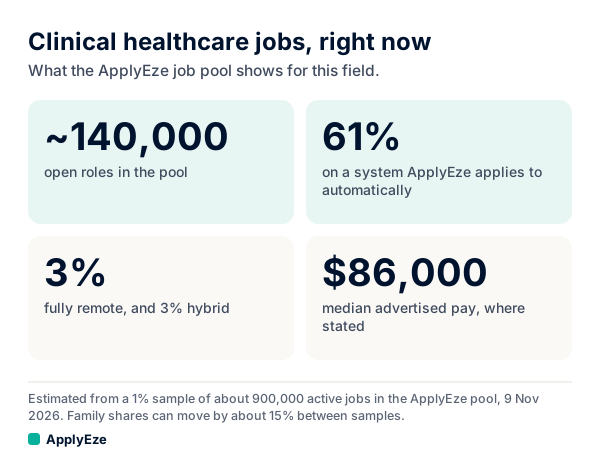
Clinical healthcare is the largest field in our job pool: roughly 140,000 open roles, estimated from a 1% sample of about 900,000 active jobs on 9 November 2026. Family counts can move by about 15% between samples. Roughly 3% of those roles are fully remote, so your location decides most of what you can apply to. The $86,000 median advertised pay in the chart covers every clinical role that states pay, including many that need a license you do not hold, so read it as the field's figure and not a student wage.
Two things follow for a student:
- Titles scatter. The same work appears as nurse extern, student nurse, nurse tech, patient care technician and nursing assistant. Search all of them. Our post on target job titles shows why the list matters.
- Timing is tight. One extern page we read says it hires in the spring and fall, and residency windows can be far shorter. Check the page for each hospital you want.
Aide and tech roles at many employers are where the typing adds up, and that is the part ApplyEze takes on. It polls more than 100,000 employer boards directly, and roughly 61% of clinical roles in our sample sit on a system it applies to. That share includes Workday and Oracle jobs, which stay hidden until you connect an application inbox, because those sites email a code. You pick matches from a board ranked on your target titles and the requirements it reads out of each posting, and queue them in the desktop app, which runs in Chrome while your computer stays on and awake. A program that wants letters and a personal statement is yours to write, and it should be.
For each application, an AI model reads that posting and your real history and writes a resume for it. Your employers, job titles, dates, schools, degrees and certifications come from your own record, and a certification the posting asks for is not added unless you hold it. ApplyEze brings the posting's named skills and tools onto your skills line, even when your own record does not list them. There is no step to remove one before a live run, so use a dry run to see what it writes, and be ready to discuss anything on the page.
Hard facts come from your profile. When a required question is not covered by your saved answers, ApplyEze still fills it rather than stopping the run, so that answer may not come from you. Fill in your saved answers, use dry run first, and read your receipts. Your GPA and license status belong in those answers.
Your next step is the status line. Write the one that matches where you stand today, then build the rotation block around it. If you would rather spend your evenings on clinical paperwork than on retyping it into forms, your first 50 applications are free, with no card, and a credit is used only when an application is confirmed as Submitted.