

How to get a software engineer job comes down to treating the search as a funnel, because each stage fails for a different reason and needs a different fix. Across Ashby's customers, 3.6% to 4.7% of applications reach an interview, and offer conversion for technical roles was 7.3% in the first quarter of 2026. In a 2026 survey, tech job seekers reported 103.7 applications over a 9.7 month search. Below, we run that arithmetic so you can use it on your own numbers, then go stage by stage, using 155 live software engineer application forms we read on 9 November 2026 to show what employers ask for today.
The funnel, in numbers
| Stage | Figure | Source | What it really measures |
|---|---|---|---|
| Application to interview | 3.6% to 4.7% | Ashby, April 2026 | All applications at Ashby's customers. The range is "depending on role type", and the page does not say which type is which |
| Offer conversion, technical roles | 7.3%, Q1 2026 | Ashby | The share of interviewed candidates who reach an offer |
| Interviews hosted per hire, technical | 17.6 (engineering 17.9) | Ashby | All candidates interviewed for one hire, not one person's rounds |
| Application to accepted offer, technical | 40 day median | Ashby | Three quarters of hires fall inside 57 days. Q2 and Q3 2025 |
| Applications sent, tech job seekers | 103.7 on average | United Way NCA, May 2026 | 1,000 US job seekers, self-reported from memory, with a 9.7 month search and 69.9 hours spent applying |
Multiply Ashby's rates and you get the employer's view (our arithmetic): 1 / (0.036 x 0.073) is about 380 applications per offer, and 1 / (0.047 x 0.073) is about 291. That covers the whole pile, including people who were never close to qualified. Ashby's own headline for all roles is 291 applications per hire. The survey's 103.7 sits far below that, which is what you would expect from people applying to jobs they thought they could do, though it is also memory rather than a count. Neither is a quota. Our post on how many applications it takes traces where the popular figures come from.
The useful version replaces those rates with yours. Applications per offer is 1 divided by (your interview rate times your offer rate):
| Your interview rate | At 7.3% to offer | At 15% to offer | At 25% to offer |
|---|---|---|---|
| 2% | 685 | 333 | 200 |
| 4% | 342 | 167 | 100 |
| 8% | 171 | 83 | 50 |
The 7.3% column is Ashby's average. The other two are illustrations, not measurements. The table says two things. Doubling either rate halves the applications you need, so an hour of interview practice and an hour of resume work compete for the same result. And the rates are noisy. At 7.3% per process, treated as independent, the chance of at least one offer is 32% after 5 processes, 53% after 10 and 78% after 20 (our arithmetic). Five rejections in a row tell you very little.
Use your tracker to find the stage that is actually failing:
| What your last 50 applications show | Likely problem | First thing to change |
|---|---|---|
| Zero or one human reply | Titles, level or resume | Read the years line before applying, then fix the resume |
| Assessments arrive, then silence | The assessment | Timed practice, before you send more applications |
| Recruiter calls that stop there | Level, pay or location mismatch | Ask the recruiter what the role needs, and adjust your targets |
| Final rounds with no offer | Design and behavioral rounds, or plain odds | Mock interviews, and more processes running at once |
Where applications really go
ApplyEze polls more than 100,000 employer boards directly, and a 1% sample of that pool on 9 November 2026 puts software engineering at roughly 20,000 open roles out of about 900,000 active jobs. Roughly 24% are fully remote and roughly 10% hybrid, against 8% and 8% across the whole pool. The median advertised pay is $161,000, among postings that state one. A second sample moved field shares by up to about 15%, so read all of this as rough.
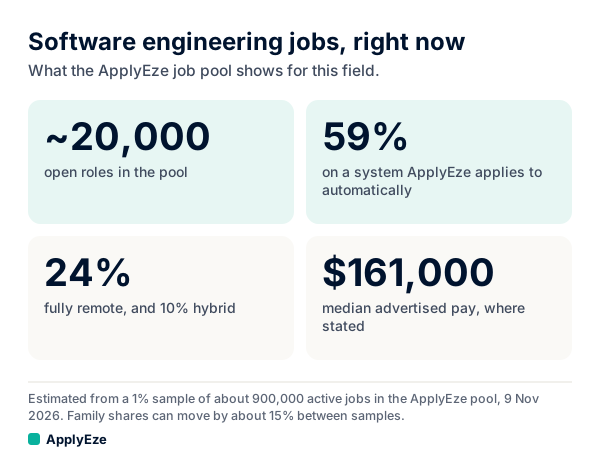
Three practical readings:
- A remote-only search throws away about three quarters of the field. If you can move or commute, say so and search both ways.
- The words "software engineer" miss part of the work. Our data counts backend, frontend and DevOps as separate fields, each a few thousand roles. List those titles too if you do that work.
- Advertised pay is not what people earn. The Bureau of Labor Statistics puts the median wage for software developers at $135,980 in May 2025, and projects 10% employment growth from 2025 to 2035. Our $161,000 is the midpoint of ranges on the postings that publish one, a different and narrower thing.
Online assessments: plan for them
Treat the coding test as a calendar entry, not a surprise. In a plain text search of the 155 postings we read, only 3 warned of one, and all 3 came from the same employer, Betterment, which says it "may ask you to complete a case study exercise or technical assessments". So the posting will rarely tell you.
The inbox tells you fast. In the application inboxes of about 29 candidates at one staffing team using ApplyEze, machine labels found 465 assessment invitations in email received from 4 October to 8 November 2026. Of the 279 tied to a specific application, the median arrived 0.2 hours after applying, about 12 minutes, and 81.7% arrived within 72 hours. Screening calls took a median of 98.1 hours, and interviews 126.8.
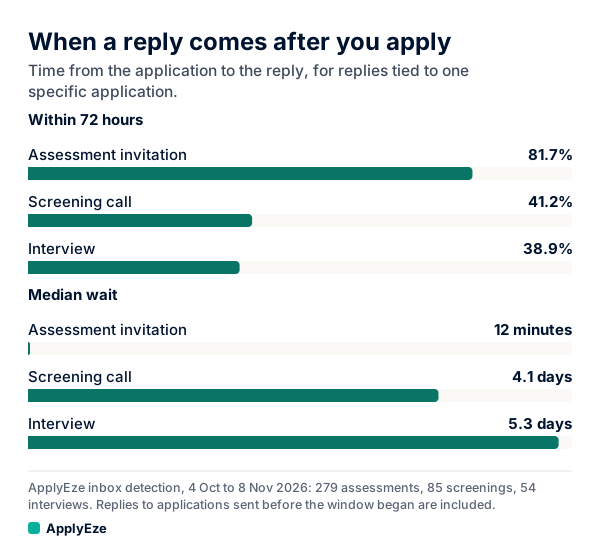
These are machine labels across all fields at one team, no person reviewed them, and recent applications had less time to draw a reply. The inbox scanner behind them is rolling out with staffing teams first and is not part of self-serve accounts yet.
The mechanism is simple: most of these invitations are sent automatically by the application system, so the test can come before any human has judged you. Our CodeSignal guide links that vendor's integrations with Greenhouse, Lever and Workday. What to do about it:
- Block 90 minutes within three days of every batch you send. That window catches most invitations in the data above.
- Read the deadline, then do not rush. CodeSignal's default is 14 days, and each company can change it, so the date in your email is the one that counts. If you miss it, you have to ask the recruiter for a new invitation, and CodeSignal says one is not assured.
- Log assessments as their own stage. If you pass few of them, more applications only produce more tests you will not pass. Fix this first. The same guide has a two-week plan.
GitHub and portfolio fields on forms
We read the application forms for 155 software engineer postings with a US location, through Greenhouse's public job board API, on 9 November 2026, at most three per company, from 59 companies. It is one application system, it leans to technology companies, and a form can change tomorrow. This is what they asked for:
| Field | On the form | Marked required |
|---|---|---|
| 152 | 41 | |
| Resume | 155 | 135 |
| Sponsorship question | 133 | 128 |
| Cover letter | 132 | 0 |
| Website or portfolio | 93 | 0 |
| A question about AI | 25 | 25 |
| A field naming GitHub | 21 | 2 |
| A written "why us" question | 12 | 8 |
The two required GitHub fields are one employer's catch-all box, "Professional Profile (LinkedIn, Github, Website, etc)", which any of those satisfies. No form in the sample demanded GitHub by itself. And 56 of the 155 had no box for GitHub or a website at all, so the link also has to live in your resume header. For when the field is optional:
| What your GitHub shows today | What to do |
|---|---|
| Two or three pinned repos with READMEs, and activity in the past year | Fill it, and use the Website box if there is no GitHub box |
| Merged pull requests in a public project | Link the pull request list rather than the profile |
| Coursework, forks and tutorials | Leave it blank, and link a project once you have one |
| Your real work is private at an employer | Leave it blank, and say so in a resume line. Never link code your employer owns |
That table is judgment, and the argument is about cost: an optional blank asks nothing of a reviewer, while a thin profile is something they can see. The cover letter has its own answer, since no form here required it.
Interview rounds
The sequence usually runs from an online coding assessment early on, to a phone screen in a shared editor, to an onsite of several rounds covering coding, system design and behavior, with system design mainly for mid-level and senior candidates. It varies by employer. Ashby says technical hiring averages nearly twice the interview hours of business roles and one more interview event, and that one extra round adds roughly a week.
The clock matters more than the count. A median of 40 days to an accepted offer means a process you start today likely runs about six weeks. At 7.3%, one offer takes about 14 processes on average. Run one at a time, that is roughly 550 days (our arithmetic, and an overstatement, since rejections come sooner than offers). So keep applying while you interview.
Rules on AI now show up in the form itself, and they conflict. Waymo "prohibits the use of unauthorized outside assistance during the interview process", naming AI tools. Duolingo requires an answer to "How has AI changed the way you approach your work?" Block says acceptable use "may differ depending on the role" and suggests confirming with your recruiter. Across the sample, 25 forms from 11 employers carried a required question about AI, whether asking how you use it, setting rules for interviews or disclosing the employer's own use. And 50 postings from 26 employers mentioned AI coding tools or AI-assisted work. So keep one true sentence ready about how you use these tools, and ask the recruiter the rule before each round.
New grads and experienced engineers
We also counted every US software engineer title on the 83 company boards we could read that day, 860 in all:
| Title signal | Titles | Share |
|---|---|---|
| Senior, staff, principal or lead | 663 | 77% |
| No level in the title | 168 | 20% |
| Early-career words | 29 | 3% |
Of those 29, 18 were internships, which leaves 11 full-time early-career titles. Among the 134 sampled postings that stated years of experience, the median minimum was 5, by a rough text match. One system on one day cannot describe the whole market, and campus hiring runs in seasons, but the direction is hard to miss. For wider context, the New York Fed puts unemployment among recent college graduates at 5.2% for the third quarter of 2026, across all majors.
If you are a new grad, the 168 titles with no level are where to look, and only the years line tells you which are open to you. Search for dated titles such as "2027" and "early career", since those are how the programs we saw were named. Assessments screen before anyone reads your resume, so practice is worth more here than for anyone else. Two linked projects you can explain will carry more than a long skills list.
If you are experienced, most of the market is at your level, and a resume rarely stops you for long. The stage most likely to fail is design and level calibration, so spend your time there. Ask the recruiter early how the role is leveled and what the pay band is, because a mismatch can take six weeks to discover.
Clearances are a separate gate. Only 1 of the 155 postings mentioned one, though the sample holds few defense employers. If you apply in that sector, read for it before you start the form.
How to spend your applications
Huntr, which sells job search tools, publishes the most useful outside data on this in its Q3 2026 report. Its users log their own applications and interviews.
- Channel. Employer career sites converted at 6.0%, application system pages at 4.8% and job boards at 3.4%. Among 5,855 people who used both, it was 6.2% on employer sites against 4.9% on job boards.
- Volume. When the same 4,456 people ran at three or more times their usual pace, their interview rate fell from 9.5% to 5.6%, and interviews per month rose from 0.7 to 2.9. Their busiest weeks averaged 17.5 applications. More volume brought more interviews and a lower rate. That is observational.
- Repeat applications. Eight or more applications to one company converted at 2.4% each against 5.9% for a single one, but the chance of at least one interview there rose from 5.9% to 17.7%.
A sample weekly budget of 20, a starting point rather than a measured recipe:
- 4 you care about most. Tailor by hand and ask someone inside for a referral first.
- 12 solid fits. Apply on the employer's own site, where your years and stack match the posting.
- 4 neighboring titles. Try backend, platform or whichever adjacent name fits, to learn which title draws replies.
Skip postings asking for several years more than you have, and any clearance you do not hold. Recount your rates every two weeks and move the budget toward what is answering.
If form time is what limits you, that is the work ApplyEze does. It has delivered 94,207 applications to 9,769 employers since August, counted on 9 November 2026. You pick matches from a ranked board and queue them in the desktop app, which fills and submits each form in Chrome on your computer while it stays on and awake. It applies automatically on systems holding roughly 62% of the jobs we track with an inbox connected and roughly 23% without, because Workday and Oracle sites email a code. For the software roles in the chart above, the figure is roughly 59%.
For each posting, it writes a resume from your real history, and code rejects a rewrite that adds a figure, employer, school or credential your record does not hold. An audit of 84 sampled resumes on 4 November 2026 found 0 invented employers, dates, degrees or numbers. ApplyEze brings the posting's named skills and tools onto your skills line, even when your own record does not list them. There is no step to remove one before a live run, so use a dry run to see what it writes, and be ready to discuss anything on the page. A clearance is never claimed, and a certification a posting asks for is not added unless you hold it. Hard facts come from your profile. When a required question is not covered by your saved answers, ApplyEze still fills it rather than stopping the run, so that answer may not come from you. Fill in your saved answers, use dry run first, and read your receipts. Some employers ask applicants not to use AI or automation, and whether to apply there is your call.
Two things stay yours. List backend, platform and every other title you would take, because a role doing your work under a title you did not list ranks low. And keep that 90-minute block on your calendar, because ApplyEze does not take assessments for you. If you would rather spend your evenings on system design than on application forms, your first 50 applications are free, once per email address with no card, and a credit is used only when an application is confirmed as submitted.