

To get into compliance, choose the branch first. Healthcare compliance, financial crime and corporate programs hire from different feeder jobs, answer to different rulebooks and reward different credentials. Even the order of steps differs. CAMS counts education and training toward its 40 eligibility credits, so it may be open to you before a first compliance job. The standard route to CHC and CCEP asks for a year in a full-time compliance role or 1,500 hours of compliance duties first. The Bureau of Labor Statistics counts about 436,400 compliance officers in 2025, with a median of $80,730 in May 2025, and says some employers prefer a legal background or auditing experience. So most people arrive sideways. This guide shows from where, and which public document to read before you interview.
Which compliance do you mean
Each branch has a document that defines what good looks like. Most career guides skip these, and they are free. The feeder jobs and first titles below are our reading of the field. The rulebooks and credentials are linked in the sections that follow.
| Healthcare | Financial crime | Corporate | |
|---|---|---|---|
| Rulebook to read | HHS-OIG General Compliance Program Guidance, 2023 | Bank AML program rule, 31 CFR 1020.210 | DOJ Evaluation of Corporate Compliance Programs, 2024 |
| Feeder jobs | Coding and billing, nursing, health information, clinical audit | Bank operations, fraud, customer onboarding | Paralegal, internal audit, HR, legal operations |
| First titles | Compliance coordinator, compliance auditor, privacy coordinator | KYC analyst, transaction monitoring analyst, AML investigator | Compliance analyst, third-party due diligence analyst, ethics program coordinator |
| Credential | CHC | CAMS | CCEP |
| Before the job? | Usually after, or through an accredited university program | Possibly, if your credits reach 40 | Usually after, or through an accredited university program |
If you meant environmental or safety compliance, this map does not fit. BLS notes that specialties involving asbestos or other hazardous substances may require a state-issued license, so check your state first.
Healthcare compliance
The Office of Inspector General at HHS published its General Compliance Program Guidance on 6 November 2023. It describes itself as voluntary guidelines and tips, and it is organized around seven elements: written policies and procedures, compliance leadership and oversight, training and education, open lines of communication, standards and consequences, risk assessment with auditing and monitoring, and responding to detected offenses with corrective action. Learn those seven. They are the vocabulary of the job.
One passage changes how a career changer should write a resume. According to the Crowell summary, the compliance officer should not "lead, report to or advise the legal or financial departments", and should not be responsible for "billing, coding, or claim submission". That is aimed at the top role, but it shows how the function thinks about independence. Coding and billing are strong feeder jobs, and they are also what you are expected to step away from. So do not describe producing claims. Describe checking them.
Sample: Audited 240 outpatient claims a quarter against payer rules. First-pass error rate fell from 8.1% to 3.4% in a year, and I wrote the education notes sent to the coding team.
The CHC math. The eligibility article from SCCE and HCCA offers two options. Option one is a year in a full-time compliance role or 1,500 hours of direct compliance duties, within the two years before you apply, plus 20 approved CEUs, at least 10 of them live, earned in the 12 months before the exam. Option two is an accredited university compliance program, which meets the work requirement for 24 months after you finish and the CEU requirement for 12.
The hours route is the interesting one, because your title does not have to say compliance if your duties match the exam's content outline. Here is the arithmetic (ours):
- 1,500 hours at 20 hours a week is 75 weeks, about 17 months. That fits the window.
- At 15 hours a week it is 100 weeks, just inside two years.
- At 10 hours a week it is 150 weeks, which does not fit.
So you need roughly 15 hours a week of real compliance duties, sustained. That is a specific thing to ask your current manager for. Confirm your plan against the candidate handbook before you count on it, since the article says requirements vary slightly by certification.
Financial crime and AML
This branch exists because of a legal requirement. A bank's anti-money laundering program must include, under 31 CFR 1020.210, internal controls, independent testing, a designated person "responsible for coordinating and monitoring day-to-day compliance", training for appropriate personnel, and risk-based customer due diligence. First jobs sit underneath that designated person: reviewing alerts, onboarding customers and writing up cases.
The rule may change. In April 2026 FinCEN and the OCC, FDIC and NCUA proposed new program rules, with comments due by 9 June 2026 and an effective date 12 months after final rules are issued. We found no final rule when we checked on 9 November 2026. Being able to explain the proposal in an interview marks you as someone who reads the source.
CAMS. ACAMS's 2026 factsheet lists active membership and 40 eligibility credits, based on education, experience, certifications and training. The exam is 120 multiple-choice questions in 3.5 hours. The package is listed at US$2,095 for the private sector and US$1,595 for the public sector. Its target titles include KYC analyst, internal auditor and MLRO/BSA officer. That is a lot to spend before you have a job. Check your credit count with ACAMS before you pay, and if you are about to be hired, ask whether the employer pays.
A resume trap unique to this branch. Federal rules say no bank, "and no director, officer, employee, or agent of any bank, shall disclose a SAR or any information that would reveal the existence of a SAR." A suspicious activity report is not a war story. Keep your lines to your own workload and how you did it, and never give anything about a subject or a specific case. If you are unsure about even a count, ask your compliance officer or leave it out.
Sample: Cleared about 35 transaction monitoring alerts a day across retail accounts. Tuned 2 scenarios with the model team, which cut false positives by a fifth over one quarter.
Corporate compliance programs
The Department of Justice tells prosecutors how to grade a company's program, and it publishes the guide. Its Evaluation of Corporate Compliance Programs, updated September 2024, rests on three questions:
- "Is the corporation's compliance program well designed?"
- "Is the program being applied earnestly and in good faith?" In other words, is it adequately resourced and empowered?
- "Does the corporation's compliance program work in practice?"
Those three questions are good interview material. When someone asks why you want this work, you can talk about how a program proves it works, which is more than most applicants will say. The document also names the risks prosecutors look at: "the location of its operations, the industry sector", "use of third parties, gifts, travel, and entertainment expenses, and charitable and political donations", and new technology. Those lists are a fair guide to where junior people start, in third-party due diligence, gift and travel registers, training tracking and hotline intake.
CCEP uses the same eligibility framework as CHC, so the arithmetic above applies.
Here is how to name what you already do in program terms. Every sample line is invented.
| What you do today | Program element | Sample line |
|---|---|---|
| Keep procedures current | Written policies | Rewrote 14 department procedures after a regulatory change and tracked sign-off to 100% |
| Run annual training | Training and education | Ran annual training for 600 staff, 97% complete by the deadline, with follow-up for the rest |
| Take complaints or tips | Lines of communication | Logged and routed 85 employee concerns in a year, with a median of 3 days to first response |
| Pull samples for QA | Auditing and monitoring | Tested 60 expense reports a quarter against policy and reported the exception rate to the controller |
| Fix what a review finds | Corrective action | Closed 11 audit findings with named owners and evidence of the fix |
For the wider case for a move like this, our career change guide covers how to frame it. If numbers and controls appeal more than rules, getting into finance is the neighboring path, and cybersecurity's GRC route is the technical one.
Paralegal and bar lines on a resume
Paralegals have a real reason to look here. BLS projects little or no change in paralegal jobs from 2025 to 2035, partly because AI and other technology make paralegals more efficient, with about 40,800 openings a year that mostly replace people who leave. It reports a median of $62,890 in May 2025. For compliance officers it projects 4% growth and about 32,700 openings a year. These are different groups, so the gap is not what you would personally gain.
Legal credentials are also where precision matters most, because this is a field of people who check. "Certificate" and "certified" are not the same word. BLS treats a paralegal studies certificate as education and professional certification as a separate step. NALA's credential is the Certified Paralegal (CP). The bar table below is our advice on plain wording. It is not a rule from any bar.
| Your status | Write | Avoid |
|---|---|---|
| Paralegal certificate | Paralegal Studies Certificate, [School], 2024 | "Certified Paralegal" |
| NALA credential held | Certified Paralegal (CP), NALA, 2025 | "CP" alone on a skills line |
| Admitted, active | Admitted: New York (active) | Your bar number, unless the form asks |
| Admitted, inactive | Illinois bar, inactive status | "Licensed attorney" |
| J.D., not admitted | J.D., 2025. Not admitted to practice | "Esq.", "Attorney" |
| Exam taken, awaiting results | Bar exam taken July 2026, results pending | "Admitted, pending" |
If you want a compliance job and hold a law degree, say what you want. "J.D. seeking compliance analyst roles" heads off the question of whether you will leave at the first legal offer.
What the numbers say about the field
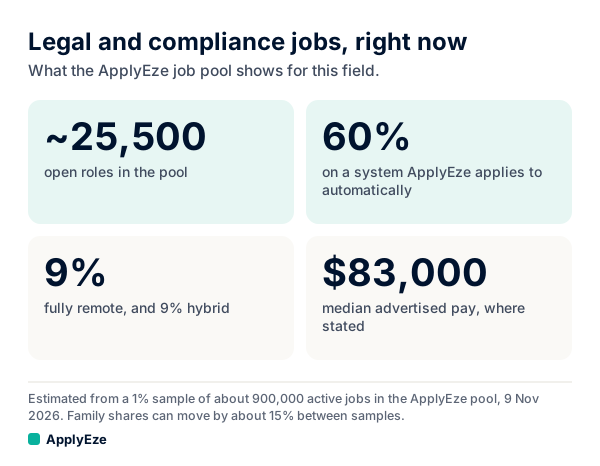
ApplyEze polls more than 100,000 employer boards directly, and the chart shows what that pool held in a 1% sample on 9 November 2026: roughly 25,500 open legal and compliance roles, from 254 sampled rows. About 9% were fully remote and another 9% hybrid (23 rows each), so most of this work is on site. Roughly 60% sat on a system ApplyEze applies to. The median advertised pay was about $83,000.
Read that pay figure loosely. Only about 15% of all postings state pay, a second sample differed by up to about 15% per family, and this family combines legal and compliance work. It happens to sit near the BLS compliance median, but the two count different groups. It tells you what these postings advertise, and it does not tell you what a first analyst job pays.
How to apply in this field
Compliance work hides under many titles, so your list of titles does more than you would expect. Depending on your branch, try these.
- Healthcare: compliance coordinator, compliance auditor, privacy analyst, coding auditor, clinical documentation auditor.
- Financial crime: KYC analyst, AML analyst, transaction monitoring analyst, fraud analyst, BSA analyst.
- Corporate: compliance analyst, ethics and compliance specialist, third-party risk analyst, regulatory analyst, internal audit associate.
Read each posting for the rulebook it names, and borrow that wording where it describes your real work. Our resume keywords guide shows how to do that without stuffing.
Titles are also how ApplyEze finds your roles. It ranks on your target titles and the requirements it reads out of each posting, and a role doing your work under a title you did not list ranks low. So list several, in order, because the first listed ranks first. Across all the jobs we track, it applies automatically on systems holding roughly 62% of them with an application inbox connected and roughly 23% without, since Workday and Oracle jobs stay hidden until you connect one. It has delivered 94,207 applications to 9,769 employers since August, counted on 9 November 2026.
This field reads closely, so here is what goes on the page. Your employers, job titles, dates, schools, degrees and certifications come from your own record, and code rejects a rewrite that adds a figure, employer, school or credential your record does not hold. An audit of 84 sampled resumes on 4 November 2026 found 0 invented employers, dates, degrees or numbers. Skills work differently: ApplyEze brings the posting's named skills and tools onto your skills line, even when your own record does not list them. There is no step to remove one before a live run, so use a dry run to see what it writes, and be ready to discuss anything on the page. A certification the posting asks for is not added unless you hold it, so CHC or CAMS will not appear because a posting wanted it.
On forms, hard facts come from your profile. When a required question is not covered by your saved answers, ApplyEze still fills it rather than stopping the run, so that answer may not come from you. Fill in your saved answers, use dry run first, and read your receipts. Some employers ask applicants not to use AI or automation. Whether to apply there is your call.
You pick the matches and queue them in the desktop app, which fills and submits each form on your computer while it stays on and awake. Start with your branch and the titles listed under it. If you would rather spend your evenings reading the rulebook for that branch than filling in forms, your first 50 applications are free, once per email address with no card, and a credit is used only when an application is confirmed as Submitted.