

To get into marketing, pick one channel, spend about eight weeks producing work with a number you can defend, then apply to roles in that channel with the number on your resume and the link in the form. The order matters because titles that sound junior still ask for hands-on work. Instacart's lifecycle marketing coordinator posting asks for roughly 1 to 3 years of CRM work, "including personally building, QA'ing, and launching campaigns." We read 437 live US marketing postings and 274 application forms on 9 November 2026 to test the usual portfolio advice. Almost none of them require a portfolio, which changes what a portfolio is for.
Why marketing hires on proof
Nobody licenses a marketer, and degree requirements are loose. In our sample, 151 of 437 postings mention a bachelor's degree and 53 name marketing, communications or business as the subject. Nike's Specialist II posting asks for a marketing degree or a related field, then adds: "Will accept any suitable combination of education, experience or training."
What employers screen for is whether you have done the work yourself. SeatGeek's paid social analyst role wants "2+ years of hands-on experience running performance advertising." That wording traps beginners. The work is easy to check, because a campaign either ran and produced a number or it did not, so employers ask for it directly.
Here is what the same postings and forms say about portfolios themselves.
| What we counted | Count | Share |
|---|---|---|
| Postings asking for a portfolio or writing samples | 13 of 437 | 3.0% |
| The same, among coordinator, specialist, associate and analyst titles | 0 of 23 | 0% |
| Forms with a box for a website, portfolio or samples | 143 of 274 | 52.2% |
| Forms that require one | 5 of 274 | 1.8% |
The people asked for a portfolio are mostly content, brand and product marketers with years behind them. Harvey's content marketing lead needs one that shows range. New Relic wants "a portfolio of messaging and content you personally wrote." NVIDIA marks writing samples "required with application" on one product marketing role.
So a portfolio is rarely a ticket checked at the door. For a beginner it does a different job. It gives you the hands-on lines your resume lacks, a real answer when an interviewer asks about a campaign you ran, and something to put in the Website box that about half of forms offer.
How we counted. We pulled live postings from public boards on Greenhouse, Lever and Ashby (164 boards, leaning toward technology and consumer brands, with some agencies), and searched the public career sites of 29 large employers on Workday for marketing titles. After keeping US locations, removing repeats and capping each employer at 10 postings, 437 postings from 124 employers remained. Forms came from Greenhouse only, the one system here whose public API returns them. This is a hand-picked sample that leans senior, not a census. We read the portfolio mentions by hand to drop phrases such as "portfolio of products."
Pick a channel
Start with one. In our count of 276 marketing postings from October, 177 had a channel in the title and 99 had a general one. General roles exist, but a claim to be a generalist is hard to prove in eight weeks. A claim that you ran one channel and can show the report is not.
Choose by the dull part of the job, since that is most of the job. The last column gives the share of that channel's postings mentioning each term in the October sample, which counted content and social as one group.
| Channel | The dull part | Build in eight weeks | The number you own | Postings stress |
|---|---|---|---|---|
| Content and SEO | Rewriting pages nobody reads yet | 6 to 8 pages on one real site, plus one old page refreshed | Clicks, impressions and position in Search Console | brand 82.9%, SEO 28.6% |
| Paid social or search | Watching spend against a target every day | A small campaign on your own money, with two creative tests | Cost per result, by variant | budget 66.7%, acquisition 59.5% |
| Email and lifecycle | Checking links and audience rules before each send | A welcome sequence with one A/B test | Click rate and unsubscribes, by variant | segmentation 65%, CRM 60% |
| Product marketing | Interviewing customers, writing for sales | Positioning document, launch brief and battlecard for a real product | Reactions from 5 real customers, with no revenue claim | positioning 90.6%, go-to-market 88.7% |
| Social | Posting to a calendar when you have no ideas | Eight weeks running one account for a club, a shop or yourself | Reach and saves per post, week by week | social media 37.1% |
If spreadsheets appeal more than any of these, a sixth option is market research, covered under entry titles below. Build one survey or public data study that answers a single business question, with a chart and a recommendation.
An eight-week portfolio
Each week ends with something you can show.
- Week 1: find a real place to work. Your own site, a local shop, a nonprofit or a student club. Get a written yes. Screenshot today's numbers, because a result needs a baseline.
- Week 2: read 20 postings in your channel. List the tools and verbs that repeat. That list is your curriculum. Then look at what the rivals of your shop or club are doing.
- Week 3: write one page. The goal, the audience, the one change you believe will move the number, the metric, and when you will stop.
- Weeks 4 to 6: ship every week. Change one thing at a time and keep a dated log of each decision. The log is what you will draw on when someone asks why.
- Week 7: measure, and write down what you cannot claim. Small samples, seasons and overlapping changes all count. Include one thing that failed.
- Week 8: publish and convert. One page per case study at a public address, two resume lines, and a version you can say aloud in 90 seconds. Then start applying.
A finished case study can be this short.
Sample case study, with invented numbers. A neighborhood bike repair shop got little search traffic for its services.
Baseline, 28 days to 1 March: 120 clicks from 6,400 impressions, a click rate of 1.9%.
What I did: rewrote 4 service pages with prices and turnaround times, and published 3 how-to articles.
Result, 28 days to 30 April: 205 clicks from 9,100 impressions, a click rate of 2.3%. Clicks rose 71% (85 more on a base of 120).
What I cannot claim: spring is busy for bike repair, so part of this is the season. I had no year-earlier data to compare.
What failed: the 3 articles brought 9 clicks between them. The service pages did the work.
That page turns into a resume line such as this sample: "Rewrote 4 service pages for a local repair shop; Search clicks rose from 120 to 205 over 28 days (Search Console, spring season)." List it under Projects or Volunteer Work, never as a job title you did not hold. Our resume guide for a first job shows where those sections go.
Skip the certificate detour as a substitute for this. Only 4 of our 437 postings named a platform certificate from Marketo, Salesforce, Google or Meta. A course can give you structure. It cannot give you a baseline and a result.
Entry titles and what they do
Titles vary more than the work. These are real postings from the sample.
| Title | Posting | The work it describes | Experience it asks |
|---|---|---|---|
| Coordinator | Instacart, lifecycle marketing | Building, checking and launching campaigns so lifecycle managers can do more | Roughly 1 to 3 years |
| Specialist | Nike, account marketing | Seasonal plans, timelines, trackers and calendars across retail and social | 1 to 3 years |
| Analyst | SeatGeek, paid social | Day-to-day campaign management across social platforms, against a return target | 2+ years |
| Associate | Stryker, EMS marketing | Supporting marketing managers with trade shows, literature and sales support | No years stated |
| Associate | Verkada, channel marketing | Partner campaigns and tracking their results | 3+ years |
Across the 23 postings with these titles, 14 stated years. The median was 3, and 5 asked for two or fewer. These titles are also scarce at software companies: on the 144 technology and consumer boards we read in full, 8 of 316 marketing postings carried them. The title alone proves little either way. Qualtrics' Technical SEO Specialist describes itself as a senior role.
One occupation does start lower on paper. The Bureau of Labor Statistics lists market research analysts with a bachelor's degree and no related work experience as typical, with a median of $78,760 in May 2025 and about 82,000 openings a year. If you like data more than copy, it is a real side door.
What the numbers say about the field
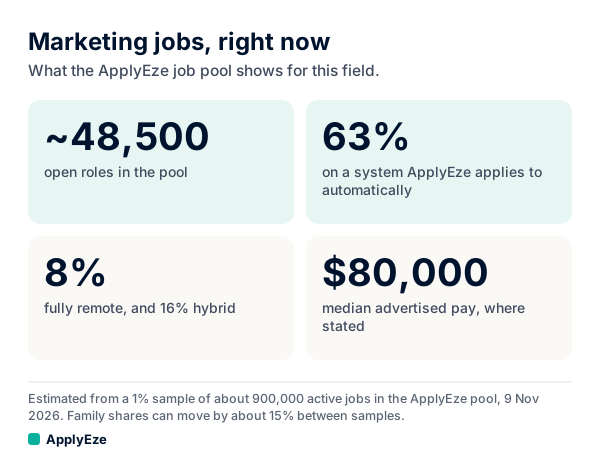
ApplyEze polls more than 100,000 employer boards directly. That pool shows roughly 48,500 open marketing roles, with roughly 63% on application systems ApplyEze applies to once an inbox is connected. Roughly 8% are fully remote and about 16% hybrid, so roughly three in four are onsite or do not say. The median advertised pay is about $80,000, among postings that state it. These come from a 1% sample of about 900,000 active jobs on 9 November 2026, and only about 15% of all postings state pay, so treat them as rough.
The Bureau of Labor Statistics puts the median for advertising, promotions and marketing managers far higher, at $165,780 in May 2025, with about 36,300 openings a year. The two figures measure different groups. Ours covers every marketing title at every level. Theirs covers managers, who it says typically need work experience in a related occupation. Our marketing manager resume post covers that next step.
Portfolio links on application forms
This is what 274 live Greenhouse forms for marketing roles asked for on 9 November 2026.
| Field | Forms with it | Forms requiring it |
|---|---|---|
| LinkedIn profile | 255 (93.1%) | 70 (25.5%) |
| Cover letter upload | 220 (80.3%) | 0 |
| Website | 126 (46.0%) | 1 (0.4%) |
| "Portfolio" in the label | 22 (8.0%) | 4 (1.5%) |
| Any website, portfolio or sample field | 143 (52.2%) | 5 (1.8%) |
The box is usually called Website, not Portfolio. That plain label appeared on 103 forms. A handful of forms do something else: four take a "Portfolio or Cover Letter" file upload, and two ask for a "Portfolio Password, if applicable." Lever's public API handles links as a set of named addresses such as LinkedIn, GitHub and Dribbble. We could not read Workday forms without creating an account, so they are not in this table.
What to do with that:
- Use one public address with no login and no password. A password box exists on very few forms, so assume none.
- Print the address in your resume header too. About half the forms have no box for it at all.
- Keep a one-page PDF of your strongest case study. It covers the forms that take a file upload instead of a link.
- Open with the result. The first screen should say what you did and what number moved, before any introduction about yourself.
- Get your LinkedIn address right. One form in four requires it, and it is the one link nearly every form asks for.
Applying in marketing
Apply by channel, using the channel's words in your resume lines where the work matches. Our marketing resume keywords post has the counts for each specialty. Send fewer applications to roles asking for many years, and more to titles where a project can stand in for the first year of experience.
When the eight weeks are done, ApplyEze can carry the form work. It delivered 94,207 applications to 9,769 employers between 14 August and 9 November 2026. You pick matches from a board ranked on your target titles and the requirements it reads out of each posting, then queue them in the desktop app. It applies in Chrome on your computer, so keep the computer on and awake until the queue finishes. List several titles, such as marketing coordinator, marketing specialist and your channel's title, because a role doing your work under a title you did not list ranks low. Workday and Oracle jobs stay hidden until you connect an application inbox, because those sites email a code. ApplyEze applies automatically on systems holding roughly 62% of the jobs it tracks with an inbox, and roughly 23% without.
For each application, an AI model reads that posting and your real history and writes a resume for it. Put your case study numbers in the resume you upload, because code rejects a rewrite that adds a figure, employer, school or credential your record does not hold. ApplyEze brings the posting's named skills and tools onto your skills line, even when your own record does not list them. There is no step to remove one before a live run, so use a dry run to see what it writes, and be ready to discuss anything on the page. A certification the posting asks for is not added unless you hold it. LinkedIn URLs are never invented, so add yours to your profile, since one form in four requires it.
Hard facts come from your profile. When a required question is not covered by your saved answers, ApplyEze still fills it rather than stopping the run, so that answer may not come from you. Fill in your saved answers, use dry run first, and read your receipts.
So start week 1 today, with a written yes from one real place to work. When you have a result to show, your first 50 applications are free, once per email address with no card, and a credit is used only when an application is confirmed as submitted.