

A marketing manager resume has to answer three questions fast: how much money you were trusted with, what it produced, and how you know. Most sample lines you will find answer the first two. One widely ranked example reads "Generated $2.4M in new revenue through segmented email automation." That is a fine line until an interviewer asks how you know. This post gives patterns for budget and pipeline lines, a table for when attribution is messy, and three labelled samples. For the vocabulary itself, see marketing resume keywords. This post is about structure.
Which number leads
The number at the top should be the one your specialty is judged on, and that differs more than most advice admits. We read 437 live US marketing postings from 124 employers on 9 November 2026, pulled from public boards on Greenhouse, Lever, Ashby and Workday, and sorted the titles into four groups. The table shows the share of each group mentioning a term anywhere in the posting.
| Term | Demand, growth, paid (115) | Brand, content, social (61) | Product marketing (93) | Lifecycle, CRM (37) |
|---|---|---|---|---|
| Budget | 64.3% | 44.3% | 7.5% | 5.4% |
| Pipeline | 46.1% | 11.5% | 31.2% | 24.3% |
| Revenue | 47.8% | 18.0% | 36.6% | 37.8% |
| Attribution | 38.3% | 13.1% | 2.2% | 2.7% |
| Incrementality | 33.0% | 16.4% | 2.2% | 18.9% |
| Agency | 38.3% | 50.8% | 14.0% | 5.4% |
| Positioning | 8.7% | 13.1% | 82.8% | 0% |
| Launch | 39.1% | 42.6% | 82.8% | 35.1% |
| Sales enablement | 5.2% | 8.2% | 72.0% | 0% |
| Adoption | 14.8% | 18.0% | 60.2% | 21.6% |
| Retention | 17.4% | 11.5% | 18.3% | 59.5% |
A product marketer who opens with budget is answering a question 7.5% of those postings raise. A brand manager who claims pipeline is reaching for a number that 11.5% ask about, and half of brand postings mention agencies instead. Among 140 postings with a plain manager title, budget and pipeline each appeared in 36.4%, and the median experience asked was 5 years among the 105 that stated it.
The sample is hand-picked, leans toward technology and large employers, and counts a word anywhere, including a company describing itself. Use it to choose an order, then read the posting in front of you.
What a hiring manager opens first
We found no public study of which links or sections hiring managers open first, so reason from what an application hands them. On 274 live Greenhouse forms for marketing roles, 93.1% asked for a LinkedIn address, 46.0% had a Website box, and 80.3% offered a cover letter upload that none of them required. The resume is the only file nearly all of them will have.
The research people usually cite on first glances is old and comes from a seller. In a 2012 TheLadders study of 30 recruiters, the first fit or no fit glance took about six seconds. A 2018 update put it at 7.4. Both measure the first sort, not how long a resume gets once it survives that sort, and TheLadders sold resume rewriting.
Whatever the true number is, the top third of the page should say what kind of marketer you are, at what scale, and with what result. Our resume summary examples cover the format. A marketing manager's version can be two lines.
Sample, invented figures. Demand generation manager, B2B software. Owned a $2.4M annual program budget and $14.2M in sourced pipeline in 2025. Case studies: yourname.com/work
Budget and pipeline lines
The pattern is verb, amount, period, channels, result against a target, and method. Most weak lines stop at the verb. All figures below are invented to show the shape.
| Weak | Stronger |
|---|---|
| Managed a large marketing budget | Owned a $2.4M annual program budget across paid search, LinkedIn and events; finished 2% under plan |
| Responsible for lead generation | Sourced $14.2M in pipeline against a $12M target (first touch, Salesforce) |
| Ran successful campaigns | Cut cost per sales-accepted opportunity from $4,100 to $3,050 by moving 30% of event spend to account-based LinkedIn |
| Worked with agencies | Managed 2 agencies and $600K in fees; rebid the media contract and saved $90K a year |
Choose the verb honestly. "Owned" means the money was yours to move. If finance held it and you proposed the split, write "recommended the allocation of." Say what the figure includes, too, because a program budget and a budget with salaries and tools in it are different claims.
A good reader does the math, so do it first.
Budget against company size. Gartner's 2026 CMO Spend Survey put marketing budgets at 7.8% of company revenue in 2026, up from 7.7% in 2025, among 401 marketing leaders, most at companies above $1 billion in revenue. At that ratio a $4M budget goes with about $51M in revenue ($4M divided by 0.078). Young software companies spend differently, so this is not a rule. If your line implies an unusual ratio, expect the question and add a word of context.
Pipeline against spend. In the sample above, $14.2M divided by $2.4M is 5.9 times spend. Apply a 20% win rate and that pipeline becomes $2.84M in closed revenue, about 1.2 times spend. A hiring manager for a demand role will run something like this in their head. Know your real win rate before you walk in.
Sourced against influenced. Metadata, a marketing software vendor, defines sourced pipeline as "any deal that started directly from a marketing activity" and influenced as "any deal where marketing had a touchpoint somewhere in the buyer's journey." The second is almost always larger. Name which one you mean. A bare pipeline number reads as the bigger one.
When attribution is messy
Attribution is messy almost everywhere, so a clean number is not what careful readers expect. They expect you to know how yours was built. The simplest habit is to put the method in parentheses.
It also dates your claim. Google retired first click, linear, time decay and position-based models across Google Ads and GA4 in 2023, moving remaining conversion actions to data-driven attribution. Data-driven and last click stayed. A first-click figure from 2022 cannot be re-run in those reports, so say the model and the year.
| Your situation | Sample line, invented figures | Be ready to explain |
|---|---|---|
| Only last click data | 1,240 demo requests at $182 each (last click, GA4, 2025) | Last click favors search and misses what created the demand |
| Sales and marketing both claim deals | Sourced $6.1M (first touch); influenced $19M (any touch in the 90 days before the opportunity opened) | Who agreed those rules, and when |
| A controlled test exists | Holdout test on paid social: 11% lift, below what last click implied; moved $180K | Test design, group sizes and why you trusted it |
| Brand spend with no direct path | Branded search up 22% in 4 test metros against 3% in controls during the campaign | What else changed in those metros |
| Before and after only | Trial starts rose from 410 to 530 a month after the relaunch (no control; a price change overlapped) | How much you would credit to the relaunch |
| Confidential figures | Grew pipeline 38% year on year on a flat budget | That you can discuss method, not the base |
| A team result | Team of 4 sourced $6.1M; I ran paid search, about 40% of spend and 35% of the pipeline | Your part, with no rounding up |
A controlled test is the strongest line you can have. Google's Conversion Lift describes the idea plainly: split an audience into people who see your ads and people who do not, and the difference is the lift. Incrementality appeared in a third of demand, growth and paid postings in our sample, so a test you ran belongs near the top. A line with no number beats a number you cannot trace to a report.
Sample: demand generation
Sample, with an invented employer and figures. Demand Generation Manager, B2B software.
- Owned a $2.4M annual program budget across paid search, LinkedIn, events and webinars; finished 2% under plan.
- Sourced $14.2M in pipeline against a $12M target (first touch, Salesforce), 5.9 times spend.
- Cut cost per sales-accepted opportunity from $4,100 to $3,050 by moving 30% of event spend to account-based LinkedIn programs.
- Ran a 6-week holdout on paid social that showed 11% lift, less than last click implied, and moved $180K to search and events.
- Managed 1 specialist and 2 agencies.
Every money line names a period or a target, and the holdout shows the writer will report a result that made their own channel look smaller. That line does more for trust than any percentage.
Sample: brand
Sample, with an invented employer and figures. Brand Marketing Manager, consumer subscription.
- Ran a $1.1M campaign across podcast, YouTube and out-of-home in 4 test metros.
- Aided awareness rose from 18% to 26% in test metros against 19% to 20% in controls (quarterly tracker, about 1,200 respondents a wave).
- Branded search rose 22% in test metros against 3% in controls during the flight.
- Managed the agency of record and $600K in fees; rebid production and saved $90K a year.
- Rewrote messaging guidelines now used by product, lifecycle and 3 regional teams.
There is no revenue claim here, and that is deliberate. Brand work rarely has a clean path to revenue, and a reader knows it. A control group and a sample size earn more belief than a number that cannot be defended.
Sample: product marketing
Sample, with an invented employer and figures. Product Marketing Manager, B2B software.
- Wrote positioning and messaging for 3 launches, including a move into mid-market.
- Launched usage reporting to existing accounts: 34% adopted within 90 days against 21% for the previous launch (product analytics).
- Built battlecards attached to 60% of competitive deals; win rate against the main rival rose from 31% to 38% over 2 quarters, though a pricing change overlapped.
- Ran 24 win-loss interviews and rewrote the pitch deck from what lost deals said.
- Writing samples I authored: yourname.com/work
No budget line, because 7.5% of product marketing postings mention one. The verbs match what they do mention: positioning, launches, enablement and adoption. The last line says "I authored" on purpose, as the next section explains.
Portfolio links that get opened
Decide by what postings ask. Only 13 of the 437 asked for a portfolio or writing samples, most of them in content, brand or product marketing. A demand generation manager can usually skip the portfolio and lead with the numbers. A content lead or product marketer usually should not.
The wording of those 13 tells you what the page must hold. New Relic wants "messaging and content you personally wrote." Scale AI wants "a portfolio of campaigns that made executives stop and respond, and the ability to explain the insight behind each one and the business result it drove." Brex asks for campaign work "that shifted market perception." General Dynamics IT wants writing samples available on request, so have them ready even when no one asks up front.
So build it like this:
- One page, three cases. For each: the goal, what you personally did, the result with its method, and what you would change.
- Say whose work it was. Credit the team, and mark what you wrote yourself.
- Keep it public and clean. No login, no password, no client data you do not have the right to show. Strip or round figures that were confidential.
- Print the full address on the resume. Words like "portfolio" with a hidden link disappear when a resume is printed or pasted into plain text.
The field in numbers
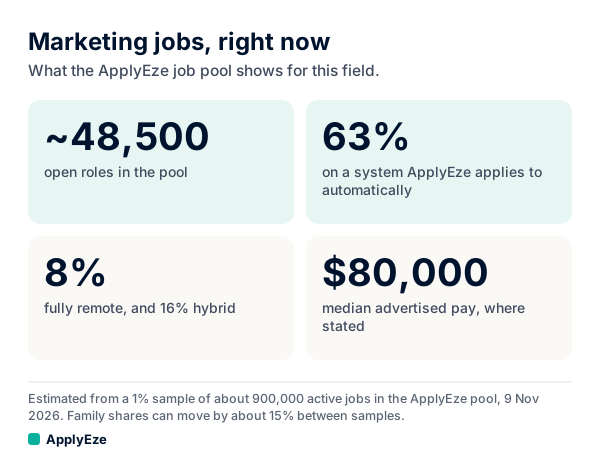
ApplyEze polls more than 100,000 employer boards directly. That pool shows roughly 48,500 open marketing roles, roughly 63% on application systems ApplyEze applies to once an inbox is connected, roughly 8% fully remote and about 16% hybrid, with a median advertised pay of about $80,000 among postings that state it. That comes from a 1% sample on 9 November 2026, and only about 15% of all postings state pay. It covers every level, which is why it sits far below the Bureau of Labor Statistics median of $165,780 for advertising, promotions and marketing managers in May 2025. If you are still working toward this title, start with how to get into marketing.
Sending it
If you apply through ApplyEze, your numbers stay yours. An AI model reads each posting and your real history and writes a resume for it. Your employers, job titles, dates, schools, degrees and certifications come from your own record, and code rejects a rewrite that adds a figure, employer, school or credential your record does not hold. An audit of 84 sampled resumes on 4 November 2026 found 0 invented employers, dates, degrees or numbers. So your budget and pipeline figures, with their methods, belong in your resume before you upload it. The skills line is different: ApplyEze brings the posting's named skills and tools onto it, even when your own record does not list them. There is no step to remove one before a live run, so use a dry run to see what it writes, and be ready to discuss anything on the page.
Hard facts on forms come from your profile. When a required question is not covered by your saved answers, ApplyEze still fills it rather than stopping the run, so that answer may not come from you. Fill in your saved answers, use dry run first, and read your receipts. You pick the matches and queue them in the desktop app, and it applies in Chrome on your computer, so keep the computer on and awake until the queue finishes. Workday and Oracle jobs stay hidden until you connect an application inbox, because those sites email a code.
Rewrite your top three lines this week, with the method in parentheses. Then your first 50 applications are free, with no card, and ApplyEze builds a resume for each posting.