

How to say you were laid off on an application depends on the field in front of you. In a dropdown, pick the option that names a layoff, or "Involuntary" if that is the closest. In a text box, write "Position eliminated in layoff" and the month. On a yes or no question, read the exact words first, because "fired", "discharged" and "terminated" do not all mean the same thing, and a layoff fits some of them and not others. A layoff is an ordinary thing to report. It becomes a problem only if you write something a reference or a record can contradict.
Most advice stops at "be honest and brief". We read what forms actually ask, including the federal declaration form, a city's application and a federal trucking rule, because the wording changes the right answer. Every answer below is a sample written for this post, with invented details. This is general information, not legal advice.
Six sample answers, by field
| Sample | Field in front of you | What to enter |
|---|---|---|
| 1 | Dropdown with a layoff option | Select "Layoff" or "Reduction in force". On any Explain line: "Position eliminated, March 2026." |
| 2 | Dropdown with no layoff option | Select "Involuntary". If the only choices are "Resigned" and "Terminated", select "Terminated" and add: "Position eliminated in a company-wide layoff, not for performance or conduct." |
| 3 | Short text box | "Position eliminated in layoff, Mar 2026" |
| 4 | Long text box | "The company cut about 15% of staff in March 2026 after losing its largest contract, and my role was eliminated. My manager can confirm this." |
| 5 | Yes or no follow-up | To "Have you ever been discharged or asked to resign?": "No." To "Have you ever been terminated for any reason?" with a note box: "Yes. Position eliminated in a company-wide layoff, March 2026. Not for performance or conduct." |
| 6 | Interview | "My role was one of about 200 cut in March when we lost our largest contract. I ran the billing migration there, and I want more of that kind of work, which is what this role is." |
The rest of this post explains why each answer is worded that way, and what changes when your case is not a plain layoff.
Laid off, let go, fired: what the words mean to an employer
A layoff means the job went away. Being fired means the employer ended it because of you, and the job usually stays and gets filled. The practical test: if someone was hired into your exact seat a month later, "laid off" is hard to defend.
Two words cause most of the trouble.
"Let go" covers both. A reader cannot tell which you mean, and many will assume the worse one. Our reason for leaving guide suggests "Let go; happy to discuss" for a firing. If you were laid off, use a word that says so.
"Terminated" has two meanings. In conversation it sounds like fired. In HR paperwork it often means any ending. Georgia's Separation Notice "must be completed for each worker who leaves your employment, regardless of the reason", applies "where the employer-employee relationship is terminated", and offers "LACK OF WORK" as its first reason. So a layoff can be a termination on paper. That gap between the two meanings is why the yes or no question below is harder than it looks.
Your old employer also holds its own record. Workday's admin guide describes how a company can "configure a default value for the Eligible for Rehire field based on the termination reason". So a recorded reason may exist, with a rehire flag attached to it. Before you fill in forms, find your separation letter or ask HR what was recorded, and match that wording. The same record matters for unemployment, which our checklist for the first days after a layoff covers.
When the form has a dropdown
The City of Mishawaka, Indiana, application is a useful specimen. For each past job it offers four checkboxes, each with an Explain line:
- Voluntary Resignation
- Involuntary / Layoff / Closed
- Discharge / Asked to Leave
- Other
Layoffs and closures sit together, and discharge sits apart. Dropdown lists differ by employer, so map what you see onto the truth.
| Options you see | Pick | Add on any note line |
|---|---|---|
| A layoff, reduction in force or position eliminated option | That one | The month, if asked |
| Voluntary, Involuntary, Other | Involuntary | "Position eliminated in layoff" |
| Resigned, Terminated, and nothing else | Terminated, because the employer ended the job | "Position eliminated in layoff, not for performance or conduct" |
| Resigned, Fired, Other | Other | "Laid off: position eliminated" |
| Better opportunity, Relocation, Personal, Other | Other | "Laid off: position eliminated" |
If there is no note line at all, make the choice closest to the truth, and say the word "layoff" the first time you speak to a person. Do not pick "Resigned" or "Personal reasons" because it reads better. The Mishawaka form's applicant statement says "false, misleading, or omitted information in my application may result in the rejection of my application, the revocation of an offer of employment, or discharge if subsequently found after hire."
Many forms never ask. The City of Charlotte's Workday guide for candidates lists the required fields for each job as "Job Title*, Company*, and From* and To* date". If a form does not ask, do not volunteer it, and do not write "laid off" on your resume. Others are obliged to ask. Federal rules for commercial drivers at 49 CFR 391.21 require the application to list employers for the prior 3 years, the dates, and "The reason for leaving the employ of that employer".
When the form has a text box
In a short box, name the event and stop. These are samples, all under 40 characters.
| What happened | Short box sample |
|---|---|
| Company-wide cut | Company-wide layoff, Mar 2026 |
| Team cut | Department eliminated, Mar 2026 |
| Site closed | Office closed, Mar 2026 |
| Whole company shut | Company closed, Mar 2026 |
| Merger | Role eliminated after merger |
| Funding ended | Position eliminated, funding ended |
In a long box, use one or two sentences: the event, the scale if you know it, the date. Add the cause only if the company stated it, and leave out your opinion of the decision. Keep the end date as your real last day. If the layoff was announced in March and you worked until May, the date is May.
Cases that are not a plain layoff
| Your situation | Honest wording, as a sample |
|---|---|
| Told you are being cut, still on payroll | "Currently employed. Role ends June 2026 in a company layoff." |
| Took a voluntary package | Pick Voluntary if offered. "Accepted voluntary separation during a restructuring." |
| Contract or temp job ran out | "Contract ended as scheduled." |
| Temporary layoff with a return date | "Temporary layoff, Mar to May 2026." BLS describes temporary layoff as having a date to return or expecting to return within 6 months. |
| On a performance plan when cuts came, and the job is gone | "Position eliminated in layoff" is accurate if that is what your papers say. |
| Fired, and someone replaced you | Not a layoff. Use "Let go; happy to discuss". |
The voluntary case is not rare. Challenger, Gray & Christmas reported that Microsoft announced voluntary exit offers to 60,000 employees in October 2026. If you accept one, you were not laid off, however little the choice felt like one.
Yes or no questions: read the words
This is where a layoff can go wrong, because the question decides the answer. Here are two real forms and one common phrasing.
| The form's words | Source | Plain layoff |
|---|---|---|
| "During the last 5 years, have you been fired from any job for any reason, did you quit after being told that you would be fired, did you leave any job by mutual agreement because of specific problems" | Optional Form 306, federal jobs | Usually No. None of these describes a cut position. |
| "Have you ever been permitted to resign, rather than be discharged, or asked to resign from any position?" | City of Mishawaka | No, unless someone asked you to resign instead of being laid off. |
| "Have you ever been terminated?" | Sample wording | Depends. See below. |
When the word is a bare "terminated", there is no universal rule, so here is our judgment. With a note box, answer Yes and explain, because the note removes the risk from either reading. Without one, look at the words around it. If they say "for cause", "discharged" or "dismissed", answer for that meaning, which is No. If nothing narrows it, ask HR at the employer if you can. If you cannot, answer as a plain reader would understand the word and raise the layoff at your first conversation. On a federal form, a license application or anything tied to a clearance, ask the employer or a lawyer, since Form 306 warns "A false statement on any part of this declaration or attached forms or sheets may be grounds for not hiring you, or for firing you after you begin work."
Employers can check. The EEOC and FTC note that "some employers may ask about your employment history", and an employer must get your consent before ordering a report from a background check company.
The Mishawaka form also asks two follow-ups worth preparing for: "May we contact this employer?" and "What will your immediate supervisor tell me about you?" A sample answer to the second: "That my role was cut in the March layoff and that I delivered the billing migration on schedule." Ask the supervisor first, so that it is true.
In an interview
The form gives the headline, and the interview is the same story with one more sentence. Keep it near 20 seconds, then move to what you want next. Three samples:
Sample, the first answer: "My role was one of about 200 cut in March when we lost our largest contract. I ran the billing migration there, and I want more of that kind of work, which is what this role is."
Sample, if asked "why you?": "They closed the whole Denver team, so it was about the site. My manager is happy to take a call."
Sample, if you do not know how they chose: "I was not told how they picked. My last review was strong, and my former manager will speak to my work."
Do not guess at the criteria or criticize the decision, and stop talking once you have answered.
How common this is
Very common, and recruiters know it. Two numbers get quoted, and they measure different things.
- Challenger, Gray & Christmas counted 617,189 announced job cuts by US employers through October 2026, down 44% from 1,099,500 in the same months of 2025. These are announcements by employers, reported by a firm that sells outplacement.
- The Bureau of Labor Statistics counted 1.6 million layoffs and discharges in September 2026, a rate of 1.0 percent. These are separations that happened, across all sectors, in one month.
Do not read the BLS figure as a count of layoffs. Its definition is "Involuntary separations initiated by the employer", and it includes firings for cause. Even the federal statistic does not split the two words this post is about.
Challenger's breakdown also shows how many ordinary reasons sit behind a cut. Through October, employers cited market or economic conditions for 130,531 cuts, AI for 121,401, closings for 109,342 and restructuring for 85,391. Market conditions have now passed AI as the top stated reason, so do not assume AI was the reason for yours unless your employer said so.
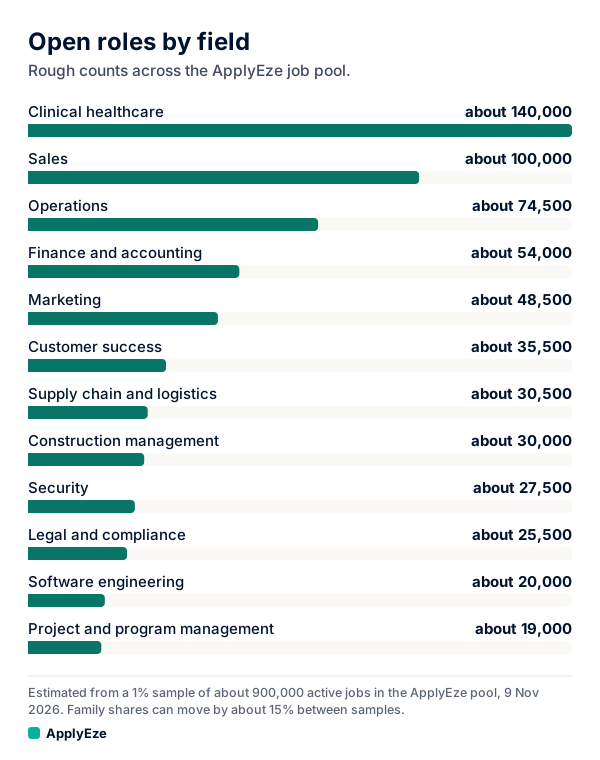
Technology leads by sector with 171,501 cuts, 28% of the total. That label describes the company, not the job: Challenger tracks Amazon under technology and counts even its seasonal warehouse hiring there. It matters for your next application, because you search by what you do. The chart below shows rough counts of open roles by field across about 900,000 active jobs in our pool: clinical healthcare about 140,000, sales about 100,000, operations about 75,000, finance and accounting about 54,000, marketing about 49,000, and software engineering about 20,000. These come from a 1% sample on 9 November 2026, and a second sample differed by up to about 15% per field, so treat them as rough. A finance manager cut from a software company has a field far larger than the headline suggests. Our first 30 days plan turns that into a target list.
What not to say
- "Let go", if you were laid off. It reads as a firing.
- "Resigned" or "left for a new opportunity", if neither happened. A reference or a record can contradict it.
- "Laid off", if you were fired. The mismatch costs more than the original fact.
- Anything about the decision being unfair. A form is not the place for it, even when it is true.
- A blank. A blank in a required reason field looks like avoidance. Use the short sample.
- A shifted end date. Moving your last day to shrink a gap is easy to check.
- A different story on each form. Write the wording once in a sheet and copy it, because a single employer can compare your form, resume, references and background check.
Once your wording is settled
Your next step is one sheet: your reason for leaving, your exact dates and your short answer, word for word. After that, the same few questions repeat on every form, and that part can be handed off. ApplyEze has delivered 94,207 applications to 9,769 employers since August, and it polls more than 100,000 employer boards directly.
Hard facts come from your profile. When a required question is not covered by your saved answers, ApplyEze still fills it rather than stopping the run, so that answer may not come from you. Fill in your saved answers, use a dry run first (it fills the form and stops before Submit), and read your receipts. You queue the roles you want, it runs on your own computer, which stays on and awake until the queue finishes, and Workday and Oracle jobs need a connected application inbox.
If you would rather spend this month on the conversations a layoff calls for than on retyping your job history, your first 50 applications are free, with no card.