

A job search after a layoff works better in a fixed order: money first, then your story and resume, then a target list, then applications. Order is what a layoff takes away, because everything feels urgent at once and sending applications is the one task that feels like progress. This plan gives you one job per week for 30 days and a definition of done for each, then sets expectations with numbers read the way their publishers mean them. For your rights and the legal deadlines (severance, COBRA, the Marketplace, visa clocks), start with our checklist for the first days after a layoff. This post picks up from there and is about the search.
| Week | The one job | Done when | Not yet |
|---|---|---|---|
| 1 (days 1 to 7) | Money and paperwork | Unemployment filed, coverage decided, runway number written down | Mass applications |
| 2 (days 8 to 14) | Your story and your resume | One-sentence story, updated resume, two or three references agreed | Target list |
| 3 (days 15 to 21) | A target list by field | Two or three titles, 30 named employers, a location rule | Volume |
| 4 (days 22 to 30) | Your first real applications | About 15 sent and logged, about 5 conversations held | Judging the results |
One exception runs through all four weeks. If someone you know offers an introduction, or a posting fits you exactly, apply now. In a study of 125 million applications on Dice, a tech-heavy site, from 2012 to 2017, 45% of applications went to postings under 48 hours old and the median posting lived seven days. A perfect fit will not wait for week 4.
Week 1: money and paperwork
Do the legal dates first, from the checklist. The DOL says to contact your state's program "as soon as possible after becoming unemployed". Then write down the one number that shapes every later decision: your runway, meaning months until the money you are willing to spend runs out.
Runway = (savings you will spend + severance after tax + total unemployment benefits) ÷ monthly spending
The middle term changes more than people expect. According to the Center on Budget and Policy Priorities (updated 28 September 2026), most states offer up to 26 weeks, 16 states offer fewer, and Massachusetts currently offers 30. Florida, Louisiana, North Carolina and Tennessee stop at 12, and Georgia at 14. In many 26-week states your own maximum depends on your earnings history, so use the figure your state gives you, not the headline.
A worked example, with invented numbers:
| State with 26 weeks | State with 12 weeks | |
|---|---|---|
| Savings you will spend | $14,000 | $14,000 |
| Severance after tax | $6,500 | $6,500 |
| Unemployment at $420 a week | $10,920 | $5,040 |
| Total | $31,420 | $25,540 |
| Months at $3,900 a month, including health coverage | 8.1 | 6.5 |
Same person, same savings, a month and a half apart because of a state line. Benefits are also generally taxable, and you can request withholding with Form W-4V, so the real figure is a little lower unless you plan for it. Ask your state how it treats severance too, since rules differ.
What the number decides, as our rule of thumb:
| Runway | What it means for the search |
|---|---|
| Under 3 months | Start contract, temporary or part-time work now, and search alongside it. Report that income to your state as it asks. |
| 3 to 6 months | Search full time, and set a date on the calendar when you will add bridge work if nothing is close. |
| Over 6 months | You can be choosy for the first eight weeks. Set the same date, only later. |
Then use what is free. The Department of Labor says every state has an American Job Center network "open to all residents", with career counseling and resume workshops, and local "financial support for training". After a large layoff, a state Rapid Response team may bring services to your workplace before your last day. Services vary by state, so make the call. It costs nothing.
Done when: claim filed, coverage decision made before its deadline, runway written down, bridge-work date on the calendar.
Week 2: your story and your resume
The first recruiter call will ask why you left, so write that before you apply anywhere. One sentence, true, ending on what you want next. A sample: "My role was one of about 200 cut in March, and I want to keep building billing systems, which is why I applied here." Our post on how to say you were laid off has wording for dropdowns, text boxes and yes or no questions. Use the same words on your profile and your forms.
Update your resume while you still remember the numbers. Add your last role's results first, because that memory fades fastest and your access to the figures may be gone already. Keep every date exact. The word "laid off" does not go on the resume.
Then ask two or three people, ideally a former manager and a senior peer, whether they will take a call. Send each one the titles you are targeting and two projects you hope they will mention.
Done when: story written and said aloud twice, resume updated, references confirmed.
Week 3: a target list by field
It is tempting to restart with the title you just lost and the first site you think of. Take a week to choose instead, because the choice sets how many openings you are looking at.
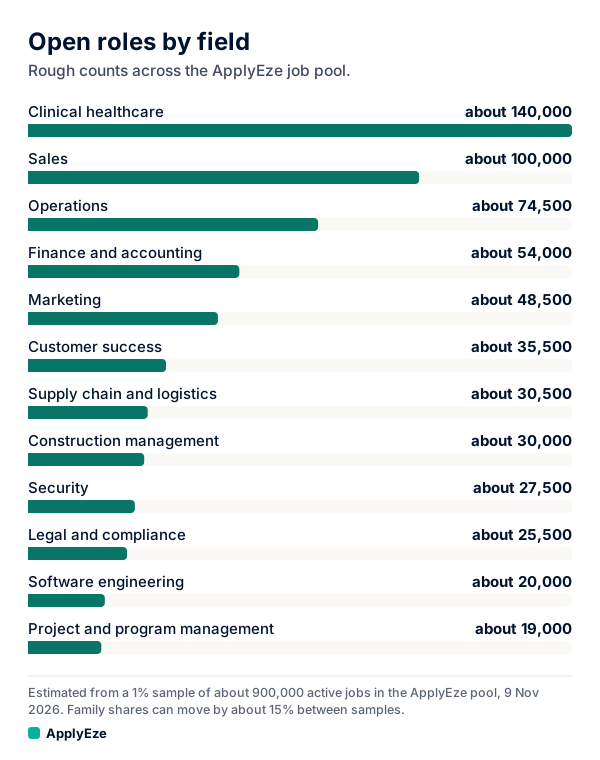
Check the size of your field. The chart below shows rough counts of open roles by field across about 900,000 active jobs on more than 100,000 employer boards we poll directly: clinical healthcare about 140,000, sales about 100,000, operations about 75,000, finance and accounting about 54,000, marketing about 49,000, customer success about 35,000, software engineering about 20,000 and project and program management about 19,000. These come from a 1% sample on 9 November 2026, and a second sample differed by up to about 15% per field. They tell you the order of magnitude and nothing finer.
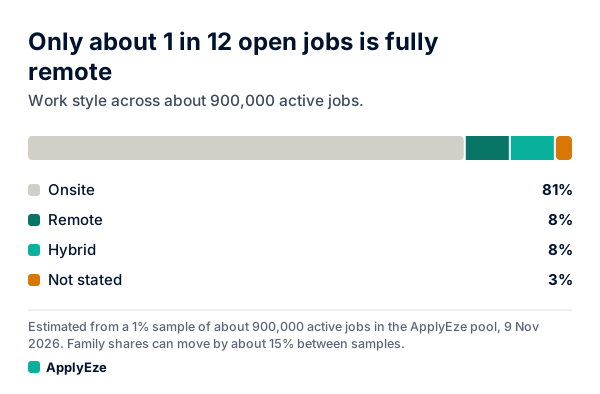
Then decide where you will work, since that is the largest filter you will set. Across the same pool, roughly 81% of open jobs are onsite, 8% remote, 8% hybrid and 3% do not say. Remote alone means about 1 in 12. It varies a lot by field: roughly a quarter of software engineering roles are remote, against about 5% in finance and operations and about 3% in clinical healthcare. If your runway is short and you are searching remote only, you have chosen the hard version of this search, and it helps to know that up front.
Now build the list:
- Write two or three titles. One you held, one next to it, one you could do now with a small step up. People name the same job differently, so read a few postings for the words they use.
- Name 30 employers. Start with your old employer's competitors, customers and vendors, since those people know what your experience means. Add every place a former colleague now works.
- Open their career pages. Note whether each one has a role you fit today. Empty is fine, and a company with no opening now is still a reason to talk to the person you know there.
- Set a pay floor and a location rule. Only about 15% of the postings in our pool state pay, so you will often have to ask.
Done when: titles chosen, 30 employers listed, floor and location rule written down.
Week 4: your first real applications
Send about 15 applications you would be glad to discuss, and hold about 5 conversations. Those numbers are our rule of thumb. For each application, rewrite the summary and put the most relevant bullets first, then log the date, the company, the title, and who you know there. For conversations, a former colleague at a target employer is the place to start, and our guide on asking for a referral has the wording. Keep your dates, your reason for leaving and your titles identical on every form.
Then wait longer than feels comfortable, because replies are slower than a first week suggests. Huntr, a job search tracker, reports a median of 5 days from application to interview for its users in Q3 2026. Our own read points the same way: for applications sent from 12 to 23 October 2026 for candidates at one staffing team using ApplyEze, 58 human callbacks (a screening call, an interview or an offer) were found in their inboxes at a median of 116 hours, with 38% inside 72 hours and 74% inside 7 days. Those are machine labels on a small set from one team, and results for any one person will differ. Both figures sit near five days, so treat two quiet weeks as silence and one quiet week as nothing.
Do not draw conclusions yet. Ashby, an applicant tracking company, reports that 3.6% to 4.7% of applications on its customers' jobs reach an interview. If each of yours had an independent 4% chance, the odds of no interviews at all would be about 54% after 15 applications, 29% after 30 and 13% after 50 (our arithmetic: 0.96 raised to that power). A silent first batch is more likely than not on those odds. A referral changes them most: in Ashby's data from 2021 to 2024, 40% of referred candidates reached an interview against 3% of inbound applicants, though people who get referred differ in other ways too. Review your interview rate after 30 to 50 applications, and change one thing at a time.
Done when: about 15 sent and logged, about 5 conversations held, a weekly number chosen that you can keep up.
How long this may take
Three sources get quoted, and each answers a different question.
| Source | Figure | What it counts | How to read it |
|---|---|---|---|
| BLS, October 2026 | Median 11.9 weeks, mean 27.1 weeks; 27.6% at 27 weeks or more | People unemployed and looking on the survey date | BLS says these "reflect the still-in-progress spells of unemployment, not completed spells". They had been looking this long, and many kept going. |
| United Way NCA, May 2026 | Laid-off respondents: 6.5 months, 95.3 applications, 32.6 minutes each | Survey of 1,000 recent and current US job seekers, February and March 2026, panel not stated | Self-reported. Current seekers are included, so some of those searches were still running. |
| Huntr, Q3 2026 | Median 52 days to a first interview, 102 days to a first offer | 1,961 and 667 users who logged one | Only people who reached that point, using one tracking tool. |
These do not add up to one figure, so do not average them. A sensible reading for planning: expect months, not weeks, and a first interview may well arrive after this 30-day plan ends. Starting promptly still matters. In a field experiment that sent 12,054 fictitious resumes to 3,040 US openings, callbacks fell from roughly 7% at one month out of work to roughly 4% at eight months, with most of the decline inside those first eight months.
The United Way numbers repay a little arithmetic, because they say something the headline does not. All of this is our math on their self-reported averages:
- 95.3 applications at 32.6 minutes each is about 52 hours of form time. Spread over 6.5 months (about 28 weeks), that is 3.4 applications and under 2 hours a week.
- Respondents overall reported 62.6 applications at about 44 minutes each, or about 46 hours, over 6.6 months.
- So laid-off respondents sent about 52% more applications, spent about a quarter less time on each, put in similar total hours, and reported nearly the same search length.
Averages over different people cannot show cause, and laid-off people may differ in many ways. Still, it is a useful warning: more applications at less care per application did not visibly shorten the reported search. It also shows that 15 careful applications in week 4 is well above the average pace, so you do not need to feel behind. Our post on how long it takes to find a job goes further into these measures.
Read that 6.5 months against your runway. In the worked example above, the 12-week state leaves 6.5 months of money, which is the whole of an average self-reported search with nothing spare. That is what the bridge-work date is for.
Keeping your head
In the United Way survey, 83% of laid-off respondents reported burnout, against nearly 80% overall, so feeling this way puts you with most people doing this. Three things help keep the search from filling every hour:
- Set start and end times. Treat the search as a job with hours, and stop at the end of them.
- Take the weekend off. In the inboxes of about 29 candidates at one staffing team, 304 of 336 human callbacks found in email received from 4 October to 8 November 2026 arrived on a weekday, or 90.5%, New York time. Those are machine labels from one team, but they suggest little is lost by closing the laptop on Saturday.
- Tell people. The people who might send you a lead cannot do it if they do not know.
If things feel heavier than that, talk to someone. In the US you can call or text 988, or chat through the 988 Lifeline, which is free, confidential and available 24/7/365.
If form time is what eats your week
Once your list and your story exist, ApplyEze can take over the form filling. It has delivered 94,207 applications to 9,769 employers since August, and it polls more than 100,000 employer boards directly, so new postings keep reaching your board through the day.
You keep the choices. You pick the matches and queue them, and it applies in Chrome on your own computer, which has to stay on and awake until the queue finishes. It covers 12 application systems, and Workday and Oracle jobs stay hidden until you connect an application inbox. For each application, an AI model reads that posting and your real history and writes a resume for it. Your employers, job titles, dates, schools, degrees and certifications come from your own record. ApplyEze brings the posting's named skills and tools onto your skills line, even when your own record does not list them. There is no step to remove one before a live run, so use a dry run to see what it writes, and be ready to discuss anything on the page. You record employer replies yourself on each application.
When income has stopped, the price matters too. Your first 50 applications are free, once per email address, with no card, and a credit is used only when an application is confirmed as submitted. Spend the hours it gives back on the conversations in week 4.