

The share of job postings that list salary depends on who is counting. Indeed reported 59% of US postings in May 2025. The New York Fed, using Lightcast data, reports about 53% since January 2024. In a 1% sample of the ApplyEze job pool on 9 November 2026, polled directly from more than 100,000 employer boards, we hold a pay figure for about 15%. Those numbers are not really in conflict, and the reason they differ teaches you something practical: stated pay often is not a field at all. It is a sentence buried in a posting, and filters miss it. This post covers what each number means, how to read a range, where the law applies, and what to do when pay is blank.
The number, and how it was measured
| Who counted | Share with pay | When | What it covers |
|---|---|---|---|
| Indeed | 59% | May 2025 | US postings on Indeed |
| New York Fed, using Lightcast | About 53% | Since January 2024 | US online postings, up from 15% before 2018 |
| ApplyEze | About 15% | 9 November 2026 | 1% sample of about 900,000 active jobs, 9,474 rows |
Our figure is the low one, and we think it undercounts. Here is the mechanism.
We poll employer systems directly, and those systems handle pay differently. On Greenhouse, Ashby and Lever, our intake can read pay when it starts. Workday, which holds about a third of our pool, gives us no pay figure in its listing feed, so those rows start blank. Other systems do the same. A later read picks up pay from the posting text on some of those rows, but not all. So our 15% means "postings where we hold a figure". Read it as a floor on how many state pay. We would not quote it as the share of US employers who disclose.
Reading it that way still leaves a point worth your time. If a pipeline built to read postings misses pay that often, a "has salary" filter on a job site can miss it too. A blank field does not always mean a blank posting. Read to the bottom of the description before you decide. On many boards, the pay band sits inside the description text, often near the end.
Our figure is one snapshot, with no split by state or field. For those, use Indeed's numbers: it found accounting at 62% and physicians at 44%, and its state figures are in the section on the laws below.
What a range really tells you
Where the law requires a range, the states define it, and those definitions are the best guide to what the numbers mean.
| Where | The rule's words | What that tells you |
|---|---|---|
| California | "a good faith estimate of the salary or hourly wage range" an employer "reasonably expects to pay for a position upon hire" | It is about pay at hire, so the top is not the most the job could ever pay |
| Washington | The "most reasonable and genuinely expected" range, lowest to highest, set before posting, "clear without open-ended phrases" | "$80,000 and up" should not pass there |
| Massachusetts | The range the employer "reasonably and in good faith expects to pay for such a position at that time" | It can change. It describes that moment |
| Illinois | "nothing in the IL EPA limits an employer to that range when making a job offer" | It is not a cap or a promise |
| Minnesota | A "good faith estimate", and the range may not be open-ended | Same idea, and it says "starting salary range" |
So read a range as an estimate of hiring pay. Three checks help.
Check the width. Huntr's Q3 2026 report puts the median advertised range at $110,000 to $150,000, where the top is about 36% above the bottom (our arithmetic). That is one tracker's users, so treat it as a rough yardstick. A range where the top is double the bottom probably covers more than one level or location. A sample: $85,000 to $175,000 is that wide, and it is worth asking what separates the two ends.
Place yourself on it. Meeting every requirement points to the middle or above. Meeting most points to the lower half. A sample: for $70,000 to $90,000, the midpoint is $80,000. If you meet everything, aim a little above it. If you meet most, plan on the midpoint or just under.
Separate base from the rest. Washington requires postings to describe bonuses and commissions as well, and New York requires employers to say if a role is commission-based. A sales range that includes commission is not the same number as a salary.
The chart shows what stated pay looks like across fields, from machine learning at $183,000 down to customer success at $48,000, as the median midpoint among postings where we hold a figure.
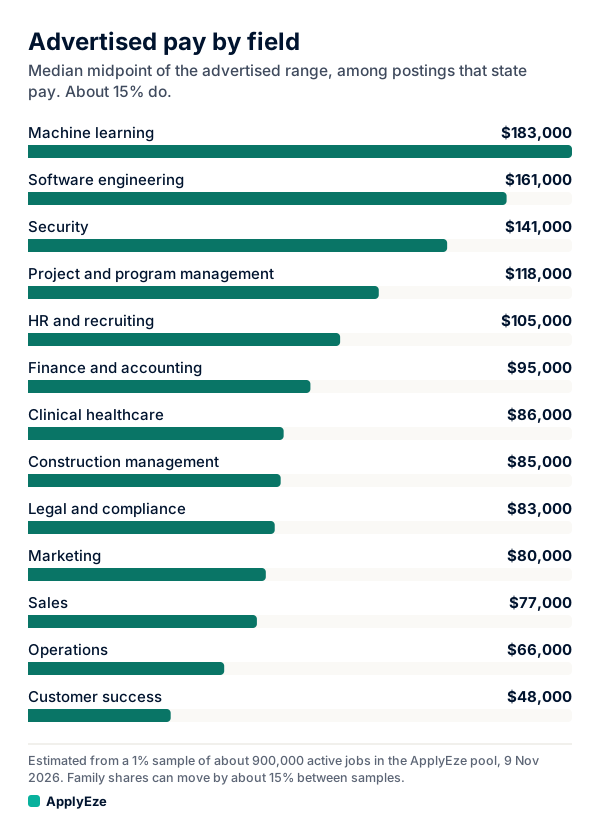
Those medians are a rough map, with real limits that our median pay by field post sets out.
Where pay transparency laws apply
This is general information, not legal advice. We read the pages below on 9 November 2026, and dates in the first column come from those pages or, where noted, the New York Fed's October 2025 summary.
| Place, and since when | Who is covered | Reach to remote roles |
|---|---|---|
| California, January 2023 (NY Fed) | 15 or more employees, at least one in California | Applies "if the position may ever be filled in California, either in-person or remotely" |
| Washington, January 2023 (NY Fed) | 15 or more employees | The page does not address it. Employers get 5 business days to correct a posting after notice |
| New York State, September 2023 (NY Fed) | Four or more employees | The page does not address it |
| Illinois, postings from 1 January 2025 | 15 or more employees | Out-of-state remote postings only if the employer had reason to foresee Illinois work |
| New Jersey, 1 June 2025 | 10 or more employees over 20 weeks, wherever they work | Can apply to an employer "advertising nationally" that takes New Jersey applications |
| Massachusetts, 29 October 2025 | 25 or more employees in the state | Roles with a primary place of work in Massachusetts, including remote work tied to a worksite there |
| Minnesota, date not on this page | 30 or more employees at Minnesota sites | The page does not address it |
| Virginia, 1 July 2026 | The statute names no size limit in the text we read | The state's page refers to postings "in Virginia" |
The New York Fed's summary also lists Colorado (January 2021), New York City (November 2022) and Vermont (July 2025). Colorado was first, and in Indeed's September 2024 figures it reached 88%. Connecticut's governor signed a law in May 2026 requiring a wage range and benefits description in postings. That release gives no start date for this part. Other states and cities have passed laws too, and HR Dive keeps a running list, so check your state labor department for the current text.
Two facts about the laws in practice:
- They work where they apply. As of September 2024, Indeed saw 97.7% of New York postings with salary information and 90% in Washington, against 57.8% nationally.
- They do not reach every posting. The New York Fed estimated that as of January 2025, about 24% of ads subject to these rules did not comply. Small employers are exempt in many states, too.
California's wording has a useful side effect. A posting that "may ever be filled in California" is covered, so a nationwide remote posting from a covered employer should carry a range even if you live elsewhere.
Answering a salary question when pay is blank
A blank posting means your number is the first one on the table, so the desired salary field matters more. Our desired salary guide covers every field type. This is the part specific to blank postings: where to get a number.
-
Find the same employer's posting in a state with a law. Search the employer's careers page for the same title in New York, California, Washington or Colorado. A multi-state employer often has to show a range there for a similar job. Treat it as a clue, since pay differs by city.
-
Read the raw posting data. Some systems hold pay in a field a page may not display. These are public addresses you can open in a browser, with the employer's name in place of the capital letters:
- Lever:
https://api.lever.co/v0/postings/SITE?mode=json, then look forsalaryRange. - Ashby:
https://api.ashbyhq.com/posting-api/job-board/NAME?includeCompensation=true, per its documentation. - Greenhouse:
https://boards-api.greenhouse.io/v1/boards/NAME/jobs/JOB_ID?pay_transparency=true, per its documentation.
All three fields are optional, so an empty result tells you only that the employer did not fill it in.
- Lever:
-
Check public wage data. BLS publishes wages by occupation and metro area.
-
Then enter a number, not a placeholder.
| What the form allows | You found a range for a similar role | You found only wage data |
|---|---|---|
| Required, numbers only | The middle of your target within that range | The metro median, adjusted for level. Never 0 or 1 |
| Required, free text | A narrow range. Sample: "$95,000 to $105,000" | A narrow range around that figure |
| Optional | A narrow range | A narrow range, or blank if you are unsure of the level |
Should you avoid blank postings? Huntr's Q3 data found applications to jobs that posted a salary got interviews at 4.1%, against 5.9% for jobs that did not, and the gap held in all three quarters it shows. That is observational, and postings that show pay may simply draw more applicants. Either way, it gives you no reason to filter blank postings out.
Using this in a first recruiter call
If pay was blank, ask before you are asked. These are samples written for this post.
Asking for the range: "Before we go further, could you share the budgeted range for this role? I want to make sure we're aligned and not waste your time."
If they ask first: "The posting didn't list a range, so I looked at similar roles at your company and public wage data for this city. I'm targeting $95,000 to $105,000, depending on level and the full package. What range do you have budgeted?"
If they decline: "That's fine. Could you tell me what level this role is at? That helps me compare it fairly."
In some states, you have a legal footing. California's FAQ says "upon reasonable request, an employer must provide an applicant for employment the pay scale". Massachusetts says prospective employees have "a legal right to know the pay range for a position" upon applying, for covered employers. Employers may still ask you too: California's FAQ says "nothing in the statute prohibits an employer from asking an applicant about their salary expectation". When the offer arrives, our salary negotiation scripts take over.
Your next step
Take one posting with no pay that you care about. Run the four steps above, write down your number, and keep the three lines ready for the first call.
ApplyEze's setup asks for your salary, and its ranking reads pay where a posting states it. A posting with no figure cannot be checked against your number at all, so read blank-pay matches with the steps above in mind. You pick the matches and queue them in the desktop app, which fills and submits each form in Chrome on your computer while it stays on and awake. Workday and Oracle jobs stay hidden until you connect an application inbox, because those sites email a code. On forms, hard facts come from your profile. When a required question is not covered by your saved answers, ApplyEze still fills it rather than stopping the run, so that answer may not come from you. Fill in your saved answers, use dry run first, and read your receipts. A credit is used only when an application is confirmed as submitted. If you would rather spend your evenings preparing for recruiter calls than filling in forms, your first 50 applications are free, with no card.