

LazyApply vs ApplyEze is a choice between a lower price on paper and a different product. LazyApply is the less expensive of the two if you stay with it long enough: under 2 cents an application on paper, if you use every daily slot for a year, against ApplyEze's listed 2.7 to 3.3 cents. It also names job boards ApplyEze does not touch. ApplyEze writes a resume for each posting, uses a credit only on a confirmed submission, and bills by the month where LazyApply bills by the year.
We make ApplyEze, which competes with LazyApply. LazyApply's prices come from its homepage as of November 2026, and we show the arithmetic so you can redo it. For LazyApply on its own, see our LazyApply review. This post is about the decision between the two, and the number that decides it is how long you expect to be searching.
The paper price, with the math
LazyApply is billed yearly only. Divide each price by the cap times 365:
| Plan | Price a year | Daily cap | Slots in a year | Cost per slot |
|---|---|---|---|---|
| Basic | $99 | 15 | 5,475 | 1.8 cents |
| Premium | $149 | 150 | 54,750 | 0.27 cents |
| Ultimate | $999 | 1,500 | 547,500 | 0.18 cents |
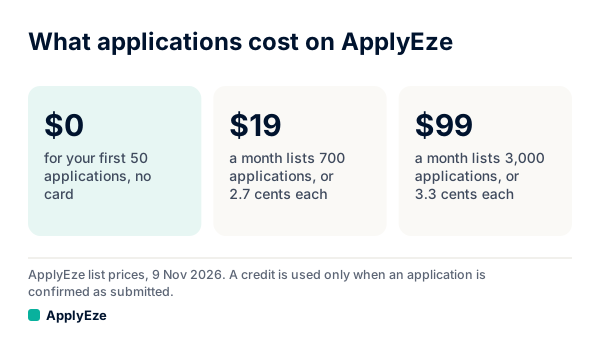
ApplyEze lists three prices: $0 for the first 50 applications with no card, $19 a month for 700 (2.7 cents each) and $99 a month for 3,000 (3.3 cents each).
So LazyApply wins this comparison at every tier. But "cost per slot" assumes three things:
- You use every slot, every day, weekends included, for a full year, including any months after you have taken a job.
- Enough postings you actually want appear on its platforms each day to fill the cap.
- Every slot ends in a submitted application.
Nobody's search looks like that. The same caveat applies to ours: 2.7 cents needs you to use all 700 in a month, and unused plan credits end with the month.
What a real search costs
So price an actual search. The job tracker Huntr's 2025 report puts the median pace at roughly 16 applications a week, the 75th percentile at 40 and the 90th at nearly 85. Here is what those paces cost on the two lower plans (our arithmetic, a month taken as about 4.33 weeks).
| Your search | Applications | LazyApply Basic | ApplyEze Starter |
|---|---|---|---|
| 16 a week for 3 months | 208 | $99, or 47.6 cents each | $57, or 27.4 cents each |
| 40 a week for 3 months | 520 | $99, or 19 cents each | $57, or 11 cents each |
| 40 a week for 6 months | 1,040 | $99, or 9.5 cents each | $114, or 11 cents each |
| 85 a week for 6 months | 2,210 | $99, or 4.5 cents each | $114, or 5.2 cents each |
| 15 a day for 12 months | 5,475 | $99, or 1.8 cents each | $228, or 4.2 cents each |
The crossing point is a simple division. $99 is 5.2 months of $19 (our arithmetic). A search that ends inside five months costs fewer dollars on ApplyEze's monthly price. A longer one costs fewer on LazyApply Basic, and the gap keeps growing. Against LazyApply Premium at $149, the crossing is at 7.8 months. How long a search might run is its own question, covered in how long it takes to find a job.
Two more things change the sums:
- Caps. Basic stops at 15 a day, about 450 in a 30-day month. Starter stops at 700 a month. If you want more than 15 in a day on LazyApply you need Premium, which then allows 150 a day, or 1,050 a week. That is more than 12 times the 90th percentile pace in Huntr's data.
- The free start. ApplyEze gives new accounts 50 free credits, once per email address, with no card. LazyApply's FAQ says "we don't offer a free trial", and offers a live demo by email.
Where LazyApply is ahead
- Price over a long search. See above. It also costs less per application than ApplyEze at any tier on paper.
- Job boards. Its homepage says it applies "on platforms like Greenhouse, Dice, Indeed and Ziprecruiter", and it has an Indeed Bot page. ApplyEze does not apply through any job board's own form.
- Referral emails. It says it will "automatically send customized referral emails to relevant employees". ApplyEze has no such feature. If you use it, read what goes out in your name.
- Written refund terms and public ratings. It has both, as covered below. ApplyEze has no published refund policy and no public reviews.
Where ApplyEze is ahead
-
A measured record. 94,207 applications have gone through ApplyEze since 14 August 2026, to 9,769 employers, as of 9 November 2026, and we poll more than 100,000 employer boards directly. LazyApply's homepage gives a user count, and we found no count of submissions on it.
-
A resume for each posting, in the price. LazyApply offers reusable resume profiles, and we found no per-posting tailoring claim on its site. In Huntr's data, tailored applications converted to an interview, offer or hire at 5.8% against 3.73%. That is observational, and people who tailor may differ in other ways, but it is a lever a reader controls. The method is in our guide to tailoring a resume.
-
A stated rule for what costs a credit. "A credit is used only when an application is confirmed as Submitted. Practice runs, skipped postings and forms that could not be finished cost nothing, and free credits are spent last." LazyApply's cap is daily, and we found no statement of how a failed or half-filled attempt counts against it.
-
Monthly billing. A search that ends in month three costs three monthly payments.
-
No Gmail requirement to start. Each LazyApply plan's checkout field reads "Must be a gmail account". ApplyEze's sign-up asks for an email and a password, and its application inbox, needed for Workday and Oracle, can be Gmail or Outlook.
-
Workday and Oracle. We found no Workday or iCIMS claim on LazyApply's pages. Roughly 4 in 10 of the open jobs we track sit on Workday and Oracle. On ApplyEze those "stay hidden until you connect an application inbox, because those sites email a code."
On accuracy, ApplyEze's employers, titles, dates, schools, degrees and certifications come from your record, and in an audit on 4 November 2026 of 84 sampled resumes we found 0 invented employers, dates, degrees or numbers. ApplyEze brings the posting's named skills and tools onto your skills line, even when your own record does not list them. There is no step to remove one before a live run, so use a dry run to see what it writes, and be ready to discuss anything on the page.
We also measure how often the work finishes, on our team product. In the 14 days to 9 November 2026, 79.1% of ApplyEze Autopilot runs ended in a submission, at a median of 2.5 minutes an application over the last 7 days. Those are team numbers, not a free user's result. Autopilot is set up today for staffing and recruiting teams that work with ApplyEze. If you are job hunting on your own, you can start with 50 free applications on sign-up, no card needed. You pick the matches and queue them in the desktop app, and ApplyEze fills and submits each form.
Boards against employer systems
These two products mostly apply in different places, and a job can be reached either way. A posting on a job board usually does one of two things. It takes your application on the board's own form, such as LinkedIn Easy Apply or an Indeed form, or it sends you to the employer's own system, such as Workday or Greenhouse. Those are different submission paths to the same employer.
LazyApply leans on the first: three of the four names on its homepage are boards. A homepage line says its scripts mean "your profiles will never get blocked by platforms". We cannot verify that, and nobody outside the platforms can. LinkedIn's help page says "we don't permit the use of any third party software", including browser extensions that "automate activity on LinkedIn's website", and that members "risk having their accounts restricted or shut down". LazyApply's homepage does not name LinkedIn today, though its meta description did on 17 October 2026, and a Trustpilot review from May 2026 describes LinkedIn applications with blank or wrong fields. If you plan to run any extension on your LinkedIn account, read that page first. Whether Easy Apply is worth your time at all is its own question, covered in does LinkedIn Easy Apply work.
ApplyEze stays on the second path. Of the about 900,000 active jobs we track, it applies automatically on systems holding roughly 62% with an application inbox connected, and roughly 23% without one. The rest have no automatic path, and a role that only takes applications on a board's own form is out of reach. Some employers ask applicants not to use AI or automation. Whether to apply there is your call.
Refund terms
LazyApply's policy gives four conditions: initial subscriptions only, requested within 30 days, fewer than 100 jobs applied to, and the product must demonstrably fail to function as advertised. You may be asked for proof.
The third condition is the one to run numbers on. At Basic's cap of 15 a day you pass 100 applications on the seventh day. At Premium's 150 a day you pass it on the first. So the 30-day window is shorter in practice if you use the tool as sold. Plan any test accordingly: stay under 100 until you have decided. A June 2026 Trustpilot review reports waiting about two weeks for a reply to a refund request, and another says the plan could not be used without a Gmail address, which you can check before paying.
ApplyEze has no published refund policy. Its line is: "For anything else, a refund included, email hello@applyeze.com and we will sort it out." What it offers instead is structural: you can use the free credits before any money changes hands, and a form that cannot be finished costs no credit.
Reviews, and the story you will see quoted
On 9 November 2026 LazyApply showed 2.1 from 110 reviews on Trustpilot, 9 of them in the last 12 months, and 3.4 from 215 ratings in the Chrome Web Store, with 20,000 users. Its homepage shows "4.9" with no source beside it. ApplyEze has no public reviews.
You will also see one story attached to LazyApply: a software engineer who sent 5,000 applications and got about 20 interviews, reported by Futurism in November 2023. It is one person, three years old, with no control for field or fit, and it tells you little about the product today.
Who should pick which
Lean toward LazyApply if you expect a search longer than about six months, you want to apply through Indeed, Dice or ZipRecruiter, one or a few reusable resumes suit your target roles, you use Gmail, and you are comfortable paying for the year up front.
Lean toward ApplyEze if your target employers use Greenhouse, Lever, Ashby, Workday or the other systems on its list, you want a different resume per posting, you would rather pay month by month, and you want to see the output before paying anything. You will need a computer that stays on and awake while the queue runs, with Chrome installed, and you pick and queue the roles yourself.
Whichever you choose, track your own interview rate from your first 30 or so applications, so you know whether the resume is getting read.
Before any live run on ApplyEze, read what it wrote on a dry run. Hard facts come from your profile. When a required question is not covered by your saved answers, ApplyEze still fills it rather than stopping the run, so that answer may not come from you. Fill in your saved answers, use dry run first, and read your receipts.
If you would rather see a resume written for each posting before paying for a year of anything, your first 50 applications are free, with no card, and nothing is charged when they run out.