

To auto apply to jobs, software opens an employer's application form, fills it from a profile you gave it, attaches a resume and clicks Submit, so you do not type any of it. It works at real volume: 94,207 applications went in through ApplyEze from 14 August to 9 November 2026, to 9,769 employers. Whether it brings you more interviews is a separate question, and the outside evidence is mixed: in Huntr's October 2026 survey, of 68 people who had used a tool that sends applications for them, 6 got more interviews than when they applied themselves, 33 about the same and 17 fewer.
We make one of these tools, ApplyEze. Below: one form question by question, what stops it, how employers' own rules can make a careless application expensive, what it costs, what we measure, and how to test any tool without risking your name.
What auto apply actually does
Two products get sold under this name. Autofill types into the form and leaves Submit to you. Auto apply clicks Submit as well, and that one difference decides most of what follows.
A run has work to do before the form opens. On ApplyEze it checks that the posting is on a supported system and still live, that an inbox is connected where needed, your employer limit, and duplicates. It then builds a resume for that posting, as PDF and DOCX, and reads each file back the way a parser reads it. A failed read stops the run before the form.
Here is what a form typically asks, and where the answer comes from on ApplyEze. Other tools differ, and twelve questions tell them apart.
| The form asks for | Where the answer comes from | What can go wrong |
|---|---|---|
| Name, email, phone, address | Your saved profile | A wrong saved value repeats on every form until you fix it |
| Resume upload | A resume built for that posting | The skills line, explained below |
| Employers, titles, dates, schools | Your own record | A rewrite that adds a figure, employer, school or credential is rejected by code |
| Work status and sponsorship | The answers you saved | A careless answer goes out as a statement about you |
| Cover letter | Written when the form asks. Claims about you come from your record, and any name or figure about the company must appear in the posting | It can still read like every other letter |
| An emailed code, on Workday, Oracle and some Greenhouse forms | The connected inbox, checked during the run | With no inbox, Workday and Oracle jobs stay hidden |
| A required question your profile does not cover | ApplyEze fills it rather than stopping | That answer may not come from you |
| A link to an assessment | Nothing. You take it yourself | The invitation lands in your inbox, often quickly |
| Full Social Security or national ID number | Nothing. That application stops | You lose the application, not a credit |
Most of the judgment sits in the rows about work status, uncovered questions and resume skills. Hard facts come from your profile. When a required question is not covered by your saved answers, ApplyEze still fills it rather than stopping the run, so that answer may not come from you. Fill in your saved answers, use dry run first, and read your receipts.
On the resume, code holds the hard facts. In an audit on 4 November 2026 of 84 sampled resumes, we found 0 invented employers, dates, degrees or numbers. ApplyEze brings the posting's named skills and tools onto your skills line, even when your own record does not list them. There is no step to remove one before a live run, so use a dry run to see what it writes, and be ready to discuss anything on the page. A certification the posting asks for is not added unless you hold it.
What it cannot do
Reach every job. ApplyEze polls more than 100,000 employer boards directly, about 900,000 active jobs, and roughly 38% of those sit on systems where it has no automatic path.
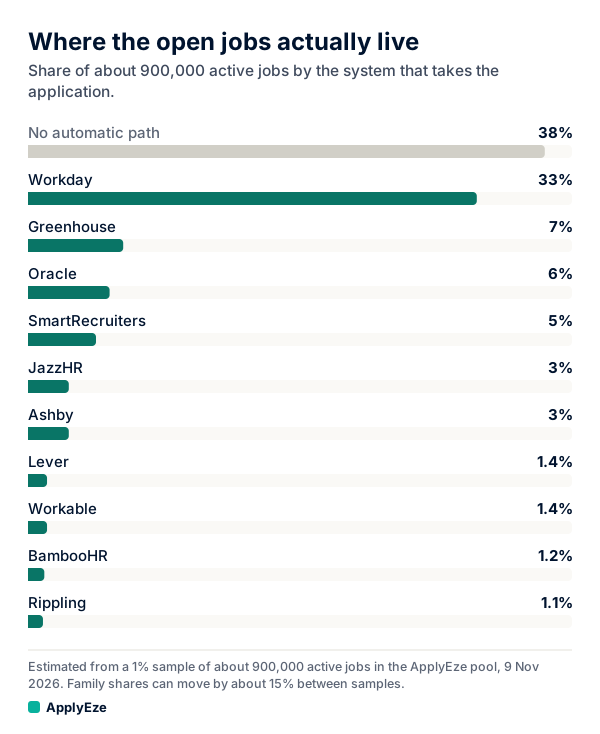
The chart splits about 900,000 active jobs by the system that takes the application: roughly 38% with no automatic path, 33% on Workday, 7% on Greenhouse, 6% on Oracle, 5% on SmartRecruiters and 3% each on JazzHR and Ashby. It comes from a 1% sample, so treat every share as rough.
Workday and Oracle email a code, so their jobs stay hidden until you connect an application inbox. That puts reach on the free path at roughly 62% of open jobs with an inbox and roughly 23% without. Paylocity, Eightfold, Avature, SuccessFactors, Taleo, Radancy and company career sites show as manual only, and iCIMS is in limited rollout and is not open to every account yet.
Before you commit to any tool, open the last 20 postings you cared about and count where Apply takes you. That tells you more about a tool's fit for your field than any list.
Take an assessment. ApplyEze does not take assessments for you, and the invitations can arrive fast. In about 29 candidates' application inboxes at one staffing team, in email received from 4 October to 8 November 2026, we found 279 assessment invitations tied to a specific ApplyEze application, and the median one came 0.2 hours after applying. Those are machine labels no person reviewed, most such invitations are sent automatically, and it is one team. Still, a separate application inbox only works if someone reads it.
Give what it does not have. A form that requires your full Social Security or national ID number stops that application. LinkedIn URLs are never invented. A clearance is never claimed, and a posting requiring one you lack is skipped.
Stop and ask you. Runs end, they do not pause. You can cancel a single lane, but there is no approval step before Submit. Dry run is the preview.
What people who tried it report
Two recent surveys are worth reading closely, because they show what people want from these tools.
Greenhouse, in a survey of more than 2,800 candidates including 1,200 in the US, found "69% would feel comfortable using an AI agent", yet "only 5% would let one apply to jobs on its own". Greenhouse sells anti-spam products to employers, so it has a view. Huntr asked 329 people in October 2026, and 68 of them had used a tool that sends applications for them:
| Compared with applying themselves | People | Share of 68 |
|---|---|---|
| Got more interviews | 6 | 9% |
| About the same | 33 | 49% |
| Got fewer | 17 | 25% |
| Not sure | 12 | 18% |
And 40 of the 68 had stopped using the tool.
Two readings are fair. The harsh one: fewer interviews was almost three times as common as more, and most people quit. The kinder one: 39 of 68 did no worse, and if interviews held steady while the typing went away, those people saved real hours. Neither is proof. It is 68 self-selected people, Huntr sells resume tools, and Huntr itself writes: "We cannot measure mass-apply or auto-apply tools."
Read Greenhouse's 5% next to that. People are comfortable with an agent, and not with one that decides alone. On ApplyEze's free path you pick every role you queue, and a dry run fills the form and stops before Submit so you can see it first.
Complaints name the failure modes: wrong knockout answers in a Tsenta thread (read 17 October 2026), incorrect information entered in a Simplify review (15 October 2026), and applications to unwanted roles in a JobCopilot review (1 November 2026). These are individual reports, not rates.
How employers are responding
Employers are not banning automation in general. They are adding limits, checks and interviews, and complaining about volume. Robert Half reported in March 2026 that 67% of US HR leaders say reviewing AI-generated applications has slowed hiring, and 38% have added interviews per candidate. Robert Half sells staffing, so it has an interest in that finding.
What should change how you test a tool is in the product manuals, because these rules fire without a person.
- Ashby's application limits "automatically block excessive applications". An employer can limit how many times someone applies within a scope of jobs over a set number of days, and can "block rejected candidates from reapplying to any role within the scope within a certain number of days".
- Greenhouse's limits can restrict applications over a period and set the days that must pass before a rejected candidate can apply to the same job again.
- Ashby's auto-reject rejects submissions that match set conditions, such as an answer to a location question, at the moment they arrive.
Each employer sets its own numbers, and most of the time you will not know them. So a poorly matched application that gets rejected can start a clock that blocks you from the role you actually wanted at that company, and an auto-filled answer can end an application before anyone reads it. Those rules act on what was submitted, whoever typed it.
Platforms are moving as well. Greenhouse now lets a job seeker mark one application a month as their Dream Job, so scarcity becomes the signal. LinkedIn's help page says members using third party automation "risk having their accounts restricted or shut down". ApplyEze applies on employers' own application systems, not through LinkedIn Easy Apply.
The most telling move came from Indeed. In July 2026 it began testing Apply For Me with a limited number of US job seekers, conceding that "employers are rightfully concerned about tools that encourage high-volume, low-relevance applications". On 4 August it wrote: "based on the feedback we've received, we're pausing the automatic application mode of Apply For Me", and kept the mode where people look over each draft before submitting. It did not say whose feedback.
We found nothing that measures how employers treat a well-matched automated application differently from a typed one. Some employers ask applicants not to use AI or automation. Whether to apply there is your call.
What it costs, as of November 2026
These are list prices, with cost per application at full use, which is the lowest possible figure.
| Tool | Listed price | Allowance | Per application at full use |
|---|---|---|---|
| ApplyEze | $0 once, $19 and $99 a month | 50, 700, 3,000 | $0, 2.7 and 3.3 cents |
| Tsenta | $0 once, $19, $39 and $99 a month | 25, 600, 1,500, 4,500 | $0, 3.2, 2.6 and 2.2 cents |
| FastApply | $14 a month, $21 with tailoring | 200 | 7 or 10.5 cents |
| Wonsulting | $19.99 a month | 50 | 40 cents |
| Simplify+ | $39.99 a month | 20 a week | about 47 cents |
| LazyApply | $99 a year | 15 a day | under 2 cents on paper, if you use every daily slot for a year |
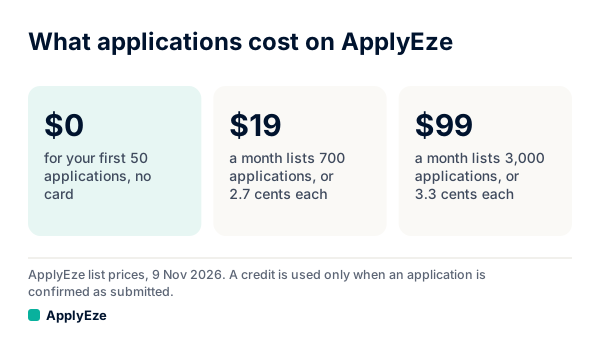
The chart shows our own prices: $0 for the first 50 with no card, $19 a month for 700 and $99 a month for 3,000, with a resume built for each posting. At $19 that is more than Tsenta Starter's 600 and Wonsulting Premium's 50. Tsenta charges less at $39 and $99, and LazyApply costs less on paper. Full use also flatters everyone: send 100 a month on a $19 plan and each one costs 19 cents, because unused plan credits end with the month. People who apply for you run 50 cents to $3.00 per listed application, and the price ladder has that math.
What we measure on our team product
ApplyEze Autopilot, our product for staffing teams, shows what this looks like at volume. In the 14 days to 9 November 2026, 79.1% of its 45,376 runs ended in a submitted application, and a run that ended without one counts against that figure for any reason, including a posting that closed. The median application took 2.5 minutes in the 7 days to 9 November. The completion post has the table by system.
An AI judge sits in front of the form. In the same two weeks it turned down about 4 of every 5 roles on the shortlist, with a median of 4.9 minutes from shortlist to verdict over the last 7 days. On 20 October 2026 a separate model re-judged 601 of its decisions without seeing the verdict and agreed on 83.5%. In a blind audit of 193 applications on 26 October 2026, 84% of Autopilot's read as ones a recruiter would send, against 69% of those recruiters hand-picked. That sample is small, and it is a model's reading, not a recruiter's.
Those are team numbers, not a free user's result. Autopilot is set up today for staffing and recruiting teams that work with ApplyEze. If you are job hunting on your own, you can start with 50 free applications on sign-up, no card needed. You pick the matches and queue them in the desktop app, and ApplyEze fills and submits each form.
How ApplyEze does it on the free path
New accounts get 50 free credits, once per email address, with no card, and nothing is charged when they run out. "A credit is used only when an application is confirmed as Submitted. Practice runs, skipped postings and forms that could not be finished cost nothing, and free credits are spent last." So it means up to 50 submitted applications, not 50 attempts.
You create an account, answer the setup questions and upload your resume, install the desktop app from your home page, sign in, queue the matches you want and press start. You do the choosing, from a board ranked by rules on your target titles and the requirements read out of each posting. A role doing your work under a title you did not list ranks low, so list several.
It covers 12 systems: Greenhouse, Lever, Ashby, Workday, Workable, SmartRecruiters, Oracle, JazzHR, BambooHR, Rippling, Pinpoint and Recruitee. It runs in Google Chrome on your own Mac or Windows x64 computer. "Applications run on your computer while the app is open, so keep it on and awake until your queue finishes. You can use the computer in the meantime."
Every run leaves a receipt: the result, the time taken, screenshots where taken and the documents sent. You record employer replies yourself on each application.
How to try it without risking your name
This works for any tool, ours included.
- Apply by hand first where it counts. List the employers you would hate to lose, and apply to those yourself before any software touches them. Because of the rules above, a rushed automated application could cost you the slot. On the free path you pick the matches, so leave those companies out of your queue.
- Use a separate inbox, and read it. The product advises a new Gmail kept only for applications. Nothing will tell you a reply arrived, so put it on your daily list.
- Answer everything before the first run. Work status, sponsorship, salary, start date and every saved answer. Each gap is a place where a form gets something that may not come from you.
- Dry run three postings on three different systems. Dry-run mode is off by default, so turn it on. It fills the form and stops before Submit, and it uses no credit as long as you have one left. Check your contact details, work status answers, salary, every free-text answer and the skills line on the resume.
- Send ten roles you would have sent by hand. Read each receipt before you queue more.
- Keep your own count, and read it for what it is. Even if each application had a 4% chance of an interview, close to what Ashby reports across all applications on its customers' jobs, the chance of none in 50 would be about 13% (our arithmetic). So 50 applications test whether a tool fills your forms correctly. They are not a verdict on your interview odds, and results for any one person will differ.
If you would rather spend your evenings preparing for interviews than retyping your history, your first 50 applications are free, with no card, and ApplyEze builds a resume for each posting. The full walkthrough covers each step.