

No one can show you the best AI to apply for jobs automatically, because the number that would settle it, interviews earned per application on comparable people, is published by nobody. We make ApplyEze, a competing product, so read any ranking from a vendor, ours included, with that in mind.
What you can do is ask twelve questions that separate these tools. Each one is answered below for named products, from their own pages, as read on 9 November 2026 unless a line says otherwise. Where a rival leads, the answer says so.
Why no one can name a best
Look at what the rankings rest on. SlashGear's list from September 2025 ranks five tools from helpful to most helpful, and never asks what happens when a form fails. Many other lists come from companies selling one of the entries. Careery, which sells a service, says it itself: "No public, independent data shows interview rates for these tools." Huntr, which tracks job searches at scale, writes: "We cannot measure mass-apply or auto-apply tools."
Ratings do not fill the gap. On Trustpilot, Jobright shows 4.8 from 3,740 reviews, JobCopilot 1.8 from 98, Tsenta none, and ApplyEze has no profile. Those scores track something, but not interviews. Vendors' own outcome claims use different definitions and no stated method, such as Massive's "Most people get 1-2 interviews every 100 applications".
So judge what can be checked.
Questions about what it does
1. Who picks the job?
This decides more than anything else. A tool you feed only types. A tool that chooses can send applications you would never send.
Tsenta has you approve each role on Starter and Pro, and its Auto Apply, which picks for itself, is on Power only. FastApply's Apply for Me applies only above a match score you set. JobCopilot uses filters and a selectivity setting. Simplify Autopilot leaves each choice to you. On ApplyEze's free path you pick from a board ranked by rules, and no AI chooses the job. A recent JobCopilot review (1 November 2026) reports applications to unwanted roles, which is the failure this question is about.
2. Who clicks Submit, and can you stop it?
Huntr and Careerflow fill and leave Submit to you. Simplify Autopilot says plainly: "There is no review step before submission." Wonsulting goes the other way: "Before any application goes out, you review and edit." Tsenta added a pause before the final submit in July 2026, and JobCopilot can save applications for review. Several rivals lead here: ApplyEze has no approval step before Submit. Runs end, they do not pause, and the preview is a dry run, which fills the form and stops.
3. Which systems does it name in writing?
"Supported platforms" is not an answer. ApplyEze names 12 for a free user, and polls more than 100,000 employer boards directly. Those 12 hold roughly 62% of the about 900,000 open jobs we track with an inbox connected and roughly 23% without, because Workday and Oracle jobs stay hidden until you connect one. Roughly 38% have no automatic path. Tsenta says "30+", and its AI disclosure page names 60 entries. FastApply names 10 in both its modes and more in its extension. LazyApply names Greenhouse, Dice, Indeed and ZipRecruiter. AIApply and Wonsulting name none on the pages we read. Those lists are claims, not tests, and rivals claim more than we do.
A personal test beats any list: open the last 20 postings you cared about, look at where Apply takes you, and count by system. Ask about LinkedIn too. LinkedIn says members using third party automation "risk having their accounts restricted or shut down". Tsenta says it does not submit Easy Apply applications, and LinkedIn Easy Apply is on no ApplyEze list.
4. Where does it run?
A cloud tool keeps going with your laptop closed, and some can start from a phone. Tsenta, FastApply's Apply for Me, Simplify Autopilot, JobCopilot, AIApply, Massive and ApplyPass work that way. ApplyEze runs in Chrome on your own Mac or Windows computer, which must stay on and awake, and you can watch it work. Tsenta and Simplify also have phone apps, and ApplyEze has none.
Questions about money
5. What is charged when a form fails?
Mostly nothing, on the tools that say. Simplify: "Failed or cancelled applications do not use a credit." Tsenta: "applications that fail on the employer's side do not use them up". FastApply: "Only applications actually submitted use a credit". ApplyEze: "A credit is used only when an application is confirmed as Submitted. Practice runs, skipped postings and forms that could not be finished cost nothing, and free credits are spent last." That is a tie, not an advantage. The next question to ask is what happens when a site never confirms. On ApplyEze no credit is used, and it will not apply there again by accident.
6. What does it cost at the volume you will use, and what is left out?
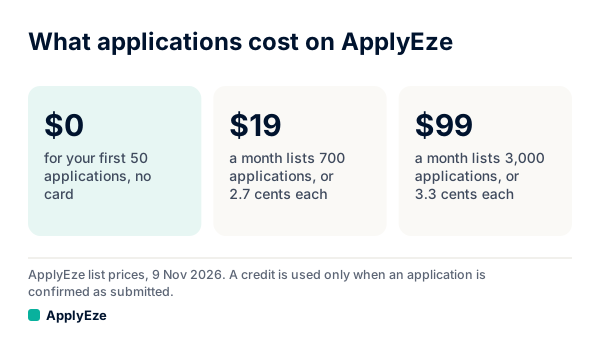
Our prices, in the chart: $0 for the first 50 with no card, $19 a month for 700, $99 a month for 3,000. That is 2.7 and 3.3 cents at full use. As of 9 November 2026, 700 at $19 is more than Tsenta Starter (600 for $19) and Wonsulting Premium (50 for $19.99). It is not the lowest price per application: Tsenta charges less at $39 for 1,500 and $99 for 4,500, and LazyApply costs less on paper if you use every daily slot for a year. We have no plan between $19 and $99 and no annual plan.
Look for what the headline leaves out. FastApply's tailoring is an add-on of $7 to $29 a month. JobCopilot's tailoring is on Elite only. AIApply's help center says tailored resumes need another subscription, and we could find no public price for Auto Apply. LazyApply bills yearly only. Then divide by what you will really send, because allowances end with the month. The price ladder does that sum at 100 a month.
7. What are the refund terms, in writing?
LazyApply: 30 days, first subscription only, fewer than 100 jobs applied, and the product must demonstrably fail. Jobright: 7 days on monthly and longer plans, 24 hours on weekly. LoopCV: 7 days if under 10% of quota is used. Simplify: non-refundable once activated. FastApply: non-refundable except where law requires. These terms are often narrow, but they exist. ApplyEze has no published policy, only this: "For anything else, a refund included, email hello@applyeze.com and we will sort it out." Rivals with written terms lead here.
Questions about what you can see
8. Can you see exactly what was sent?
Tsenta keeps a record of fields, answers and documents. Massive shows what was submitted. ApplyPass says "You'll receive every application in your inbox for total transparency." Scale.jobs, a human service, offers "a proof screenshot for every single application". ApplyEze leaves a receipt for each run: the result, the time taken, screenshots where taken and the documents sent. Ask for a sample before you pay anyone, because "you can track it" can mean many things.
9. Does it publish completion numbers?
This is where we have something to show. Across ApplyEze Autopilot, our team product, 45,376 runs in the 14 days to 9 November 2026 ended in a submitted application 79.1% of the time.
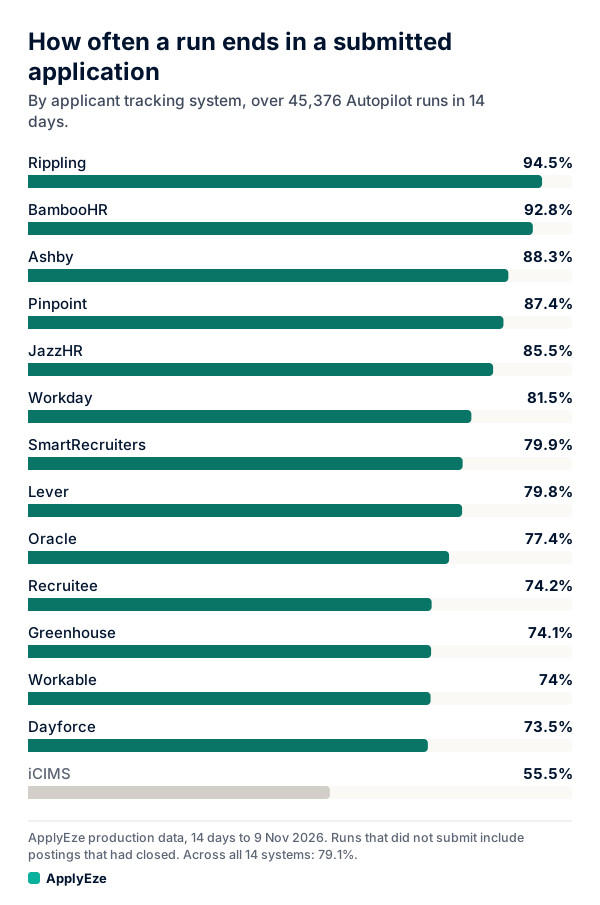
The chart runs from Rippling at 94.5% to iCIMS at 55.5%. A run that ended without a submission counts against the system for any reason, including a posting that closed. The full table has the counts. On the rival product pages we read on 9 November 2026, we did not find a figure like this. The closest we saw is an open-source project, AIHawk, whose site table lists status per system and warns that it rests on one send per site.
Those are team numbers, not a free user's result. Autopilot is set up today for staffing and recruiting teams that work with ApplyEze. If you are job hunting on your own, you can start with 50 free applications on sign-up, no card needed. You pick the matches and queue them in the desktop app, and ApplyEze fills and submits each form. Ask any vendor for its own figure.
10. Will it tell you when someone replies?
Tsenta links recruiter replies to the right application on every plan, free included. Simplify's Gmail link is free, and you approve each status change. Wonsulting syncs with Gmail. FastApply and LoopCV claim it without saying how. Rivals lead here: on a self-serve ApplyEze account you record replies yourself.
Questions about your name
11. What does it do on a question it cannot answer?
Every tool has to choose, and neither choice is free. Stopping loses the application. Filling means an answer you did not give goes to an employer under your name. Simplify says "If information is missing or Autopilot cannot complete the form, the run can fail." AIHawk's changelog says "A form no longer stops to ask." Threads about Tsenta describe wrong knockout answers (read 17 October 2026).
Our answer: hard facts come from your profile. When a required question is not covered by your saved answers, ApplyEze still fills it rather than stopping the run, so that answer may not come from you. Fill in your saved answers, use dry run first, and read your receipts. Ask every vendor the same question, in those words, and be wary of anyone who says the problem does not arise. Some employers ask applicants not to use AI or automation, and whether to apply there is your call.
12. What can it add to your resume, and can you stop it?
Tsenta has stated modes, Off, Honest and Aggressive, and warns: "Aggressive mode rewrites more freely, so review every claim." FastApply's add-on says it uses "only what your profile verifies". On ApplyEze: in an audit on 4 November 2026 of 84 sampled resumes, we found 0 invented employers, dates, degrees or numbers. ApplyEze brings the posting's named skills and tools onto your skills line, even when your own record does not list them. There is no step to remove one before a live run, so use a dry run to see what it writes, and be ready to discuss anything on the page. A certification the posting asks for is not added unless you hold it. On this question a stated mode is the stronger answer, and a dry run is how you check ours.
How named tools answer, as of November 2026
These are from each product's own pages. Claimed means stated by the vendor and not tested by us. The free path and Starter share one row, and our team product is left out on purpose.
| Tool | Who picks | Who submits | Runs | A listed price | Replies shown |
|---|---|---|---|---|---|
| ApplyEze | You, from a board ranked by rules | Software, no pause, dry run first | Your Chrome, computer on | 700 for $19 | No, you record them |
| Tsenta | You on Starter and Pro, it can on Power | Software, optional pause | Its cloud | 600 for $19 | Yes, every plan |
| FastApply | You, or above a score | Software | Browser or its servers | 200 for $14, $21 with tailoring | Claimed |
| Simplify Autopilot | You | Software, no review | Away from your browser | 20 a week, $39.99 a month | Yes, Gmail, free |
| Wonsulting | You, in its job board | Software, after you look it over | Web | 50 for $19.99 | Yes, Gmail |
| JobCopilot | Filters and selectivity | Software, optional review | Its side | From $1.05 a day for 50 matches a day | None found |
| LazyApply | Its search | Software, via extension | Your browser | $99 a year for 15 a day | None found |
| AIApply | Your filters, with a match score | Software | Its side | Price not public | None found |
Read across the row that matters to you, not down a column of prices. If you want it running with the laptop closed, Tsenta or FastApply fit where we do not. If you want to look over everything yourself and 50 a month is enough, Wonsulting does that. If you want 700 applications at $19 with a resume for each posting, and a vendor that publishes its numbers, that is ApplyEze.
What we can show
We cannot tell you we are the best tool, and neither can anyone else without data nobody publishes. Here is what we can show.
- Delivery. 94,207 applications submitted through ApplyEze since 14 August 2026, to 9,769 distinct employer names, as of 9 November 2026. The count is slightly low because an outage left 676 runs unrecorded, and a few test candidates are included.
- Reach. More than 100,000 employer boards polled directly, about 900,000 active jobs.
- Completion by system, including the weak ones, above, at a median of 2.5 minutes an application in the 7 days to 9 November 2026.
- How much it turns down, on the team product. Across 259,378 roles judged in the two weeks to 9 November 2026, 50,609 scored 6 or higher, or 19.5%, so about 4 of every 5 were turned down, with a median of 4.9 minutes from shortlist to verdict over the last 7 days. A separate model re-judged 601 decisions blind on 20 October 2026 and agreed on 502, or 83.5%. That is one model checking another, not a panel of recruiters.
- What a recruiter would send. In a blind audit on 26 October 2026 of 193 applications, 84% of Autopilot's read as ones a recruiter would send, against 69% of those recruiters hand-picked. The sample is small, and it is a model's reading.
- Resume facts. In an audit on 4 November 2026 of 84 sampled resumes, we found 0 invented employers, dates, degrees or numbers. The skills line works as question 12 describes.
- Callbacks, with denominators. At one staffing team, human callbacks per candidate per month rose from about 2 in spring to 7 for October applications, with volume more than tripled and the rate per 1,000 holding near 3. Part of that rise is better counting, and results for any one person will differ. The mass applying post has the record.
On the pages we read on 9 November 2026, we found no rival that publishes completion by system, how many roles it turns down, a blind check on that decision, callback counts with denominators or a resume audit. That puts us ahead in what is shown, not in results, because nobody can show who gets more interviews.
For someone job hunting alone, the case is concrete: 50 free applications, twice Tsenta's 25, both once and both with no card; 700 listed at $19 with a resume for each posting; and a dry run that fills a form and stops before Submit. Your next step is to put these twelve questions to any tool you are considering, and auto apply, explained covers how to test it without risking your name. If you want to check us rather than trust us, your first 50 applications are free.