

A machine learning engineer resume has to answer one question fast: did your models change something in production, or did you publish work that others build on? Those are different resumes. Of 108 ML postings we read on 9 November 2026, 87 mentioned production and 20 mentioned publications, and only 13 mentioned both. Below are line patterns for model metrics, data scale, latency and papers, a table of the numbers a reviewer is likely to challenge, and two labelled samples, one applied and one moving from research to industry. Every person, employer and figure in the sample lines and resumes is invented.
Research and production are different resumes
We read these postings through Greenhouse's public job board API: US locations, at most four per company, 39 companies, with titles naming machine learning, ML, applied scientist, research scientist, research engineer or AI engineer, and managers left out. It is one application system and leans to technology firms, and these are plain text matches, so read it as a rough sample of what these employers write, not the whole market.
| Word in the posting | Postings, of 108 |
|---|---|
| Production | 87 |
| At scale, scalable or large-scale | 83 |
| Python | 78 |
| Deploy | 76 |
| LLM or generative AI | 66 |
| Evaluation or evals | 57 |
| A/B test or experiment | 53 |
| Monitoring | 49 |
| PhD | 47 |
| Cost | 43 |
| PyTorch | 36 |
| TensorFlow | 29 |
| Latency | 26 |
| Publications or papers | 20 |
| A named venue, such as NeurIPS or ICML | 8 |
Split them by the two words that matter: 74 mentioned production and not publications, 13 both, 7 publications and not production, and 14 neither. So decide per posting which resume you are sending:
| The posting says | Lead with | Papers go |
|---|---|---|
| Production, deploy, latency, on-call | Shipped models and their online results | Near the bottom, three at most |
| Both, with "publications a plus" | Shipped work, then one line on research impact | After experience |
| Publications, novel methods, a named venue | Papers and what they enabled | Directly after your summary |
If a posting is more about experiments than serving models, our data science resume post fits better.
PhD shows the same split. It appeared in 21 of the 29 postings with research or scientist in the title, and in 26 of the other 79. A rough text match puts 32 of the 47 mentions next to words like "preferred", "plus" or "or".
Production lines: metrics, scale and latency
The pattern is what shipped, against what baseline, in what test, moving what, under what limit. These lines are samples:
| What you are showing | Sample line |
|---|---|
| An online result | Replaced a rules-based hotel ranker with a gradient-boosted model; a 4-week A/B test on 20% of traffic raised booking conversion 1.8% |
| An offline result that shipped | Raised fraud recall from 61% to 74% at 95% precision on a held-out month of transactions, then shipped to all card traffic |
| Data scale | Retrained weekly on 1.2 billion events from a 90-day window in Spark, finishing in under 3 hours |
| Latency | Served 6,000 requests a second at 38 ms p99 against a 50 ms budget by caching feature lookups and trimming the model from 900 trees to 400 |
| Cost | Cut GPU spend 35% at the same p99 by batching requests and moving to a smaller instance type |
| An LLM feature | Built an evaluation set of 1,200 hand-labeled support tickets; correct answers rose from 71% to 86%, and any release dropping the score by 2 points is blocked |
| Monitoring | Added drift alerts on 40 input features, catching a broken upstream join within 2 hours instead of at the weekly review |
Latency has earned its own line. In a KDD 2019 paper on 150 models at Booking.com, summarized by The Morning Paper, an experiment that added about 30% latency saw conversion rates fall about 0.5%. Only 26 of our 108 postings say "latency", but anyone who serves a model will ask.
The numbers a reviewer will challenge
Many guides tell you to quantify. Fewer say which numbers invite a harder look. This table is our judgment on where a technical reader pushes, with sources where they exist.
| The line as often written | The question it invites | What to write instead |
|---|---|---|
| "Achieved 98% accuracy" | On what class balance? Google's ML course notes that with a 1% positive class, a model that always says no scores 99% and is useless | Precision and recall at a stated operating point, plus the base rate |
| "Improved AUC by 5%" | Did it ship, and what moved? Booking.com's authors found that "increasing the performance of a model does not necessarily translate into a gain in [business] value" | The offline number, then the online test, or say plainly it did not ship |
| "Drove $4M in revenue" | Measured by what? Who else changed the product that quarter? | The test design, share of traffic and your part |
| "Reduced latency by 60%" | Mean or tail? The Google SRE book prefers percentiles to the mean because a high percentile shows "a plausible worst-case value" | p50 and p99, before and after, at stated traffic |
| "Scaled to 1 billion users" | Is that the company's user count or your model's traffic? | Requests your service handled |
| "Trained on 10 TB of data" | So what did the size change? | Refresh rate, training time or the lift over a smaller window |
| "State-of-the-art results" | What split, and against what? Kapoor and Narayanan's 2022 survey found leakage errors affecting 329 papers across 17 fields | The split method and the baseline you beat |
| "Improved LLM quality" | Measured how, on how many examples, labeled by whom? | Evaluation set size and who labeled it |
The test is simple. If you cannot explain how a number was measured in two sentences, cut it. A true scope line ("owned the ranking service for search") is safer than a figure you inherited from a slide.
Research lines: papers and impact
An applied reader wants to know two things: is the work real, and can you ship. So:
- Give the format a reader can check. Your author position, title, venue, year, link. Label a preprint as a preprint.
- List three to five. "Selected publications" with a link to the full list beats a page of citations.
- Add one impact line per paper, only if it is checkable. Adoption by another group, released code people use, or a method taken into a product. If there is none yet, leave it off.
- Translate the work into engineering. Your cluster size, the data loader you wrote and the training time you cut are the parts an applied team recognizes.
- Name the comparison. "Cut memory 40% against the prior baseline at equal recall on three public benchmarks" tells a reader more than "novel approach".
Sample: applied ML engineer
This is a sample. The person, employers and numbers are invented.
MAYA LINDQVIST
Seattle, WA | (555) 010-4417 | maya.l@example.com
linkedin.com/in/example | github.com/example

EXPERIENCE
Machine Learning Engineer, Harborline Travel, Seattle, WA | Mar 2023 to present
- Replaced a rules-based hotel ranker with a gradient-boosted model; a 4-week
  A/B test on 20% of traffic raised booking conversion 1.8%, then rolled out to
  all search traffic
- Served 6,000 requests a second at 38 ms p99 against a 50 ms budget by caching
  feature lookups and trimming the model from 900 trees to 400
- Retrained weekly on 1.2 billion events from a 90-day window in Spark; added
  drift alerts on 40 input features
- Built an evaluation set of 1,200 hand-labeled support tickets for the LLM
  answer feature; correct answers rose from 71% to 86%, and any release dropping
  the score by 2 points is blocked

Software Engineer, Data Platform, Cobalt Retail, Portland, OR | Jun 2020 to Feb 2023
- Moved 30 nightly Airflow jobs to incremental loads, cutting warehouse spend 22%
- Built the feature store client used by 4 teams; training and serving mismatches
  found in review fell from 9 a quarter to 1

SKILLS
Python, SQL, PyTorch, XGBoost, Spark, Airflow, Redis, Kubernetes, AWS

EDUCATION
MS Computer Science, Cascade State University | 2020
Note what is missing: no summary of passions, no list of every library, no offline metric standing alone. The second job earns its place because it shows the pipeline work that production lines depend on.
Sample: research to industry
This is a sample. The person, papers, employers and numbers are invented, though the venue names are real. It targets an applied scientist posting that says "publications a plus".
TOMAS ABARA, PhD
Boston, MA | (555) 010-7320 | t.abara@example.com
scholar.example.com/tabara | github.com/example

EXPERIENCE
Postdoctoral Researcher, Language Systems Lab, Bayview University | 2023 to present
- Developed a retrieval method for long documents that cut memory use 40% against
  the prior baseline at equal recall on 3 public benchmarks; released the code,
  used by 2 other labs in published follow-up work
- Wrote the distributed data loader for the lab's 64-GPU cluster, cutting epoch
  time from 5 hours to 70 minutes; now used by 6 lab members

Applied Science Intern, Meridian Health, Boston, MA | Summer 2022
- Shipped a clinical note classifier behind a feature flag to 2 hospital sites;
  91% precision at 80% recall against 84% for the prior rules, checked by hand
  on 500 notes

SELECTED PUBLICATIONS (full list at the Scholar link)
- First author. Retrieval over long documents at low memory. ACL 2025.
- First author. Calibrating rankers under label shift. EMNLP 2024.
- Second author. Preprint: Evaluating answer quality without gold labels. 2026.

SKILLS
Python, PyTorch, SQL, Docker, Slurm, experiment design

EDUCATION
PhD Computer Science, Bayview University | 2023
Experience comes first even though the person is a researcher, because the posting asks for applied work and treats papers as a bonus. The internship is short and carries the most weight, since it is the one place this resume shows a model reaching users. For a research scientist posting, move the publications above experience and add one impact line under each. If you have no shipped work, a small deployed project you can demo does part of the job of that internship. Say what it is, and do not dress it up as production.
GitHub, papers and links on forms
Forms give you fewer boxes than you would expect. Of the same 108:
| Field | On the form | Marked required |
|---|---|---|
| 103 | 25 | |
| Cover letter | 96 | 0 |
| Website or portfolio | 60 | 0 |
| A question about AI | 20 | 20 |
| A field naming GitHub | 6 | 0 |
| A field for Google Scholar or publications | 0 | 0 |
So put every link in your resume header, since no form in the sample had a place for your papers. Use the website box for a single page linking GitHub, Scholar and your two strongest projects. Leave GitHub blank if it holds only coursework and forks. Our software engineer resume guide covers how to present repositories.
Written questions are where ML forms surprise people, so draft these before you start. Elastic requires you to "Describe a GenAI or agentic project you built independently, end-to-end." A staff software posting at Flexport warns of an "AI Project Deep Dive" and asks for the project up front. Figma's PhD internship has an optional box for "your PhD research in 3-5 sentences". Three to five sentences on your strongest project, written once and adapted, covers most of these.
What the numbers say about the field
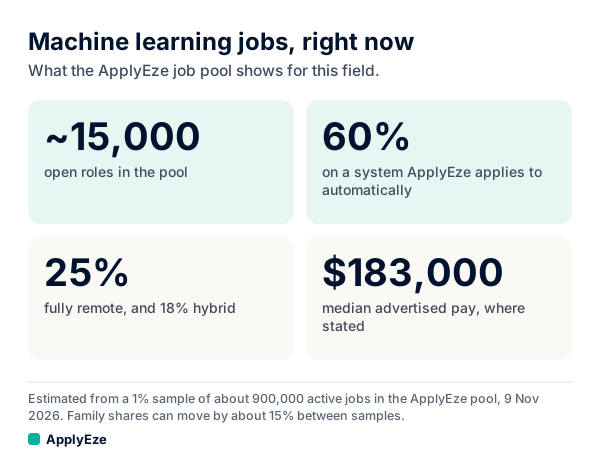
ApplyEze polls more than 100,000 employer boards directly, about 900,000 active jobs. A 1% sample of that pool on 9 November 2026 puts machine learning at roughly 15,000 open roles, roughly 60% of them on a system ApplyEze applies to, roughly 25% fully remote and roughly 18% hybrid, with a median advertised pay of $183,000 where a range is stated. About 15% of postings across the pool state pay at all. These figures are rough, and a second sample moved field shares by up to about 15%.
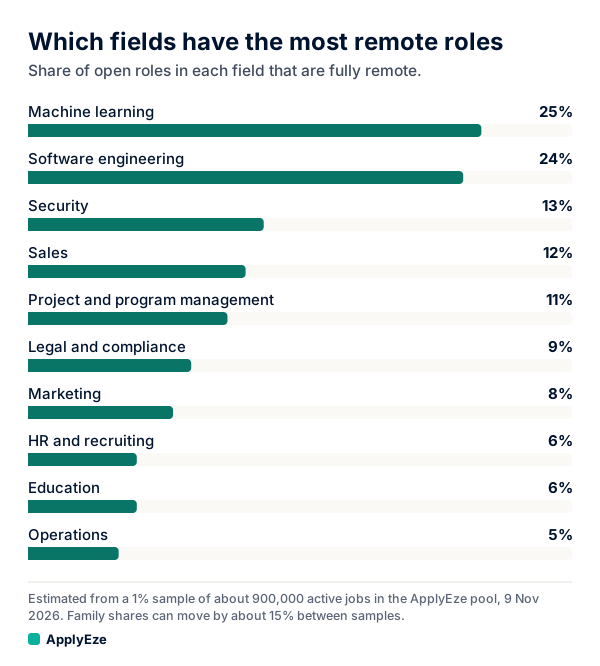
Among fields with a solid sample, that 25% is the highest fully remote share. Software engineering at 24% is level with it given the noise, and both sit well above security at 13% and sales at 12%. A few thin fields show higher shares on very few rows, so we would not read much into those.
The harder number is level. Of 289 ML titles on the 83 company boards we could read that day, 186 said senior, staff, principal or lead, and 60 gave no level. Another 43 used early-career words, and 39 of those were internships. Among postings stating years, the median minimum was 5, by a rough text match. If you are early in your career, the realistic routes are an internship, a software or data role next to an ML team, or a title with no level whose years line you meet. One system on one day is a narrow view, but it is enough to plan around.
If you want a resume built per posting without writing each by hand, that is what ApplyEze does on the self-serve path: for each application, an AI model reads that posting and your real history and writes a resume for it. Each file is read back the way a parser reads it before the form is touched. Your employers, job titles, dates, schools, degrees and certifications come from your own record, and code rejects a rewrite that adds a figure, employer, school or credential your record does not hold. An audit of 84 sampled resumes on 4 November 2026 found 0 invented employers, dates, degrees or numbers. Skills work differently: ApplyEze brings the posting's named skills and tools onto your skills line, even when your own record does not list them. There is no step to remove one before a live run, so use a dry run to see what it writes, and be ready to discuss anything on the page. A certification the posting asks for is not added unless you hold it. See also what belongs on a skills line.
Two steps before you start. Put your p99s and A/B results in your record, since the rewrite works from the figures you hold. And queue the postings whose stack you could defend in an ML loop, since you choose what goes in the queue. The desktop app then fills and submits each form on your computer, which stays on and awake until the queue finishes, and Workday and Oracle jobs need an application inbox connected. If you would rather spend your evenings on an evaluation set than on forms, your first 50 applications are free, once per email address with no card.