

A good data science resume example shows what a model or analysis changed, and leaves the library for the skills line. We read 78 data science postings on 9 November 2026 to check that advice. Of those, 71 named SQL, 60 named A/B tests or experiments and 70 mentioned decisions. Only 6 named a modeling library such as PyTorch, TensorFlow, scikit-learn or XGBoost. Employers largely assume the tools and ask what you did with them. Below is a table that rewrites library-first lines, then labelled samples for an analytics-leaning and a modeling-leaning data scientist. If you are after analyst roles, our data analyst resume post is the better fit. Every person, company and figure in the sample lines is invented.
Two kinds of data scientist
The title covers more than one job. When Elena Grewal led data science at Airbnb, she wrote in a 2018 article: "Sometimes it is purely machine learning. Sometimes it's business intelligence at a tech company." She added that "Hiring is complicated when candidates come with a vague title". Airbnb split the work into analytics, inference and algorithms tracks. That framework is eight years old and from one company, but the postings still sort the same way.
We read these through Greenhouse's public job board API: US locations, at most five per company, 28 companies. It is one application system and leans to technology firms, and these are plain text matches. Sorted by two signals:
| What the posting mentions | Postings, of 78 | Which resume to send |
|---|---|---|
| Experiments or causal work, and not production or deployment | 32 | Analytics-leaning |
| Both | 29 | Lead with whichever the first three bullets of the posting stress |
| Production or deployment, and not experiments | 14 | Modeling-leaning |
| Neither | 3 | Read closely |
Titles help when they exist. Discord's "Staff Data Scientist, Causal Inference & Experimentation" and Lyft's "Senior Data Scientist, Algorithms" tell you plainly. "Data Scientist" alone does not, so read the responsibilities. Grewal's other point is worth keeping too: analytics experts "would have less impact if they tried to apply machine learning" to their problems. Dressing analytics work up as modeling can hurt you with the reader who wrote that posting.
State what the model changed
Many sample resumes list a stack and then say "built models". The fix is to put the change first. Each right-hand line is a sample:
| Library-first line | Change-first line |
|---|---|
| Built churn models using Python, scikit-learn and XGBoost | Built a churn model that let support call the 8% of accounts holding 41% of predicted losses; 12-week holdout showed 6% fewer cancellations |
| Performed A/B testing using Python and SQL | Ran a pricing test on 180,000 users that stopped a planned discount; it lifted orders 3% and lowered margin 5% |
| Developed time series forecasts in Prophet | Replaced a spreadsheet demand forecast; error fell from 22% to 13% on a held-out quarter, and the buyers now order from it weekly |
| Used causal inference methods to analyze marketing | Used a geographic holdout to show paid search drove 40% fewer new customers than attribution claimed; budget moved to two other channels |
| Created dashboards in Tableau | Defined the activation metric the growth team now reports on, and built the dashboard for it, used in the weekly review |
| Applied NLP to customer feedback | Classified 90,000 support tickets by cause, at 88% precision on 500 checked by hand, showing billing issues had doubled after the plan change |
The pattern is four parts: the decision or system, the method, the change, and how you know. Name a library only when it is part of how you know.
Two lines most resumes miss:
- A result that stopped something. "Showed a planned feature had no measurable effect on retention at 80% power, and the team dropped it" is a good line. Saving a team from a bad bet is a real outcome.
- A model that did not ship. Say so. "Prototype beat the baseline by 4 points offline; not shipped, because the data refresh could not meet the product's timing" reads better than letting a reader assume, and it gives you something true to say in an interview.
If you cannot say how a figure was measured, cut it. The machine learning engineer resume post has a table of which numbers reviewers push on, and most apply here.
Tools and keywords
| Word in the posting | Postings, of 78 |
|---|---|
| Python | 76 |
| SQL | 71 |
| Stakeholder, cross-functional or partner with | 70 |
| Decision | 70 |
| A/B test or experiment | 60 |
| Machine learning, predictive or statistical model | 57 |
| Production or deployment | 43 |
| R | 36 |
| Causal | 35 |
| Forecasting | 23 |
| A named modeling library | 6 |
So a skills line can be short: SQL, Python, then the methods, then only the tools you would defend. Do not stop at the skills line, though. Put SQL in a bullet with its data size, and experiment design in a bullet with its result. A method listed as a word proves less than a method used in a sentence. For layout and grouping, see our skills section guide.
Sample: analytics-leaning
This is a sample. The person, employers and numbers are invented. It targets a posting that stresses experiments, metrics and partnering with product.
PRIYA NAIR
Chicago, IL | (555) 010-3381 | priya.n@example.com | linkedin.com/in/example

EXPERIENCE
Data Scientist, Product, Fernway Grocery, Chicago, IL | Feb 2023 to present
- Ran 14 checkout experiments with product managers; a delivery fee test on
  180,000 users stopped a planned discount that lifted orders 3% but cut margin 5%
- Defined the activation metric the growth team now reports on, replacing 3
  conflicting versions; wrote the SQL model and the weekly dashboard
- Used a geographic holdout across 12 markets to show paid search brought 40%
  fewer new customers than attribution claimed; $600K a year moved to 2 channels
- Showed a planned loyalty tier had no measurable effect on retention at 80%
  power; the team dropped it before engineering work began

Data Analyst, Crestline Bank, Chicago, IL | Jul 2020 to Jan 2023
- Sized card fraud losses by merchant type in SQL on 40 million transactions;
  the risk team changed review rules for the top 2 categories
- Built the branch staffing report used by 30 regional managers

SKILLS
SQL, Python (pandas, statsmodels), experiment design, causal inference, Tableau

EDUCATION
MS Statistics, Lakeshore University | 2020
Each bullet starts from a decision, and the only tools named are the ones that matter. The analyst job stays because it shows SQL at scale and a move upward.
Sample: modeling-leaning
This is a sample. The person, employers and numbers are invented. It targets a posting that stresses forecasting, pricing models and deployment.
DANIEL OKORO
Austin, TX | (555) 010-9024 | d.okoro@example.com
linkedin.com/in/example | github.com/example

EXPERIENCE
Data Scientist, Algorithms, Redline Mobility, Austin, TX | May 2022 to present
- Built the surge pricing model now running in 9 cities; a 6-week switchback test
  raised completed trips 2.4% with no drop in driver earnings
- Replaced a rules-based ETA estimate with a gradient-boosted model; median
  error fell from 4.1 to 2.9 minutes, deployed with weekly retraining and alerts
- Forecast rider demand by zone every 15 minutes in Python and SQL; error fell
  from 22% to 13% on a held-out quarter, and ops now schedules from it
- Prototype beat the fraud baseline by 4 points offline; not shipped, because the
  data refresh could not meet the product's timing. Wrote up why

Data Scientist, Lumen Utilities, Dallas, TX | Aug 2019 to Apr 2022
- Modeled transformer failure risk for 60,000 assets; inspection crews moved to
  the top decile and found 2.5 times as many faults per visit

SKILLS
Python, SQL, XGBoost, scikit-learn, Spark, experimentation, time series, Airflow

EDUCATION
BS Applied Math, Hill Country State University | 2019
This one names libraries, because a modeling posting may want them, but they sit on the skills line while each bullet leads with what moved. The unshipped prototype is deliberate. If you are drifting toward model serving and latency, see the ML engineer post, since that is a different resume.
New graduates and PhDs
The entry point is narrow on these boards. Of 94 US data science titles across 83 company boards, 67 said senior, staff, principal or lead, and 13 gave no level. The remaining 14 used early-career words, and 13 of those were internships. Among sampled postings stating years, the median minimum was 5, by a rough text match. One system on one day cannot describe the whole market, but it points to a plan with more than one route.
New graduates. Put education first, then two or three projects, each ending in a stated result and how you checked it. A baseline comparison on a held-out set shows more than a competition rank alone. Add any analyst internship, because analyst roles can be a way in. Our guide on getting into data analytics lists the titles to apply to. If a project never left a notebook, say that.
PhDs. The Bureau of Labor Statistics says data scientists typically need at least a bachelor's degree, and that some employers require or prefer a master's or doctorate. In our sample, 40 postings mentioned a PhD and 34 a master's. Translate the thesis into the same four parts: the question, the method, the result and how you know. Replace "developed novel estimators" with what the estimator let someone conclude. Forms for internships ask directly. Stripe asks if you are enrolled in a PhD program and when you will finish, and requires 1 to 2 paragraphs "about a past data-related project". Draft that paragraph now.
Links on forms are sparse here too. Of the 78 forms, 3 named GitHub, 50 had a website box, none had a field for Google Scholar and none required a cover letter. So your links belong in the resume header.
How thin the numbers are
ApplyEze polls more than 100,000 employer boards directly, about 900,000 active jobs, but a 1% sample of that pool gives data science only 30 rows. That means a few thousand open roles, and a second sample moved field shares by up to about 15%, so this is no market figure. The median advertised pay on that row, about $185,000, comes from very few postings, so treat it as thin and not as what the field pays. Only about 15% of postings across the pool state pay at all.
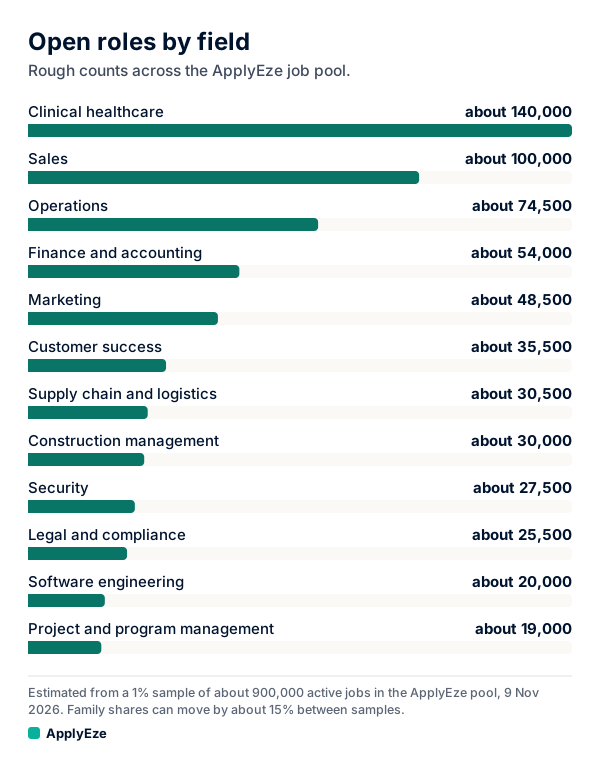
That chart runs from clinical healthcare at about 140,000 down to project and program management at about 19,000. Data science does not appear on it, and our pay chart leaves it out as well. Part of the reason is likely naming, since work described as data science also appears in machine learning, roughly 15,000 roles in the same sample, and in analytics and product titles. The rough scale does hold across two independent looks. On the job boards we read, there were 94 data science titles against 860 software engineer titles, about 1 to 9. In the pool sample it is 30 rows against 197, about 1 to 7.
For a real market number, use the government's. The Bureau of Labor Statistics reports a median wage of $120,230 for data scientists in May 2025, 35% projected growth from 2025 to 2035, and about 24,800 openings a year. It is broader than the title you are applying to, and it still rests on far more than our 30 rows. Data roles also take more interviewing than most. Ashby reports they host the most interviews of any category, 19.5 per hire, counted across all the candidates for that hire.
If tailoring is what limits you, ApplyEze writes a resume per posting on the self-serve path: for each application, an AI model reads that posting and your real history and writes a resume for it. Each file is read back the way a parser reads it before the form is touched. Your employers, job titles, dates, schools, degrees and certifications come from your own record, and code rejects a rewrite that adds a figure, employer, school or credential your record does not hold. An audit of 84 sampled resumes on 4 November 2026 found 0 invented employers, dates, degrees or numbers. Skills work differently: ApplyEze brings the posting's named skills and tools onto your skills line, even when your own record does not list them. There is no step to remove one before a live run, so use a dry run to see what it writes, and be ready to discuss anything on the page. A certification the posting asks for is not added unless you hold it.
So put your lift and holdout results in your record first, since the rewrite works from the figures you hold. Then pick your matches and queue them in the desktop app, which fills and submits each form on your computer while it stays on and awake. Workday and Oracle jobs need an application inbox connected. If you would rather spend your evenings on a holdout test than on tailoring, your first 50 applications are free, once per email address with no card, and a credit is used only when an application is confirmed as submitted.