

An operations manager resume should read differently in a warehouse, a clinic and a software company, because the title means different work in each. The Bureau of Labor Statistics says general and operations managers oversee activities "too diverse to be classified into one area of management or administration", and it counts about 3.6 million of them. Generic advice follows from that vagueness: "optimized processes", "drove efficiencies". A reader who runs a plant or a clinic discounts those lines at once. What follows is the vocabulary of each setting, a way to check your numbers before someone else does, the exact wording for headcount, budget and shifts, and three invented samples.
Three settings, three resumes
Before you write a line, decide which of these you are applying to. The KPI names are standard in each setting, and the table is our summary.
| Warehouse or plant | Clinic or services | Software company | |
|---|---|---|---|
| What you protect | Throughput, safety, labor cost | Access, flow, collections | Speed of internal processes, spend |
| Numbers to use | Units per labor hour, on-time shipping, inventory accuracy, recordable rate, scrap | Third next available appointment, no-show rate, visits per provider, days in accounts receivable | Onboarding time, quote-to-cash days, vendor spend, forecast accuracy |
| People line | Associates, leads, shifts, temporary staff | Providers, staff, locations | Direct reports, plus the teams you work across |
| Rules you answer to | Safety recordkeeping, quality audits | Licensing surveys, HIPAA training | Finance controls, contracts |
| What gives you away | Saying "stakeholders" for the floor | Calling patients "customers" | Describing a software team in terms of shifts |
Here is one accomplishment, shortening a slow process, written for each.
- Warehouse: Cut dock-to-stock from 18 hours to 7 across about 1,100 inbound loads a year.
- Clinic: Cut third next available appointment from 19 days to 8 in 10 months.
- Software: Cut new-customer onboarding from 31 days to 14 across 180 customers.
Those are samples, and so is every number from here on unless it has a source. If you are moving between settings, translate your numbers into the target's terms, and be ready to explain the move.
The clinic term needs a note, because it surprises people outside health care. A National Academies report explains why the third opening is measured rather than the first: "Because the first and second available appointments are often the result of last-minute cancellations or other events, the third next available appointment best represents the performance of the appointment access system as a whole." Using that term correctly tells a clinic director you have done the job.
KPI lines that read as real
A line reads as real when it has four parts: a starting point, a result, a volume and a time period. Take any one away and a reader starts to wonder.
| Reads as filler | Reads as real |
|---|---|
| Improved productivity by 30% | Raised units per labor hour from 41 to 52 in 14 months, with volume up 9% |
| Reduced no-shows significantly | No-show rate fell from 14% to 9% across about 41,000 scheduled visits in a year |
| Streamlined vendor management | Cut 34 of 120 software vendors, saving $410,000 a year on $2.6M of spend |
Then run your numbers past a skeptical reader. Most resume guides stop at "quantify your impact" and hand you figures nobody can check. An operations reader can do this math in their head, so do it first. Here are three checks, with invented figures and our arithmetic.
Check the claim against the payroll. Take a site with 62 associates at about 2,000 hours a year and $24 an hour. That payroll is 62 × 2,000 × $24 = $2,976,000. A line saying "saved $1.2M in labor" claims 40% of payroll. With the same staff and volume, nobody believes it. "Reduced overtime by $180,000", about 6%, is a number a plant manager will accept and ask about.
Calculate the safety rate properly, and show the base. BLS gives the formula: the number of injuries and illnesses times 200,000, divided by hours worked. The 200,000 stands for 100 full-time employees at 40 hours a week for 50 weeks. Our 62-person site works about 124,000 hours, so:
- 1 case: (1 × 200,000) ÷ 124,000 = 1.6
- 3 cases: (3 × 200,000) ÷ 124,000 = 4.8
One injury moves that site's rate by 1.6. So "cut recordable rate by 67%" may describe two fewer cases, and a safety-minded reader knows it. Write "Recordable rate 1.6 in 2025 (1 case, about 124,000 hours), down from 4.8 in 2023 (3 cases)". For scale, BLS put private industry at 2.3 cases per 100 full-time equivalent workers in 2024, though your own industry is the fairer comparison.
Check for what else changed. If volume fell 20%, a fall in overtime is no achievement. If you added a provider, more visits do not prove better scheduling. Say what you changed and what stayed the same: "with volume up 9%" does a lot of work in the first row above.
Keep the numbers you could defend with a report in hand, and drop the rest.
Headcount and budget
Vague size is the most common weakness in these resumes. "Managed a large team" could mean 6 or 600. BLS also says most general and operations managers hired from outside need lower-level supervisory or management experience, so a reader wants to see how many people, through how many layers, and for how long. If you came up from the floor, make those steps visible. Our guide on showing a promotion on a resume covers the format.
| Say this | It tells the reader | Instead of |
|---|---|---|
| Lead 4 supervisors and 62 associates across 2 shifts | Span and layers | Managed a large team |
| 3 direct reports, working across sales, finance and support | The real size, without inflation | Led cross-functional teams |
| Owned a $3.1M labor budget, reporting variance monthly | You could approve spending | Responsible for budget |
| Tracked a $400,000 vendor budget and flagged variances to the director | Real work, honestly scoped | Managed $400,000 |
| Second shift, 6 days, on call for 2 sites | The hours you can actually work | Flexible schedule |
| Added up to 30 temporary staff at peak | You have handled surges | Scaled operations |
Shift lines do something other fields do not need. A hiring manager with a nights opening will look for them. If you have run nights, weekends or a rotating schedule, say so.
Sample: warehouse or plant
Sample (invented). Operations Manager, regional distribution center, Apr 2022 to present

Summary: Operations manager for a 240,000 sq ft distribution center running 2 shifts.

- Lead 4 shift supervisors and 62 associates, plus up to 30 temporary staff at peak.
- Raised units per labor hour from 41 to 52 in 14 months by re-slotting the top 800
  SKUs and moving replenishment to second shift, with volume up 9%.
- Cut dock-to-stock from 18 hours to 7 across about 1,100 inbound loads a year.
- Inventory accuracy rose from 96.2% to 98.8% after moving to weekly cycle counts.
- Recordable rate 1.6 in 2025 (1 case, about 124,000 hours), down from 4.8 in 2023
  (3 cases).
- Own a $3.1M labor budget; reduced overtime by $180,000 year on year.
If your work leans toward planning, sourcing and logistics more than running a building, our supply chain resume guide may suit you better.
Sample: clinic or services
Sample (invented). Clinic Operations Manager, 3-location primary care group, Jan 2021 to present

Summary: Run daily operations for 3 clinics with 9 providers and 28 staff, about 37,000
visits a year.

- Cut third next available appointment from 19 days to 8 in 10 months by rebuilding
  provider templates and holding same-day slots.
- No-show rate fell from 14% to 9% across about 41,000 scheduled visits after adding
  text reminders and a waitlist.
- Days in accounts receivable fell from 46 to 33 through a weekly denial review with
  the billing vendor.
- Front desk departures fell from 6 of 14 staff in 2023 to 2 of 14 in 2025.
- Own a $4.2M operating budget. Led state licensing surveys at all 3 sites and ran
  annual HIPAA training for all staff.
Note the staffing line: 6 of 14 is more believable than "reduced turnover 67%", and it comes from the same two numbers.
Sample: software company
Sample (invented). Operations Manager, B2B software company, 220 employees, Aug 2022 to present

Summary: Business operations manager covering onboarding, vendor spend and the monthly
operating review.

- Lead 3 direct reports and work across sales, finance and support.
- Cut new-customer onboarding from 31 days to 14 across 180 customers by moving handoffs
  into one system and naming a single owner per account.
- Reduced quote-to-cash from 12 days to 5 by fixing contract routing with finance.
- Cut 34 of 120 software vendors, saving $410,000 a year on $2.6M of spend.
- Built the monthly operating review: 12 metrics, each with one owner, used by the
  leadership team to set priorities.
The summary line in each sample carries the setting and the size in one sentence. For more patterns, see our resume summary examples.
Onsite roles and forms
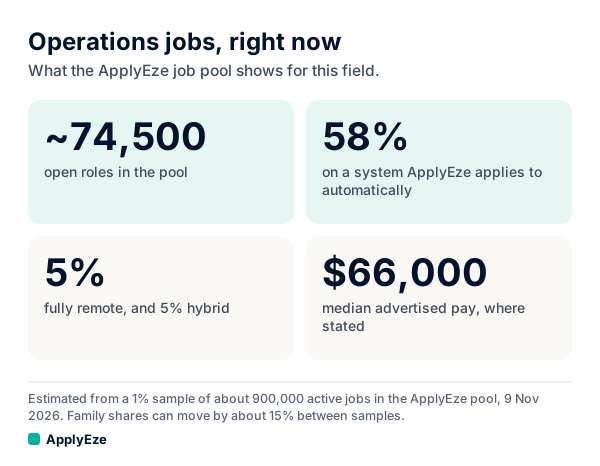
ApplyEze polls more than 100,000 employer boards directly, and the chart shows that pool in a 1% sample on 9 November 2026. Operations came to 744 sampled rows, roughly 74,500 open roles, the third largest family after clinical healthcare and sales. Only about 5% were fully remote, and about another 5% hybrid. Roughly 58% sat on a system ApplyEze applies to. The median advertised pay was about $66,000.
That pay figure needs care. It is the midpoint of advertised ranges, among postings that state pay, and only about 15% of all postings do. The family label covers the whole field, so it is wider than manager roles. BLS reports a median of $105,770 for general and operations managers in May 2025, a different group, with medians from $75,860 in retail trade to $151,040 in professional, scientific and technical services among the industries BLS highlights. Treat ours as a rough read of postings and not as a manager's salary. A second sample differed by up to about 15% per family.
With so few remote roles, where you live decides much of your search. So put your city and state on the resume, and if you are willing to move for the right job, say so in your summary. Application forms for on-site work often ask about relocation, commute and start date as well.
Here is how that works if you apply through ApplyEze. On the board, location is one of the hard filters applied before roles are ranked, so the locations you save decide what you see. On a form, hard facts come from your profile. When a required question is not covered by your saved answers, ApplyEze still fills it rather than stopping the run, so that answer may not come from you. Fill in your saved answers, use dry run first, and read your receipts. For this field, that means saving your real answer on relocation before you start.
Your KPI lines work the same way. Your employers, job titles, dates, schools, degrees and certifications come from your own record, and code rejects a rewrite that adds a figure, employer, school or credential your record does not hold. An audit of 84 sampled resumes on 4 November 2026 found 0 invented employers, dates, degrees or numbers. So a resume that says "improved productivity" stays without a number, and the figures have to be in what you upload. Skills work differently: ApplyEze brings the posting's named skills and tools onto your skills line, even when your own record does not list them. There is no step to remove one before a live run, so use a dry run to see what it writes, and be ready to discuss anything on the page.
ApplyEze has delivered 94,207 applications to 9,769 employers since August, counted on 9 November 2026. You pick the matches and queue them in the desktop app, which fills and submits each form on your computer while it stays on and awake, and Workday and Oracle jobs need an application inbox connected. So put your real KPI lines in your resume first. If you would rather spend your evenings on the floor than on application forms, your first 50 applications are free, once per email address with no card, and a credit is used only when an application is confirmed as Submitted.