

A strong supply chain resume shows four things on every line that matters: the scope you ran, a before and after, how the number was measured, and what it cost somewhere else. Cost, service and inventory trade off against each other in this field, and the person reading your resume knows it. A 30% cut in inventory can also be a cut in availability. This post gives you line patterns that survive that reader: how to state savings you only partly owned, how to define a service number so it means something, three labelled samples, and how to treat ERP names as the real keywords they are.
What a hiring manager reads for
A supply chain hiring manager can do the arithmetic on your lines, so they read for different things than a general recruiter does.
- Scope. SKUs, spend, suppliers, sites, people. "Managed inventory" says nothing until it says 1,850 SKUs across two plants.
- The trade-off. A gain in one measure may have been paid for in another. Say how you moved fill rate or on-time-in-full (OTIF) on a product family, and what it cost in inventory.
- Ownership. Did you decide, recommend or report? All three are real work, and only one is "led".
- Systems. Which ERP, which module, how deep.
The field's numbers add one more thing to read for, which is location.
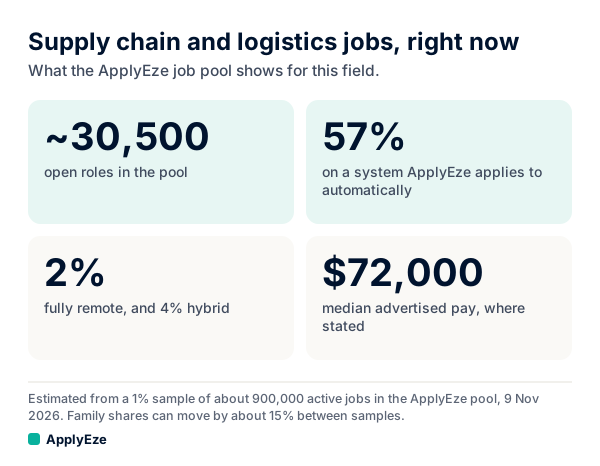
In the job pool we track, this field is roughly 30,000 open roles, with roughly 2% fully remote and roughly 4% hybrid, from a 1% sample of about 300 postings on 9 November 2026. So put your city at the top, and say so if you will relocate or work a second shift. The median advertised pay of about $72,000 covers only postings that state pay, about 15% of postings across our pool. Treat it as a rough clue rather than a salary benchmark, and do not build your ask on it.
Savings you can defend
Savings is the number most often inflated, and the person across the table may well have been the one who reported it to finance. Sievo, a procurement analytics vendor, describes hard savings as "those that can be proven and that find their way into the accounts". It gives the CIPS description of cost avoidance as a spend "lower than would otherwise have been", and notes that it is often called soft savings. Both are real work. They are not the same claim, so sort your numbers first. The examples here are samples, written for this post.
| Type | What it means | How to write it |
|---|---|---|
| Hard savings | Lower price or spend against a stated baseline, provable in the accounts | Cut unit price 7.1% against last year's PO price, saving $120,000 a year on 400,000 units |
| Cost avoidance | Spend lower than it would have been, with no drop on the books | Held a proposed 8% increase to 3% on $1.8M of spend, avoiding about $90,000 |
| Identified, not delivered | A plan or a pipeline | Identified $400,000 in sourcing opportunities, of which $150,000 is contracted |
| Team program | A shared number | Name the total and your part (see below) |
The first line shows its math, and a reader can check it. The price went from $4.20 to $3.90, which is $0.30 × 400,000 units = $120,000, and $0.30 ÷ $4.20 = 7.1%. Cost avoidance carries the word "avoiding", and that one word earns you trust.
Before a savings number goes on the page, answer five questions:
- Against what baseline? Last year's price, the first quote and the budget give very different figures.
- Annualized or in-year? A deal worth $600,000 a year that starts on 1 October lands only $150,000 by 31 December. Both are true, so say which.
- Who validated it? "Validated by plant finance" is a short phrase that does a lot of work.
- Net of what? A cheaper supplier with expediting fees, new tooling or longer lead times may not have saved what the price suggests.
- What share was yours? This is where most resumes go wrong.
Stating savings you only partly owned
Take a sample case. A carrier consolidation across three distribution centers saved a validated $1.2M a year, and you ran the bid for one of the three.
| Version | Line | Verdict |
|---|---|---|
| Inflated | Saved $1.2M in freight costs | Falls apart at the first follow-up question |
| Scope stated | Ran the carrier bid for 1 of 3 DCs in a consolidation that saved $1.2M a year, validated by finance | Honest, and still shows the size of the program |
| Split known | Ran the carrier bid for 1 of 3 DCs; my lanes delivered $430,000 of the program's $1.2M a year | Use only if finance split it this way |
| Supporting role | Built the lane cost model used to award a carrier consolidation that saved $1.2M a year | Strong, and it says exactly what you did |
Do not divide the total by the number of people or sites to create a share. If nobody measured your part, say what you did and let the total show the scale. A small number that is yours reads better than a big one that is not.
If the figures are confidential, use percentages and a range for scope. "Reduced unit cost 6% on a category over $10M" still tells the reader what they need.
Service level and inventory lines
"Service level 96%" tells a hiring manager almost nothing, because the term covers several measures.
| Term | What it counts | Add this to the line |
|---|---|---|
| Fill rate | Share of ordered units, cases or lines shipped complete | Which unit you counted |
| OTIF | On time and in full | The date used, and order, line or case level |
| Cycle service level | How often an item avoids a stockout, often measured per replenishment cycle | The item group and the target |
| Inventory record accuracy | Share of locations or items where the record matches the count | How it was audited |
OTIF is the one to be most careful with. "On time" can mean the date the retailer requested or the date the manufacturer promised, and "in full" can mean orders, lines or cases. In a 2019 survey with the Trading Partner Alliance, McKinsey found that 79% of 24 major retailers and manufacturers preferred to count in full at the case level, with no consensus on the delivery window. So the same performance can produce different figures at different companies. Write "OTIF 96%, case level, to requested date", and the number means something.
Inventory lines are also arithmetic. Turns are annual cost of goods sold divided by average inventory, and days on hand are the days in the year divided by turns. Sample math: $48M in cost of goods sold over $12M of average inventory is 4.0 turns, or about 91 days on hand. At 4.8 turns on the same cost of goods sold, inventory is $10M and days on hand are about 76. So the line can say what the reader actually cares about, which is cash:
Raised turns from 4.0 to 4.8 on flat cost of goods sold, releasing $2M of inventory, with line fill holding at 96%.
The phrase "on flat cost of goods sold" matters. If volume grew 20%, turns rise with no skill from you, and a sharp reader will ask.
Three patterns cover most lines:
- Service: Raised [measure, defined] from X to Y over [period] on [scope], with [inventory or cost effect].
- Inventory: Moved [turns or days on hand] from X to Y on [scope], releasing $Z, with [service measure] holding at N.
- Supplier: Moved [n suppliers or parts] from X to Y on [lead time, on-time delivery or quality] by [what you did].
Sample: planner
All three samples below are written for this post, with invented numbers. They are not real people or employers.
Material Planner, consumer electronics contract manufacturer, 2023 to present
- Planned 1,850 active SKUs across two plants in SAP S/4HANA (MRP review, exception messages, converting planned orders).
- Raised line fill to customers from 91.2% to 96.1% over four quarters while holding days on hand at 62, by resetting safety stock on 140 slow movers and adding it on 12 A items.
- Cut past-due purchase order lines from 310 to 85 through a weekly commit review with 22 suppliers.
- Improved family-level forecast error (MAPE) from 34% to 26% by moving 3 product families to statistical baselines reviewed monthly with sales.
This works because the second line shows the trade-off was handled, not ignored. Inventory held still while service moved, which is the hard part.
Sample: buyer
Buyer, industrial equipment maker, $18M annual direct spend, 46 suppliers, 2022 to present
- Ran 9 RFQs on machined parts and castings, cutting unit price 6.4% against prior-year PO price, or $610,000 annualized, validated by plant finance.
- Held two supplier increase requests to half the ask, avoiding about $140,000. Reported separately from savings.
- Moved 3 sole-source parts to dual source and cut quoted lead time from 16 to 11 weeks.
- Raised supplier on-time delivery from 82% to 91% across the top 15 suppliers through monthly scorecards.
- Oracle Fusion Procurement (daily transactions), Excel (should-cost models).
The buyer sample keeps hard savings and avoidance apart, and the word "annualized" is doing honest work. It also includes a line with no dollars at all, because lead time and on-time delivery are often what a plant cares about most.
Sample: manager
Supply Chain Manager, food distributor, three DCs, 14 direct and indirect reports, $140M cost of goods sold, 2020 to present
- Took inventory turns from 9.2 to 10.6 on flat cost of goods sold, releasing about $2.0M, with OTIF steady at 95% (case level, to requested date).
- Led monthly S&OP across sales, purchasing and three DCs, and moved demand planning from spreadsheets to SAP IBP with the IT team.
- Sponsored a carrier consolidation that saved $1.2M a year, validated by finance. Set the targets and approved the awards; a logistics manager ran the bids.
- Promoted 3 of 5 planners into senior roles within two years.
At this level the line that builds trust is the third one. It says who ran the bids. Managers who write "I" over their team's work get caught in the first interview. Check the first line too: $140M ÷ 9.2 is about $15.2M of inventory and $140M ÷ 10.6 is about $13.2M, so "about $2.0M" holds. If you move toward general operations, the operations manager resume post covers lines for plant and service settings. If you are still choosing a door into the field, how to get into supply chain maps the entry roles.
ERP systems and keywords
ERP names are real keywords in this field. A recruiter searching for candidates may type "SAP MM" or "Oracle Fusion", and an interviewer can test it in one question. O*NET flags SAP and Excel as in demand for logisticians. Our guide to resume keywords covers how exact terms get used, but the supply chain version comes down to product, module and depth.
| Vague | Better |
|---|---|
| ERP systems | SAP S/4HANA (MM, PP), daily transactions |
| Oracle | Oracle Fusion Cloud Procurement, super user for two plants |
| WMS experience | Manhattan WMS, receiving and cycle count, trained 12 users |
| Planning software | SAP IBP (demand planning), Kinaxis RapidResponse (scenario reviews) |
| Advanced Excel | Excel (Power Query, pivot tables, should-cost models) |
Add a depth word: transacted, super user, configured, implemented. They are different claims. Claiming ERP experience for scanning into a handheld gets caught fast, so name the handheld and the WMS and stop there.
Mirror the posting's exact product name only when it is true. If the posting says Oracle and you have used only SAP, say SAP, and say in the letter or interview that you have moved between systems before, if you have.
Credentials need the same care. ASCM's comparison chart lists CPIM, CSCP and CLTD as certifications and its shorter programs as certificates. Write "ASCM Supply Chain Planning Certificate" in full rather than something that looks like a designation. A certification also lapses: the chart says a holder who does not maintain it within five years goes into suspended status, then loses it and must pass the exams again. Employers can check status at ascm.org/verification, so check your date before you list it.
From sample lines to sent applications
Start with one master resume: every defensible number, with its scope and how it was measured. That file is the asset. Everything after it is repetition, and ApplyEze takes the repetition over.
For each application, an AI model reads that posting and your real history and writes a resume for it. Your employers, job titles, dates, schools, degrees and certifications come from your own record, and code rejects a rewrite that adds a figure, employer, school or credential your record does not hold. In an audit of 84 sampled resumes on 4 November 2026, we found 0 invented employers, dates, degrees or numbers. So put your defensible numbers in the resume you upload, because the rewrite works from what is there.
ApplyEze brings the posting's named skills and tools onto your skills line, even when your own record does not list them. There is no step to remove one before a live run, so use a dry run to see what it writes, and be ready to discuss anything on the page. A certification the posting asks for is not added unless you hold it. An interviewer can test an ERP name in one question, so make a dry run on a few postings your first move.
You pick the matches and queue them in the desktop app, and ApplyEze fills and submits each form while your computer stays on and awake. Workday and Oracle jobs stay hidden until you connect an application inbox, because those sites email a code.
If you would rather spend your evenings on your next S&OP review than on retyping your last one into forms, your first 50 applications are free, with no card, and ApplyEze builds a resume for each posting.