
To get into supply chain, pick one of four doors (planning, buying, logistics or analysis), find a building where that function actually sits, and get hired into it or next to it. A credential comes after that choice, not before it. You can start without a degree in the operations roles, and ASCM's current comparison chart lists no degree or experience requirement for its certifications. What usually decides how fast you move is where you work, because almost none of this field is remote: roughly 2% of the supply chain and logistics postings in our 9 November 2026 sample.
The main entry roles
Titles in this field are loose, so read this table by the work, not the word. Pay is the May 2025 median from the Bureau of Labor Statistics (BLS) for the closest federal occupation. It covers everyone in that occupation, including people with twenty years in, so none of these is a starting wage.
| Door, and titles to search | The work | Closest BLS median | Typical entry education (BLS) | Credential that fits |
|---|---|---|---|---|
| Inventory and receiving: inventory clerk, inventory control, shipping and receiving clerk | Receive against the order, count, fix record errors | Shipping, receiving and inventory clerks, $45,260 | High school diploma | None at first |
| Planning: production planner, material planner, scheduler, expediter | Turn demand into schedules and purchase suggestions, chase shortages | Production, planning and expediting clerks, $59,650 | High school diploma, though some employers prefer college | CPIM |
| Buying: buyer, purchasing agent, procurement specialist | Quotes, purchase orders, terms, supplier follow-up | Buyers and purchasing agents, $77,710 | Bachelor's, though "some employers hire candidates who have a high school diploma" | CPIM now, ISM's CPSM later |
| Logistics: logistics coordinator, transportation coordinator, distribution supervisor | Book and track freight, handle missed pickups and claims | Logisticians, $82,320 (coordinators are only part of this group) | Bachelor's, though some jobs may require less | CLTD |
| Analysis: supply chain analyst, inventory analyst, demand planner | Models, forecasts and the reports other people act on | Logisticians, $82,320 | Bachelor's | None required; CSCP later |
The degree wall is real, but it sits in a specific place. BLS assigns a high school diploma to the operations jobs and a bachelor's to the analytical ones. That assignment describes who typically enters. It binds no employer, so read the posting. One management route also stays open on paper: transportation, storage and distribution managers earn a $107,230 median, with a high school diploma listed as typical and five years or more of related experience as the real gate.
A warning about the first row. BLS projects shipping, receiving and inventory clerk jobs to fall 8% from 2025 to 2035, and across material recording clerks it points to automated storage, RFID and robots. All material recording clerks still average about 98,600 openings a year, all from replacing people who leave. Treat it as a door, not a place to stay.
Planning, buying and logistics: which door fits you
Planning suits people who like a puzzle with a deadline. The system says to buy 4,000 of a part by Tuesday, and you decide whether it is right. Most of the day is exceptions: a late supplier, a changed forecast, a machine down. You are doing well when nothing dramatic happens, which some people find satisfying and others find invisible.
Buying suits people comfortable asking for a better number and then living with the supplier afterward. The ladder is visible in ASCM's 2026 salary report: a self-reported median of $65,382 for buyers and $89,000 for senior buyers.
Logistics suits people who stay calm on the phone. A truck misses its 2 p.m. pickup and the customer's dock closes at 6. It runs in real time, and BLS says schedules for managers in this area may include nights, weekends and holidays. Some activities need a license: customs brokers are licensed federally, and commercial driving needs a CDL.
Analysis is the door most newcomers ask for. It has the highest paper bar, and in our reading it is easier from the inside, since an analyst who has worked a planning desk knows which numbers lie.
Why the site and shift can matter more than the title
Moves into planning and buying tend to happen inside a building, because the person who gets the job already knows the parts, the suppliers and the system. A clerk learns how the company operates before writing a schedule, and a manufacturer with a planning department has somewhere to promote you where a retail back room often does not.
Here is how that plays out. This comparison is a sample, written for this post.
| Job A | Job B | |
|---|---|---|
| Title | Supply Chain Coordinator | Inventory Control Clerk |
| Site | 12-person distributor, no planners | Plant with six planners and four buyers upstairs |
| Shift | Days | Second shift |
| What you touch | Email and spreadsheets | ERP transactions, cycle counts, shortage reports |
| Next step | Unclear | A planner opening, among people who have seen your work |
If your goal is a planning job, we would take B, even though the title is smaller and the hours are worse.
Pay supports looking at the site too. BLS puts the May 2025 median for material recording clerks at $48,950 in manufacturing and $39,290 in retail trade. Federal wage figures exclude overtime and shift differentials, so a second-shift job can pay more than the tables suggest. Ask what the differential is.
Before you accept, ask four things:
- How many planners and buyers work in this building?
- When did someone last move from the floor into one of those seats?
- Which ERP do you run, and will I have transaction access?
- How long until I can bid on a different shift?
CSCP, CPIM and CLTD
Start with a correction. Many pages still say the CSCP requires a bachelor's degree, three years of experience or another designation, and at least one ASCM chapter page still lists that rule. One exam prep provider, citing ASCM's exam content manual errata, says ASCM removed it on 2 December 2022. ASCM's 2021 chart already listed no eligibility requirements for CPIM or CLTD, and its February 2026 chart has no eligibility row at all. Confirm on ASCM's site before you pay.
These are the three that matter for this post, with bundle prices from the February 2026 chart. The lower price needs ASCM membership plus a certification upgrade, and tax and shipping are extra. An exam on its own runs $1,100 to $2,015.
| Credential | Scope | Suits | Bundle price |
|---|---|---|---|
| CPIM | Planning, scheduling and inventory inside operations | Planners, schedulers, material managers, buyers | $2,275 or $3,175 |
| CLTD | Logistics, transportation, warehousing and distribution | Logistics coordinators, distribution supervisors, 3PL staff | $1,980 or $2,760 |
| CSCP | The chain across functions, supplier to customer | People whose job already crosses sourcing, planning and logistics | $2,620 or $3,650 |
Each exam is 150 questions, 130 of them scored, in 3.5 hours, and keeping a certification takes 75 maintenance points every five years.
The CSCP is a scope credential, not a seniority one. That makes it a poor first purchase for most newcomers, since much of it covers functions you will not touch yet.
Should you pay before you have the job? In most cases we would not. BLS says certification is not required for logisticians, and it publishes no wages by credential. ASCM's 2026 report does claim median premiums over no credential of 15% for CPIM, 27% for CSCP and 30% for CLTD. Read those for what they are. The data is ASCM's own self-reported survey, 79% of respondents are in manager or associate roles, and ASCM itself says the CLTD figure is driven in part by a more experienced cohort. Nobody can separate the credential from the years behind it.
The case for buying early is narrow: you are changing careers, you have no field vocabulary, and you cannot get interviews. A credential gives you the language to discuss a master schedule before you have owned one. It will not move you from clerk to planner by itself. If you want a cheaper test, ASCM's certificates in planning, warehousing or procurement cost $495 for members and $695 otherwise, and its chart says they need no maintenance. They are certificates, not certifications, so do not write them as letters after your name. Veterans should look at the VA's test fee benefit, which covers only tests approved for the GI Bill, and confirm the exam first.
Coming in from warehouse or retail
You already do supply chain work. You just describe it in floor language. These lines are samples, written for this post, so replace every number with your own.
| What you do now | What a planner hears | Sample line |
|---|---|---|
| Cycle counts | Inventory record accuracy | Held record accuracy at 98.2% across 4,100 locations for 18 months, measured by monthly audit |
| Receiving dock | Dock-to-stock time, discrepancies | Cut dock-to-stock from 31 to 19 hours on 60 inbound loads a week by checking ship notices in the WMS first |
| Store back room and order writing | Replenishment, availability, shrink | Wrote weekly orders for 1,200 SKUs and cut out-of-stocks on the top 50 items from 7% to 3% |
| Shift lead | Labor planning, throughput | Scheduled 14 associates and raised lines picked per hour from 88 to 104 over two quarters |
Keep it true. The failure a hiring manager spots fastest is inflation: a clerk job written in manager language, or ERP experience claimed for scanning into a handheld. State the scope, then the number, then which system you used and how deep. Our supply chain resume guide has line patterns, and if you are already a supervisor aiming at operations rather than planning, see the operations manager resume post.
If you are in a warehouse today:
- Find the report that shows your metric, and read it weekly.
- Ask a planner for 30 minutes to walk through their exception list.
- Volunteer for the physical inventory reconciliation. It is unglamorous, and it puts you in front of finance and planning.
- Apply internally first. BLS notes these clerks may advance to roles such as purchasing agent with more training.
Retail is a harder start. A store usually has no planners or buyers on site, so you may need a sideways move to a distribution center or a manufacturer first, before anything looks like a promotion. Our career change plan has a worksheet for sizing that gap.
Excel and systems to learn
O*NET flags Excel and SAP as in demand for logisticians, with SQL also listed as a hot technology. You do not need access to SAP to prove the Excel half. Here is a self-test on sample data. Build it from scratch.
| SKU | Annual units | Unit cost | Annual value |
|---|---|---|---|
| A100 | 1,200 | $85 | $102,000 |
| B220 | 9,000 | $6 | $54,000 |
| C310 | 400 | $60 | $24,000 |
| D405 | 15,000 | $1 | $15,000 |
| E510 | 2,500 | $2 | $5,000 |
ABC analysis. Sort by annual value and add a running share of the $200,000 total. You should get 51%, 78%, 90%, 97.5% and 100%. Two of the five SKUs hold 78% of the value, and that is why planners watch them more closely than the rest.
Reorder point. Take B220, at 250 working days a year. That is 36 units a day. With a 10-day lead time and 120 units of safety stock, the reorder point is 36 × 10 + 120 = 480 units.
Inventory turns. A site with $6 million in annual cost of goods sold and $1.5 million in average inventory turns 4 times a year, which is about 91 days on hand.
If that took you under half an hour, using SUMIFS, a lookup and one pivot table, you have the basics. If it did not, you know what to practice tonight.
For systems, learn the three families: ERP (SAP, Oracle and others) for orders and planning, WMS for the building, and TMS for freight. Be exact about depth. Transacting in a system, being its super user and configuring it are three different claims.
What the numbers say about the field
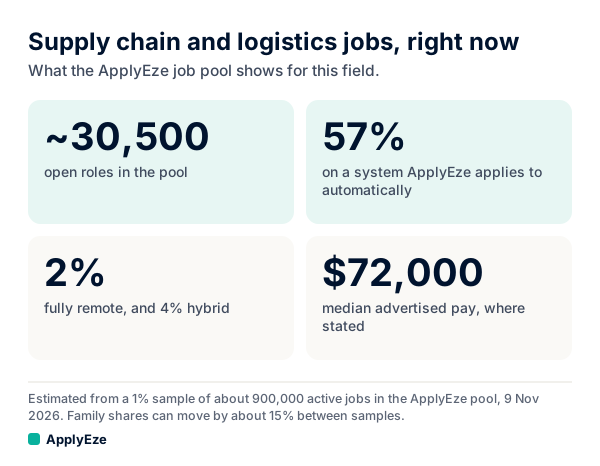
In the job pool we track, supply chain and logistics is roughly 30,000 open roles, about 57% of them on an application system ApplyEze applies to. Roughly 2% are fully remote and roughly 4% hybrid, and the median advertised pay is about $72,000. These come from a 1% sample on 9 November 2026 of about 300 postings, and a second sample differed by up to about 15% per family, so treat them as rough.
The pay figure deserves extra care. It covers only postings that state pay, about 15% of postings across our pool, so it is a clue and not a market rate.
Three figures describe three different groups, and none of them is what you should expect to earn. Our $72,000 is what a small set of postings advertised. BLS's $82,320 is every logistician in the country. ASCM's $98,500 is the median base salary among its US respondents, a mature sample of mostly managers and associates. For demand, BLS projects logistician jobs to grow 18% from 2025 to 2035, with about 26,600 openings a year.
How to apply
- Pick one door and list eight to ten titles for it. A planner's job may be called material planner, scheduler, inventory analyst or supply planner. Search all of them.
- Draw your radius first. Since nearly every role has a site, map the plants and distribution centers you could reach on any shift, then search those employers directly.
- Choose by building. Use the four questions above. A smaller title at the right site usually beats a bigger title at the wrong one.
- Rewrite your resume once for that door, then adjust it per posting.
Once your door and titles are set, ApplyEze can carry the volume. It polls more than 100,000 employer boards directly, about 900,000 active jobs, and ranks them on your target titles and the requirements it reads out of each posting. A role doing your work under a title you did not list ranks low, so list all eight to ten from step 1. You queue the matches you want in the desktop app, and ApplyEze builds a resume for each posting, fills the form and submits it while your computer stays on and awake. A clearance is never claimed, and a certification the posting asks for is not added unless you hold it.
In this field, roughly 57% of postings are on systems it applies to, a share that includes Workday and Oracle, which stay hidden until you connect an application inbox because those sites email a code. Across all fields, that is roughly 62% with an inbox and roughly 23% without, and the rest you apply to directly. Using your 50 free applications walks through the setup.
Your next step is the title list in step 1. If you would rather spend your evenings learning an ERP than retyping your work history, your first 50 applications are free, with no card, and a credit is used only when an application is confirmed as submitted.