

A strong program manager resume sample shows what a project resume does not: the scope you coordinated across teams, the money and benefit you answered for, and the dependencies and risks you saw coming. Which of those leads depends on who is reading. We read 290 live US program manager postings from 86 employers on 9 November 2026, and the split is sharper than sample resumes suggest. "Budget" appears in 12.4% of postings on technology-leaning boards and 56.7% at defense contractors. PMP appears in 7.5% against 60.0%. This post gives line patterns for each, two labelled samples, and what to do about PMP and PgMP. For vocabulary counts, see our separate post on project manager resume keywords.
Program against project: what readers look for
The difference is the end point of the line. A PMI conference paper by Patrick Weaver quotes the 2008 edition of PMI's standard, which defined a program as "a group of related projects managed in a coordinated way to obtain benefits and control not available from managing them individually." Its short version: "projects are focused on the efficient creation of outputs; programs are focused on delivering outcomes."
Weaver also complains about organizations "classifying quite simple projects as 'programs'." Readers know this happens. If your program had one deliverable and one team, call it a project. It costs you nothing, and overclaiming costs you the interview. If you are at that stage, how to get into project management is the closer fit.
What readers look for next depends on the employer.
| In postings | Technology-leaning boards (201) | Other large employers (49) | Defense contractors (30) |
|---|---|---|---|
| Median years asked, where stated | 6 | 7 | 10 |
| Budget | 12.4% | 44.9% | 56.7% |
| Dependencies | 39.3% | 36.7% | 13.3% |
| Risk | 72.1% | 77.6% | 83.3% |
| Stakeholders | 69.7% | 69.4% | 60.0% |
| Technical degree or engineering background | 32.3% | 44.9% | 50.0% |
| PMP | 7.5% | 26.5% | 60.0% |
| PgMP | 1.5% | 6.1% | 6.7% |
| Earned value management | 0% | 0% | 30.0% |
| Security clearance | 4.0% | 4.1% | 96.7% |
So one resume will not do all three jobs. For a software company, dependencies and technical depth go first. For a large employer, budget goes up. For a defense contractor, budget, earned value, contract experience and any clearance you hold go first.
How we counted. Postings came from public boards on Greenhouse, Lever and Ashby, and from a search of large employers' public Workday sites. We kept US locations, removed repeats and capped each employer at 10. Ten postings from agency and consumer boards are in the 290 but not the table. Other large employers include Abbott, Medtronic, NVIDIA, Intel and General Motors. The defense column is General Dynamics IT, Leidos, CACI, Northrop Grumman and Boeing, and two of those supply 20 of its 30 postings, so treat it as a strong hint. Counts include any mention in the posting. The sample is hand-picked, not a census.
Scope and budget lines
A scope line should let a reader picture the size of the job. The pattern is the program in plain words, then projects, teams, vendors, months and money, then the benefit it was for. Figures here and below are invented to show the shape.
| Weak | Stronger |
|---|---|
| Managed a large cross-functional program | Ran a program of 5 projects across 3 business units and 2 vendors for 18 months, $4.6M, to move member enrollment onto one process |
| Responsible for program budget | Owned a $4.6M budget; finished $140K under forecast and moved $300K from vendor training to in-house after the first pilot |
| Delivered on time and on budget | Delivered all 5 projects within 3 weeks of plan; enrollment time fell from 11 days to 6 |
"On time and on budget" is the project's test, and Weaver's paper says so: a program "should be focused on the overall benefits being created." His worked example shows how far a line should travel:
| Level | Example from the paper |
|---|---|
| Output | A new billing process, which on its own "has no value" |
| Outcome | Billing cycle falls from 45 days to 32 |
| Benefit | $500,000 less operating capital needed |
| Value | $60,000 a year, at 12% interest |
Most resumes stop at the first row. Get as far down as you can honestly go, and name who measured it. If finance signed off on the benefit, say so, because a benefit somebody else confirmed is worth more than one you calculated alone.
Be exact about the money. "Owned" means you could move it. "Tracked" means someone else could. At large employers, where about half of postings mention budget, an interviewer will ask how you handled a variance.
Dependencies and risk lines
Dependencies appeared in 64.3% of technical program manager postings and 23.4% of other program titles. The postings describe the work closely. Datadog wants someone to "proactively surface systemic risks, cross-pod dependencies, and organizational friction before they become escalations." Robinhood wants plans, milestones, risks and dependencies kept "clear and visible."
"Managed dependencies" says nothing. A useful dependency line names a count, a conflict and what you did about it.
Sample. Mapped 64 dependencies across 6 teams in one shared plan; moved storage ahead of networking after a vendor slip, which protected the contract date.
Risk lines fail in a more specific way. Everyone writes "managed risks," and it could mean they kept a spreadsheet. A risk line earns belief with four parts: the named risk, when you raised it, what you did, and what then did not happen.
| Part | Sample, invented |
|---|---|
| Named risk | A vendor API retiring in Q3 would break 9 services |
| When raised | March, six months ahead |
| Action | Negotiated a 90-day extension and moved those 9 services first |
| Result | No customer outage |
Written as one line: "Flagged in March that a vendor API retiring in Q3 would break 9 services; negotiated a 90-day extension, moved them first, and avoided any customer outage." A line about a risk that did hit can be stronger still, if you say what you changed afterward. Terms like RAID log are fine where you used them, but only 7 of the 290 postings used that term. The behavior matters more than the artifact.
Sample: technical program manager
Sample, with an invented employer and figures. Senior Technical Program Manager, cloud software.
Summary: Technical program manager, former backend engineer. Eight years moving multi-team infrastructure work, most recently a 14-month platform migration.
- Led the migration of 38 services to a new compute platform across 6 engineering teams and 2 vendors over 14 months; finance confirmed $2.1M a year in lower compute cost.
- Mapped 64 dependencies in one shared plan; moved storage ahead of networking after a vendor slip, which protected the contract date.
- Flagged in March that a vendor API retiring in Q3 would break 9 services; negotiated a 90-day extension, moved them first, and avoided any customer outage.
- Stopped 1 workstream when its cost case failed and returned 4 engineers to the core migration.
- Wrote rollback criteria with the site reliability lead; used them twice without customer impact.
The technical degree or background question is answered in the summary, because 54.1% of technical program manager postings raise it against 25.5% of other titles. No PMP appears, because postings of this type rarely ask for one. The "finance confirmed" and "stopped 1 workstream" details do more than any adjective could. Our resume summary examples cover the top of the page.
Sample: non-technical program manager
Sample, with an invented employer and figures. Program Manager, member services, health insurer.
- Ran a program of 5 projects across 3 business units and 2 vendors for 18 months, $4.6M, to move member enrollment onto one process.
- Cut average enrollment time from 11 days to 6; open enrollment call volume fell 18% year on year (call center report, with membership flat).
- Owned the budget and finished $140K under forecast; moved $300K from vendor training to in-house after the first pilot.
- Raised a state filing deadline risk four months ahead, re-sequenced 2 projects around it, and filed on time.
- Chaired a monthly steering group of 7 vice presidents and brought 3 decisions to it that had stalled between units.
- Project Management Professional (PMP), PMI.
Benefit comes in the second line, money in the third, and the risk line is about a regulator rather than a server. The credential sits at the bottom because postings at large employers often ask for it, usually as a preference.
If the reader is a defense contractor, change these lines. Northrop Grumman writes of "Earned Value Management requirements," and Boeing of "government required Earned Value Management." A sample line: "Managed a $48M cost-plus contract under earned value reporting; closed the fiscal year at a cost index of 1.02 and a schedule index of 0.97." State a clearance only if you hold it, and write its current status exactly.
PMP and PgMP on the page
Here is what each one takes, from PMI's PMP and PgMP pages on 9 November 2026, and how often our postings named it.
| PMP | PgMP | |
|---|---|---|
| Experience, with a bachelor's | 3 years managing projects, in the last 10 years | 4 years of projects (or a PMP) plus 4 years of programs, in the last 15 |
| Experience, with a high school diploma | 5 years | 4 years of projects (or a PMP) plus 7 years of programs |
| Other entry steps | 35 hours of training, or an active CAPM | A panel of PgMP holders assesses your experience before the exam |
| Exam | 180 questions, 240 minutes | 170 questions, 240 minutes |
| Renewal | 60 PDUs every 3 years | 60 PDUs every 3 years |
| In our 290 postings | 48 (16.6%) | 9 (3.1%) |
Two dated details. PMI says that from 1 December 2026, live PMP classes count toward the training hours only from its authorized partners, eligible accredited programs or China's registered providers. And PMI's pay claims are its own, from a body that sells the credential: a 17% higher median for PMP holders, with a $135,000 US median, and 42% higher earnings for PgMP holders.
The counts make the decision clearer than those claims do.
- Every PgMP mention also named PMP. All 9, including Stripe's "PgMP or PMP certification." We found no posting asking for PgMP alone. It may suit your career, but postings do not demand it.
- Required PMP was a defense contractor pattern. We read the 31 mentions at large employers by hand. General Dynamics IT has "Current PMP required" on one role and a required certifications list on 2 more. Leidos has 3 roles that accept "a PMP, FAC-P/PM" or a defense acquisition certification, and 2 more that list PMP above their preferred or desired section. That makes 8, all at those two. The other mentions were preferred, desired or did not say.
- At technology-leaning employers it is a plus. Of 15 mentions, 14 are worded as a plus, nice to have, preferred or bonus points. One Fivetran role lists it among its main qualifications without saying which.
Our earlier sample found PMP in 39 of 101 project manager postings, much higher than 7.5% here. The samples differ, but it fits the pattern: the credential matters most where the work looks like classic project delivery.
How to write it:
- In a certifications section, as issued: "Project Management Professional (PMP), PMI." Add the letters after your name only when the posting asks for it.
- Only if you hold it. PMI's registry lets anyone search active and retired holders, though holders can opt out, so not appearing proves nothing and appearing proves a lot.
- Studying for it? Say exactly that, and only if it is true: "PMP candidate, exam scheduled for March 2027." Keep the bare letters off your skills line.
What the numbers say about the field
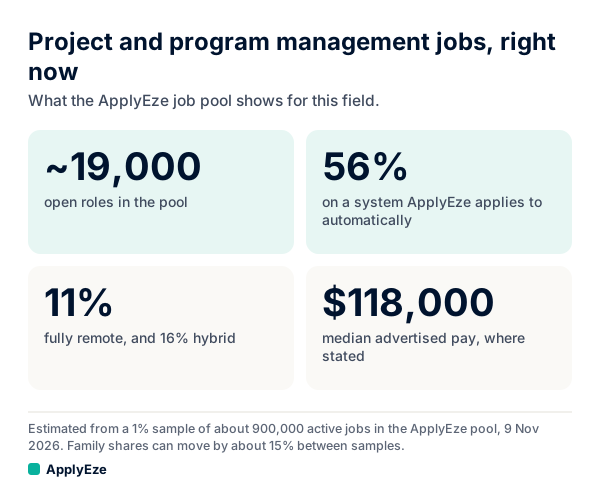
ApplyEze polls more than 100,000 employer boards directly. That pool holds roughly 19,000 open project and program management roles, with no separate count for program titles, and roughly 56% sit on application systems ApplyEze applies to once an inbox is connected. Roughly 11% are fully remote and about 16% hybrid. The median advertised pay is about $118,000 among postings that state it. These come from a 1% sample of about 900,000 active jobs on 9 November 2026, and only about 15% of all postings state pay, so treat them as rough. Across our 290 read postings, the median experience asked was 7 years among the 219 that stated a figure, and 10 at defense contractors on a base of 27. This is rarely a first job, and the resume should read like it.
Sending it
If you apply through ApplyEze, your scope and budget numbers stay yours. An AI model reads each posting and your real history and writes a resume for it. Your employers, job titles, dates, schools, degrees and certifications come from your own record, and code rejects a rewrite that adds a figure, employer, school or credential your record does not hold, so those numbers belong in the resume you upload. An audit of 84 sampled resumes on 4 November 2026 found 0 invented employers, dates, degrees or numbers. A certification the posting asks for is not added unless you hold it. A clearance is never claimed, and a posting requiring one you lack is skipped. ApplyEze does bring the posting's named skills and tools onto your skills line, even when your own record does not list them. There is no step to remove one before a live run, so use a dry run to see what it writes, and be ready to discuss anything on the page.
List several titles, such as program manager, technical program manager and project manager, because a role doing your work under a title you did not list ranks low. You pick the matches and queue them in the desktop app, and it applies in Chrome on your computer, so keep the computer on and awake until the queue finishes. Large employers are often on Workday, and Workday and Oracle jobs stay hidden until you connect an application inbox, because those sites email a code. Hard facts on forms come from your profile. When a required question is not covered by your saved answers, ApplyEze still fills it rather than stopping the run, so that answer may not come from you. Fill in your saved answers, use dry run first, and read your receipts.
So decide which of the three readers you are writing for, and rewrite your top scope line for that reader. Then your first 50 applications are free, with no card, and ApplyEze builds a resume for each posting.