

To get into project management, start by finding the project work you already do, name it accurately on your resume, and aim at a coordinator or analyst title before a project manager one. You may not need a certification first. The Bureau of Labor Statistics lists no related work experience or on-the-job training as typical for project management specialists, and says of certification only that it "may be beneficial". If you do want a credential, the choice turns on one rule. PMI's PMP needs at least 3 years of managing projects with a bachelor's degree, and PMI counts those years more strictly than most people assume. Below is how to name the work you have, how to count your months with a worked example, and which titles this work hides under.
You may already be doing it
Plenty of people run projects under titles that never say so. PMI's own test is useful here. Its 2026 exam outline asks for experience "leading and directing projects" in a professional setting, and says entries should leave out routine, operational or administrative tasks. Here is our way to turn that into four questions about any piece of work you are proud of.
- Planning: did you write the schedule or break the work into tasks?
- Decisions: did you choose the vendor, cut the scope or make the trade-off?
- Delivery: did people bring you their status, and did you chase what slipped?
- Outcomes: if it ran late, were you the one asked why?
Four yeses means you ran a project. One or two means you worked on one. Both belong on a resume, but they are described differently, and only the first fits PMI's wording. Be strict with yourself, because an interviewer will be.
Naming project work on a resume
Keep the title your employer would confirm. Do not retitle yourself "Project Manager". Put the project language in the line instead, and if it helps, add it in parentheses: "Marketing Coordinator (led 3 product launches)". Each line needs scope, time, money or people, and a result.
Every sample below is invented.
| Your title | The hidden project | Sample line |
|---|---|---|
| Office manager | An office move | Led a 120-person office move: 4 vendors, $85,000 budget, 11-week plan, finished on the target date with one weekend of downtime |
| Marketing coordinator | A product launch | Ran launch plan across 5 teams over 9 weeks, tracked 60 tasks and 3 slipped dependencies, shipped on the announced date |
| Staff nurse | A records rollout | Unit lead for an electronic records rollout on 3 wards: trained 70 staff, logged 140 issues, closed all before go-live |
| Teacher | A new program | Led adoption of a new reading curriculum across 6 classrooms: schedule, $18,000 materials budget, staff training |
| Data analyst | A system migration | Owned migration of 40 monthly reports to a new tool in 5 months, and retired the old system a month early |
Our project manager resume keywords post counted what real postings ask for. The common terms are about the work: stakeholders, schedule, risk, budget and vendors. Use those words where they are true. If your work is several linked projects with a shared goal, you may be closer to program work, and our program manager resume guide covers how that reads differently.
CAPM or PMP, by experience
Here is what each one asks.
PMP. You need one of these: a high school diploma plus 5 years managing projects, an associate's degree plus 4, a bachelor's plus 3, or a degree from a PMI-accredited program plus 2. You also need 35 hours of training. The exam is 180 questions in 240 minutes, and you keep the credential with 60 professional development units every three years.
CAPM. It asks for a secondary degree, 23 hours of project management education and no professional project experience. The exam is 150 questions in 180 minutes, and renewal takes 15 units every three years. We read those through a training provider's summary, so confirm them on PMI's CAPM page before you pay.
The months, worked out
Overlap is where a hopeful count goes wrong. PMI's exam outline asks for non-overlapping months within the past 10 years, and says "Tenure is tracked in months, not the number of projects". You still record each project individually. Take an invented person with a bachelor's degree, who needs 3 years, or 36 months.
| Project | Dates | Months |
|---|---|---|
| Customer system rollout | Jan to Aug 2024 | 8 |
| Office move | May to Dec 2024 | 8 |
| Reporting migration | Mar to Aug 2025 | 6 |
| Adding them up | 22 | |
| Counting calendar months once | Jan to Dec 2024, then Mar to Aug 2025 | 18 |
She thinks she has 22 months. She has 18. That leaves her 18 months short, not 14 (our arithmetic). The same rule works against someone with a long career who only recently began owning projects: a decade of contributing does not add up to 36 months of managing.
So here is the decision.
| Where you are | What to do | Why |
|---|---|---|
| No project you truly owned | Neither yet. Volunteer to run something small at work | Neither credential substitutes for a first line on your resume |
| Some ownership, short of PMI's minimum | CAPM if your target postings ask for it. Otherwise keep logging months | An active CAPM also fulfills the PMP training requirement |
| At the minimum, with work you led | PMP, and skip CAPM | CAPM would spend money and hours on a step you do not need |
| Years in the field, mostly contributing | Get ownership first | You have to describe each project on the application |
A date to know. PMI's page says that starting 1 December 2026, live classes count toward the 35 hours only if delivered by a PMI Authorized Training Partner, a China Registered Education Provider or an eligible accredited higher education program. Self-paced courses from any organization remain listed as eligible. If you are about to buy a live bootcamp, check the provider against PMI's directory first.
On the salary pitch. PMI's 2025 salary survey reports a 17% higher median for holders across 21 countries, and a U.S. median of $135,000. Those are the issuer's own figures, and holders already have years of experience, so read them as a claim from a body that sells the exam. BLS reports a median of $102,320 for project management specialists overall in May 2025. And when we counted real project manager postings for our keywords post, PMP was mostly listed as preferred rather than required.
Entry titles that lead in
The first job usually does not say "project manager". These do the work at a smaller scale. The descriptions are our reading of how the titles are used.
| Title | What you actually do | Where it tends to appear |
|---|---|---|
| Project coordinator or administrator | Schedules, minutes, status reports, chasing dependencies | Everywhere |
| PMO analyst | Reports across many projects, with a view of how they fail | Large companies, finance, government |
| Implementation specialist | Customer rollouts, with a real deadline and a real client | Software companies |
| Program coordinator | Running recurring programs and grants | Universities, nonprofits, health systems |
| Project engineer or assistant project manager | Submittals, schedules, site coordination | Construction |
| Business analyst | Requirements and stakeholders, the other half of the job | Technology, banking |
BLS backs up a few surprises. It names business analysts, information security analysts and training and development specialists as jobs where candidates gain related experience. Its industry split is also worth a look: 28% of project management specialists work in professional and technical services, and 22% in construction, at medians of $108,260 and $98,730 in May 2025. If you already know a trade or a building site, that is a real starting advantage.
Agile and scrum: what counts
Many people assume a Scrum Master is a project manager with a new name. The Scrum Guide, last revised in 2020, says otherwise. "Scrum defines three specific accountabilities within the Scrum Team: the Developers, the Product Owner, and the Scrum Master." There is no project manager among them, and "within a Scrum Team, there are no sub-teams or hierarchies."
That has two consequences. Attending standups is not experience running anything. And a posting that asks for a Scrum Master wants someone who helps a team use Scrum, which is different work from owning a plan and a budget. On a resume, what counts is what you ran and what changed.
Sample: Facilitated 26 two-week sprints for a 7-person team. Carried-over work fell from about a third of each sprint to under a tenth in 6 months.
If you want a credential here, Scrum.org's PSM I costs $200 per attempt, requires no class, has 80 items in 60 minutes with an 85% pass mark, and has no renewal fee. For PMP purposes, PMI's exam outline puts about 40% of items on predictive approaches and the remaining 60% on adaptive or agile and hybrid ones, so led agile work is not a lesser kind.
What the numbers say about the field
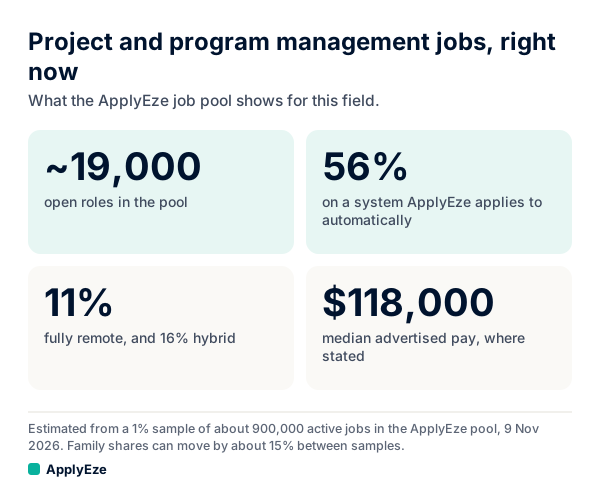
ApplyEze polls more than 100,000 employer boards directly, about 900,000 active jobs, and the chart shows that pool in a 1% sample on 9 November 2026. Project and program management came to 188 sampled rows, roughly 19,000 open roles. About 11% were fully remote and about 16% hybrid. Roughly 56% sat on a system ApplyEze applies to. The median advertised pay was about $118,000.
Three cautions apply. A second sample differed by up to about 15% per family. Only about 15% of all postings state pay, and this family covers project and program managers as well as those starting out, so do not read $118,000 as a coordinator's salary. And the count is a floor for this kind of work. Construction management is a separate family, roughly 30,000 roles at about $85,000, and some of the work described above likely sits under titles counted in other families.
List the titles this work hides under
That last point has a practical consequence if you use ApplyEze to find roles: you get what you name. ApplyEze does not rank by text similarity. It ranks on your target titles and the requirements it reads out of each posting. A role doing your work under a title you did not list ranks low, and that matters more in project management than almost anywhere, because the same work has so many names. The order is real as well, since the first title you list ranks first.
So write the list deliberately. Here is a sample for an invented office manager moving across:
- Project Coordinator
- Program Coordinator
- PMO Analyst
- Implementation Specialist
- Operations Project Coordinator
You can type any job title. Common titles resolve instantly, and for an unusual one AI maps it to the closest standard role. "Why this fits" then shows the skills matched and missing, which is a fair way to see what a posting wants that your resume does not say. Our guide to target job titles goes further on ordering.
It also writes a resume for each posting. Your employers, job titles, dates, schools, degrees and certifications come from your own record, and code rejects a rewrite that adds a figure, employer, school or credential your record does not hold. An audit of 84 sampled resumes on 4 November 2026 found 0 invented employers, dates, degrees or numbers. Skills work differently: ApplyEze brings the posting's named skills and tools onto your skills line, even when your own record does not list them. There is no step to remove one before a live run, so use a dry run to see what it writes, and be ready to discuss anything on the page. A certification the posting asks for is not added unless you hold it, so "PMP" will not appear because a posting wanted it.
You pick the matches and queue them in the desktop app, which fills and submits each form on your computer while it stays on and awake, and Workday and Oracle jobs need an application inbox connected. So write your title list today. If you would rather spend your evenings logging project months than filling in forms, your first 50 applications are free, once per email address with no card, and a credit is used only when an application is confirmed as Submitted.