

Reaching out to a hiring manager after applying is worth doing on a short list of roles: one message, after your application is in, that proves one relevant thing and asks for almost nothing. It may get a person to open your application, and it may get you nothing. No study we found measures cold notes to managers, so distrust any reply rate you see quoted. What follows is how to find the right person, what to say, two samples, and the cases where the note does harm.
Why reach out at all
Because most applications never reach a conversation. Ashby, which sells recruiting software, reports from over 109 million applications that "In 2021, approximately 7-8% of applications resulted in an interview. Today that figure sits between 3.6% and 4.7% depending on role type." That is one interview per 21 to 28 applications (our arithmetic), across Ashby's customers. It is an average over everyone who applied, including people nowhere near qualified, so a qualified applicant's odds are likely better. It still shows why a second way in is worth having on the roles you want most.
Interviews also come from outside the form. In Huntr's October 2026 survey, 271 people who had interviewed were asked how they got their most recent one: 58% applied online, 18% heard from a recruiter who reached out first, 13% had an employee referral and 11% came through networking. The sample is small and self-selected, and it does not measure how often outreach fails. It does show that the application is not the only door.
A note is not a referral, though, so do not borrow a referral's numbers for it. In a New York Fed staff report on one large firm, referred applicants were "more than twice as likely to be interviewed" as job board applicants. Someone inside was vouching for them. A stranger's message carries no such weight. If you know anyone at the company, ask for a referral first and write to the manager second.
A note is a bet, and you can only make a few. Spend them on the roles you would pick first.
How to identify the manager
No page will hand you this. Work from the posting outward.
- Read the posting for the team and level. Some state a reports-to line outright. Others name a team, such as "payments risk" or "second shift operations". Write down both.
- Check the job page. A LinkedIn posting can show "Meet the Hiring Team", and members can message the people listed, "including the job poster." That person is often a recruiter. FrogHire's guide puts the distinction well: a recruiter manages parts of the process, and the hiring manager usually leads the team, with a title that "often sits one or two levels above the opening."
- Search people at the company. On LinkedIn, filter by current company and search the function plus the title one level up: "Manager, Warehouse Operations" for an analyst role, "Director of Nursing" for a nurse manager. Add the location if the role has one.
- Search posts. Managers sometimes announce openings themselves. Search the role title plus "hiring" and filter to posts. A manager who posted about the role has also invited interest in it, which makes your note easier to justify.
- Check the team around them. Recent hires sometimes mention who they report to. A company's team page can confirm the structure.
- Ask. Anyone at the company can usually tell you who runs a team. That is often quicker than the five steps above.
Before you send, run this check. Does the person's team match the posting? Is their level above the role? Does their location fit, or did they post about the role themselves? Two yeses and you can write with some confidence. One yes and you should word the note so it can be redirected. None, and you do not have the manager yet.
What the message should do
Five jobs, in this order, and nothing more:
- Say you already applied. This removes the worry that you are going around the process.
- Name the role. Managers may have several open.
- Tie one proof to something in the posting. Not your best achievement. The one closest to the problem they described.
- Offer something small. A one-page summary or a work sample. Avoid asking for a call, a coffee or a chance to pick their brain, all of which cost them time and give them nothing yet.
- Make it easy to ignore or redirect. A manager who feels no pressure is more comfortable answering.
Write it yourself. In a Robert Half survey of more than 2,000 US hiring managers, 65% said verifying skills has become harder. A polished, generic paragraph reads as one more thing to verify. A detail only you could know does not.
Sample: LinkedIn
Both samples are written for this post, and the people, employers and numbers are fictional. This one goes in a connection note, so it has to be short. LinkedIn's help page says each note "can be up to 200 characters" and that free members can add one to up to three requests a month. Three a month is a useful budget. It forces you to choose.
Hi Elena, I applied for your Operations Analyst role. At Northwind my SQL audit cut warehouse mispicks 31%, close to the problem in your posting. Glad to share a one-page summary if useful.
That is under 200 characters. Check the length of your own before you send it.
Sample: email
Use this only if you have an address the person made public. Otherwise stay on LinkedIn.
Subject: Operations Analyst application: cut mispicks 31% across 3 sites
Hi Elena,
I applied through your site on Tuesday for the Operations Analyst role, so this is not a way around the process. Your posting mentions rising mispick rates across two warehouses. At Northwind I ran the SQL audit behind a 31% drop in mispicks across three sites.
I can send the one-page write-up if it helps. If someone else owns this role, just say so and I will leave you be.
Thanks, Jordan Lee
That runs to about 75 words. The recruiter version has a different job, which is why the email to a recruiter leads with a requisition number and asks about status. A manager does not track requisition numbers as closely and cannot always speak to status, so this one leads with their problem.
When to send it. About a week after you apply, on a weekday. Our weekday count comes from callback detection, which is rolling out with staffing teams first and is not part of self-serve accounts yet. In email found in the application inboxes of about 29 candidates at one staffing team, from 4 October to 8 November 2026, 90.5% of 336 human callbacks arrived Monday to Friday, about 60 a day, with 14 on Saturday and 18 on Sunday.
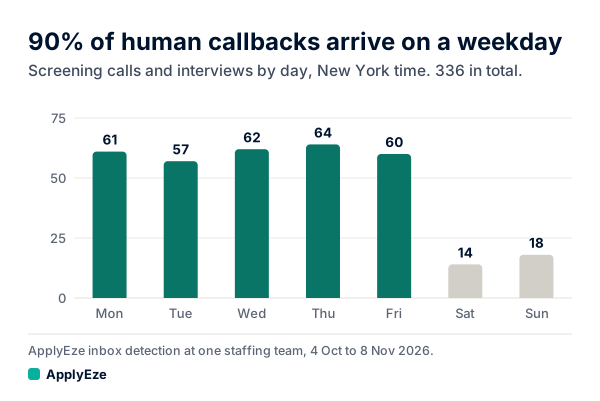
That count shows employers reaching out, not when a manager reads messages, so it is no proof of the right moment to write. These are machine labels no person reviewed, so we say found and not confirmed. They give you no reason to agonize over which weekday.
When it backfires
| What you did | Why it goes wrong | Do this instead |
|---|---|---|
| Wrote despite a no-contact line in the posting | It shows you read the rule and ignored it. A contributor to a 2022 GOBankingRates roundup is blunt: "follow the rules accordingly." | Leave it alone. |
| Skipped the application and wrote to the manager | A direct approach can look like "trying to bypass the process," as another contributor to that roundup put it. | Apply first and say so in the first line. |
| Contacted a manager at a formal or public employer | Enhancv warns that outreach can seem unprofessional at formal companies. Federal hiring has its own channel: OPM says to use the contact listed on the announcement. | Use the named contact. |
| Wrote within a day or two | The posting may still be collecting applications, so the manager has little to react to. | Wait about a week. |
| Messaged the recruiter, the manager and a teammate at once | People compare notes. It reads as pressure. | One person, then wait. |
| Missed a hard requirement and hoped to talk past it | The manager wrote that requirement. | Pick a role you meet. |
| Asked for a call or for feedback on your resume | You are asking a stranger for time and giving nothing back. | Offer a sample. Ask for nothing they cannot give in a line. |
| Attached files or used a personal number or personal social account | It feels like an intrusion, and an unexpected attachment is one more thing to open. | Stick to the professional channel. |
Weigh one more thing. A 2017 Accountemps survey of HR managers leans toward following up, with none choosing that candidates should not, but some managers will still find your note an imposition, however good it is. Keep it short enough that this costs them five seconds.
What to do if nothing comes back
- Send one more at most, about a week later, and only with something new: a result, a relevant project, a credential you just earned. A bare "any update?" adds nothing.
- Do not escalate. No messages to their boss, their teammates or the CEO.
- Do not read much into it. Silence may mean a full inbox, a paused role or a note that never surfaced. It says very little about your application.
- Keep the door open cheaply. Follow the person and respond to what they post if you have something to say. This is slow and is covered in our networking tips.
- Apply again if a similar role opens. In Huntr's Q3 2026 data, people who applied to one company eight or more times had a lower interview rate per application, 2.4% against 5.9%, but a higher chance of at least one interview there, 17.7% against 5.9%. That is observational, since people who apply repeatedly differ in other ways, but silence on one role does not close the company.
Keep the notes few and the applications moving. The note is yours to write, and the forms are the part ApplyEze handles: it has delivered 94,207 applications since August, to 9,769 employers, and it builds a resume for each posting. If forms are taking the hours you would rather put into a few careful messages, your first 50 applications are free, no card needed. You pick the roles and queue them in the desktop app, which runs while your computer is on and awake.