
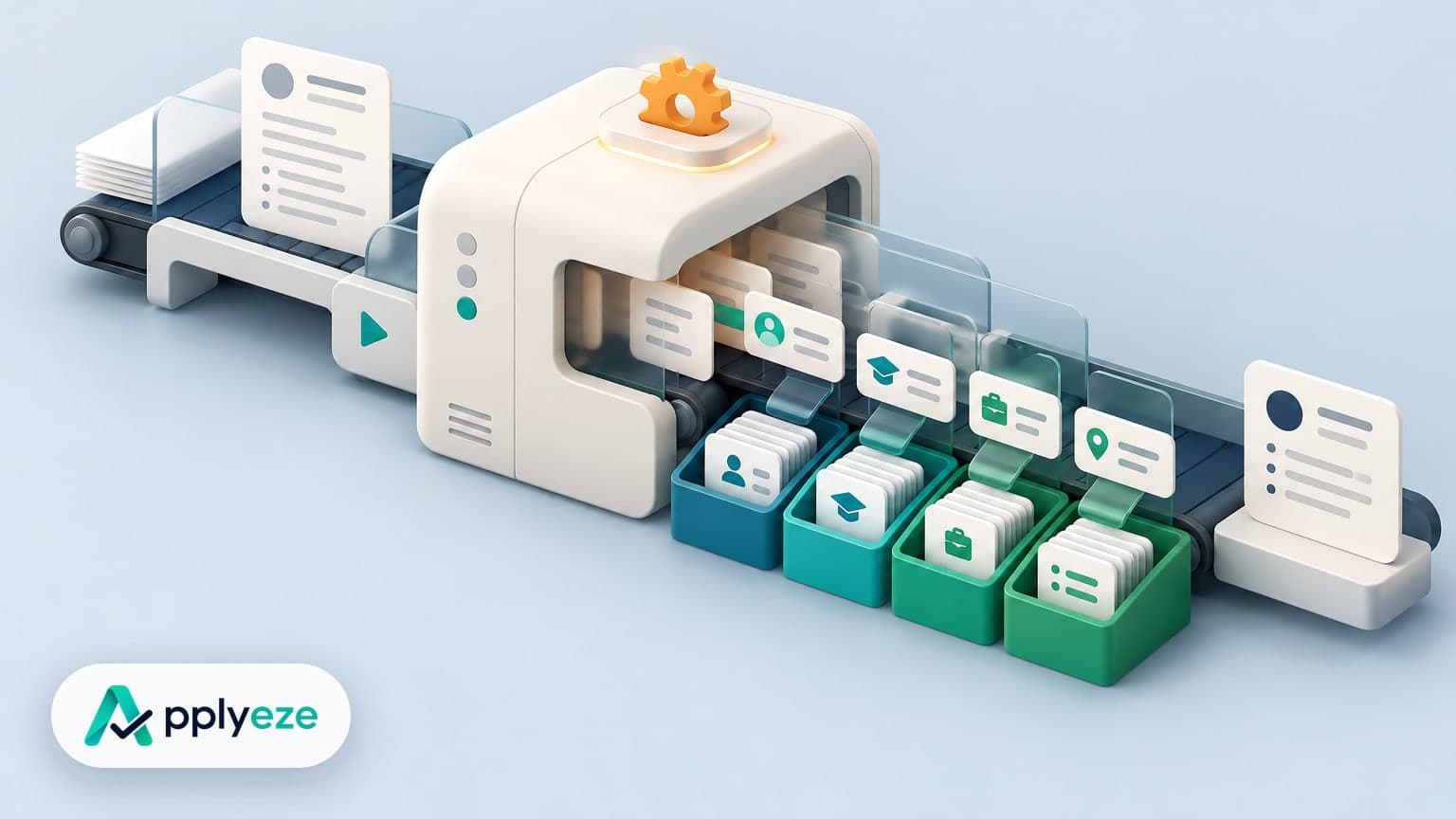
Here is what an ATS is from the side of the person applying. An applicant tracking system is the software an employer uses to post jobs, collect applications and move candidates through hiring. For you it is three things: the form you fill in, the database your application lands in, and the screen a recruiter reads it on. It stores, sorts, searches and runs rules the employer sets. In most setups it is not the thing deciding whether you get an interview: Greenhouse, which does offer an AI match score, documents that the score does not advance or reject anyone.
Nearly every large employer runs one. Jobscan's 2026 review of the Fortune 500, which checked every company's careers page by hand, detected an ATS at 97.4% of them. The results that rank for this question are mostly written by HR software vendors for the people buying it. This guide is for the people being processed by it: what happens to an application inside one, how the common systems differ, and what actually rejects people.
What an ATS is
Under the interface, every applicant tracking system holds the same handful of records. A requisition is the employer's internal approval to hire. A posting is the public advert for it. A candidate is you, and an application links you to one posting. Each application sits in a stage, such as review, phone screen, interview, offer or rejected, and recruiters move it from stage to stage. The label you see for each stage depends on the system and the employer; what under consideration means translates the common ones.
Some systems are standalone recruiting products. Others are one module of a larger HR suite. Workday is the clearest example of the second kind: Workday's own course material describes Workday Recruiting as "unified with Workday HCM", the system that also runs offers, compensation and benefits. That is the honest answer to "is Workday an applicant tracking system": yes, and it is attached to the employer's HR record system, which explains why its forms ask for so much, down to a reason for leaving each past job (our post on reason for leaving answers covers what to write).
What happens to your application inside one
The details change by system and by employer, but the sequence is close to universal.
- You submit on the employer's career site. That site is usually hosted by the ATS, which is why the web address changes when you click Apply.
- Your resume is parsed. The system extracts text from your file and fills in profile fields. iCIMS's candidate guide says that when you upload a resume "the system may populate some profile fields with the information from that resume", and asks you to review what was parsed before you continue.
- Rules run on your answers. If the employer configured screening rules, they act on the questions you answered, not on your design. More on these below.
- The application joins a queue. Greenhouse describes its own product this way: after you submit, your application "will go straight into a queue on a recruiter's dashboard", and "by and large, applications in Greenhouse are reviewed by real people, one by one, in the order received."
- Recruiters search and sort. A recruiter with a few hundred applications filters and searches rather than reading top to bottom. Some systems add an AI match score, if the employer turns it on.
- Somebody records a decision. The application moves to a stage or is rejected. Whether you hear about it is another employer setting, covered in our posts on Greenhouse application status and Workday application status. For some roles the next stage is an assessment in a separate tool, such as a HireVue video interview, a CodeSignal coding assessment or the Pymetrics games.
The systems you will meet most
Two Jobscan measurements give a sense of the market. Among the Fortune 500, "over 40%" of companies use Workday for talent acquisition and SAP SuccessFactors has a 12% usage rate. Across a broader set of more than 13,000 companies whose job descriptions Jobscan analyzed, the leaders were Greenhouse at 19.0%, Workday at 17.5%, Lever at 15.6% and iCIMS at 14.4%. The second sample comes from postings Jobscan's own users scanned, so it leans toward the employers those users apply to.
Here is what each common system looks like from the applicant's chair.
| System | How you recognize it | Account to apply? | What is distinctive for you |
|---|---|---|---|
| Workday | A myworkdayjobs.com address with the employer's name in it | Often, because the employer can require one | Long multi-page form; account per employer; status labels written by the employer |
| Greenhouse | A greenhouse.io or grnh.se address | No; an optional MyGreenhouse portal lists your applications | Rules can auto-tag, auto-advance or auto-reject on your answers to custom questions; optional AI match score you can opt out of |
| Lever | A jobs.lever.co address | No | Lever's Postings API documentation says only a name and email address are needed to create a candidate, with any other required fields set by the employer |
| Ashby | A jobs.ashbyhq.com address | No | Employers on Ashby's Enterprise plan can set auto-reject rules on global application questions |
| iCIMS | An icims.com address, often starting with careers- | Usually, one per company | You log in with "the login name and password you used to create your account with this company", and the portal's steps differ per company |
| Oracle Recruiting Cloud | An oraclecloud.com address | Identity is checked by email | Oracle's documentation describes a verification code sent to your email address to confirm it is yours |
| SmartRecruiters | A jobs.smartrecruiters.com address | Depends on the employer | SAP completed its acquisition on 11 September 2025 and is integrating it with SAP SuccessFactors |
The same system can look very different at two employers. Each one configures its own questions, stages, emails and rules, so "Workday applications ask for X" really means "most employers who run Workday chose to ask for X". If an unfamiliar address such as SmartRecruiters makes you wary, our post on whether SmartRecruiters is legit explains who runs it.
Our employer guides show this in practice. NVIDIA, Cisco and Wells Fargo hire through Workday, JPMorgan and Goldman Sachs through Oracle, OpenAI through Ashby and Deloitte through Avature, while Google, IBM and Amazon run candidate portals of their own.
Accounts: why Workday wants one per employer
The account question frustrates people more than anything else about applying, and it comes from how these systems are sold. Each employer that buys Workday gets its own instance, called a tenant. The candidate account, Candidate Home, lives inside it: Workday's administrator course says "your published external career sites include Candidate Home", that "Workday uses the candidate's email address as an identifier", and that an employer can "configure the tenant to make a Candidate Home account required", in which case "candidates must create an account before they can submit a job application."
Put those together and the per-employer account follows. Your email address identifies you inside one employer's tenant. The next employer has a different tenant with no record of you, so you register again, verify your email again, and usually re-enter your work history even though you just uploaded a resume containing it. Our guide to creating a Workday account walks through each step, and our page by page guide to the Workday application covers the form after it.
Other systems handle identity differently:
- iCIMS behaves much like Workday for the candidate: a login per company. More in what is iCIMS.
- Oracle Recruiting Cloud leans on email verification. Oracle's release documentation describes returning candidates confirming their date of birth or last name, after which "a verification code is sent to their email address to further verify ownership." Its sign-in settings let employers keep candidates signed in, but require a fresh verification code 180 days after the first one. Our Oracle Recruiting Cloud guide covers applying and tracking status. Some employers still use Oracle's older Taleo career sections, which have their own accounts; see how to apply for jobs on Taleo.
- Greenhouse, Lever and Ashby let you apply without creating anything. Our guides to Greenhouse job boards and Ashby applications show what that looks like.
Two habits save real time. Use one email address for every application, so every verification code and status email lands in one place. And keep a password manager entry per Workday and iCIMS employer, because a forgotten password on a tenant you registered with months ago means a reset email before you can even see your status. If you are already shut out, see Workday account locked.
Parsing, ranking and knockout questions
Three different mechanisms get blamed for rejections. They behave very differently.
Parsing turns your file into fields. When it fails, the documented consequence is work, not a verdict: in the recruiter flow Greenhouse documents, a resume that fails to parse means the hiring team enters the details by hand, and the file stays attached. Our post on ATS friendly resume format covers what breaks parsing and how to test your own file in a minute.
Search and ranking decide who gets read first. Greenhouse says its AI suggests keywords from the job description to recruiters, and "when recruiters search for these terms, they'll find exact matches in candidates' applications." Some Greenhouse employers also use Talent Matching, where, per the candidate FAQ, "AI compares your application to the job's requirements and assigns a match score." The same FAQ says it "does not automatically advance or reject candidates" and that you can opt out of a match score for each eligible application. Ranking does not reject you, but an application nobody reaches is in practice the same outcome. Employers know this: in the 2021 Harvard Business School and Accenture "Hidden Workers" study, 88% of employers believed qualified high-skills candidates were screened out because they did not match the exact criteria in the job description. The same report found almost half of the companies surveyed weeded out resumes with a work gap, with gaps of more than six months screened out automatically by their recruiting software. That is the real case for writing your resume in the posting's language, which our guide to tailoring a resume works through step by step.
Knockout questions are where automatic rejection actually lives. Greenhouse's application rules include Auto-Reject, which "uses custom application questions to screen and reject candidates based on their responses", available on its Plus and Pro tiers. In its candidate blog, Greenhouse gives the example of answering "no" to "are you legally allowed to work in this country?", and says its auto-rejection rules are "set and controlled directly by recruiters." Ashby's auto-reject rules "automatically archive candidates based on their answers" to global application questions, with a rejection email the employer chooses, on its Enterprise plan.
What recruiters say lines up with the documentation, with a caveat about the source. Enhancv, which sells resume software, interviewed 25 US recruiters in 2025: 23 of the 25 said rejections were manual or triggered only by eligibility filters, "never by formatting or missing keywords", and 2 said their ATS rejected applicants automatically for other reasons. Twenty-five interviews is a small, vendor-run sample, so treat it as a description of practice rather than a measurement of the market.
The practical reading: the answers to the short questions at the end of a form carry more automatic consequences than anything about your resume's design. Read them slowly. Our guide to how to fill out a job application explains each of these questions field by field.
The 75% rejection myth
You will see it claimed that three quarters of resumes are rejected by an ATS before a human sees them. Fortune looked into it in 2014 and wrote that the figure "probably came from a study by a job search services firm called Preptel", a company selling resume optimization. No method, sample or dataset behind the number has been published, and Fortune itself only said "probably".
What the evidence above supports is smaller and more useful. Knockout rules reject people automatically on specific answers. Search and ranking decide whose application gets read, and exact-match criteria cost qualified people their turn. Most other rejections are a person making a call. None of those is a robot reading your font choice.
What you can control
- Answer the screening questions carefully. Work authorization, sponsorship, location, licenses and minimum years are the questions most likely to carry a rule. A misclick there can end an application on the spot.
- Use the posting's words for work you have done. Recruiters search for terms they took from their own posting.
- Send a file that parses. One column, real text, standard headings, consistent dates.
- Apply on the employer's own site where you can. Greenhouse's candidate FAQ notes that applications sent through LinkedIn, Indeed or other third-party sites may not appear in MyGreenhouse.
- Use one email address and keep a list. Accounts, verification codes and status emails all key off it.
- Apply while the posting is live. A queue reviewed in the order received rewards being in it.
This is the mechanical layer ApplyEze takes on. It watches the career boards of more than 100,000 employers directly, with new roles arriving within minutes on most boards, and it completes applications on 12 platforms: Greenhouse, Lever, Ashby, Workday, Workable, SmartRecruiters, Oracle Recruiting Cloud, JazzHR, BambooHR, Rippling, Pinpoint and Recruitee. Workday and Oracle need a connected application inbox. It does not complete applications on iCIMS, Paylocity or Dayforce, which appear on its board as manual apply only, or on SuccessFactors, Taleo, ADP or LinkedIn Easy Apply. Every application gets a resume written for that posting, plus a cover letter when the form asks for one, and the run happens in a browser on your own machine that you can watch, or in dry-run mode, which fills the form and never clicks Submit.