

AI in staffing is usually measured by adoption, but the question a team actually gets asked is about attribution: which applications went out for this candidate, and which replies came from them? The first half has an exact answer, one record per application. The second does not. In five weeks of email at one staffing team, 418 of the 801 callbacks found could be tied to one specific ApplyEze application, and for screening calls and interviews alone it was 139 of 336. This post shows how far attribution goes, with the denominators, and gives you a report format that works whatever software you run. We build this for staffing teams at real volume: ApplyEze delivered 75,963 applications in the 30 days to 9 November 2026, about 1,651 per candidate.
Why attribution is the question a team gets asked
Most of what you read about this topic is an adoption number with a long chain behind it. Bullhorn's buyer's guide, dated September 2026, says "AI adoption among staffing agencies reached 61% in 2025, up from 48% the year before, according to the American Staffing Association." Follow the link and the ASA article credits StaffingHub's 2025 State of Staffing report, gives no sample, and names "conversational AI (55%) and résumé parsing/database cleanup (45%)" as the common uses. StaffingHub's own January 2026 piece repeats the 61%, also with no sample on the page, and says plainly that adoption does not mean measurable results.
So the number tells you tools are in use. It says nothing about what they did for a person. That same StaffingHub piece lists measuring activity rather than outcomes among the ways firms go wrong, and it asks for audit logs showing what the AI suggested, what was sent and who approved it.
A represented candidate asks something narrower: what did you send in my name, and what came back? Those are two different problems. Outbound attribution is bookkeeping, because the software did the work and can write it down. Inbound attribution is inference, because an employer's email does not carry an application ID.
The record behind one application
ApplyEze Autopilot keeps a record for each role it considers for a candidate. Here is what it holds, and the question each part lets a team answer.
| In the record | The question it answers |
|---|---|
| Score and a one-line reason | How did the AI judge rate this role, and what reason did it record? |
| Role family | Was it in the field we agreed with the candidate? |
| Times planned, judged, claimed and settled | How long did it wait, and when did it go in? |
| Status | Did it go out, or did the run end without an application? |
| Tries and failure code | If it did not go out, why not, and how many times did we try? |
Autopilot is set up today for staffing and recruiting teams that work with ApplyEze. If you are job hunting on your own, you can start with 50 free applications on sign-up, no card needed. You pick the matches and queue them in the desktop app, and ApplyEze fills and submits each form.
Two details matter for attribution. Each company sees only its own candidates and a recruiter sees assigned ones, enforced in the database with row-level security, so a report cannot pick up someone else's row by accident. And every change made through the admin page or the portal is logged, with who made it and when.
Around the record sit the controls a staffing team expects: three independent switches (ApplyEze's, the company's and the candidate's, all of which must be on), per-company settings for daily targets, working hours and pauses, and alerts checked every 10 minutes for nothing going out, a low applied rate, deliveries behind or a candidate short of roles.
A third is easy to miss: not every run ends in a clean yes or no. Sometimes nobody can tell whether a form went through. We retry only runs known not to have submitted, and a run with an unknown submit is never replayed. A report that shows only "sent" and "not sent" has quietly rounded that third state away. Give it its own line.
Sending each application to your own system
A team's system of record is usually its own, so an application that exists only in a vendor's portal is half attributed. ApplyEze can send each application to a team's system by webhook. Each delivery is signed with HMAC-SHA256. Failures are retried, 6 attempts in all, waiting from 1 minute and doubling up to 1 hour.
If you build the receiver, three things are worth knowing. They apply to any vendor.
- Check the signature in constant time, on the raw body. GitHub's webhook guide puts the rule simply: "Never use a plain
==operator." Without the check, anyone who finds your URL can write applications into a candidate's file. - Expect the same application twice. A delivery can succeed while the answer gets lost, and then it is retried. Key your write on your own client id and the lower-cased job URL, not on the sender's id alone, because one of your people may have logged the same posting first.
- Plan for the end of the retries. Six attempts means five waits: 1, 2, 4, 8 and 16 minutes, about 31 minutes from first try to last (our arithmetic). A receiver down for longer than that can miss deliveries. Compare your count with the portal once a day, so a gap is found in a day and not at the candidate's monthly review.
That covers what went out. What came back is harder.
Tying a reply back
Here is how callback detection works where it is switched on. It is rolling out with staffing teams first and is not part of self-serve accounts yet. On a self-serve account you see every application ApplyEze sends, and you record employer replies yourself on each one.
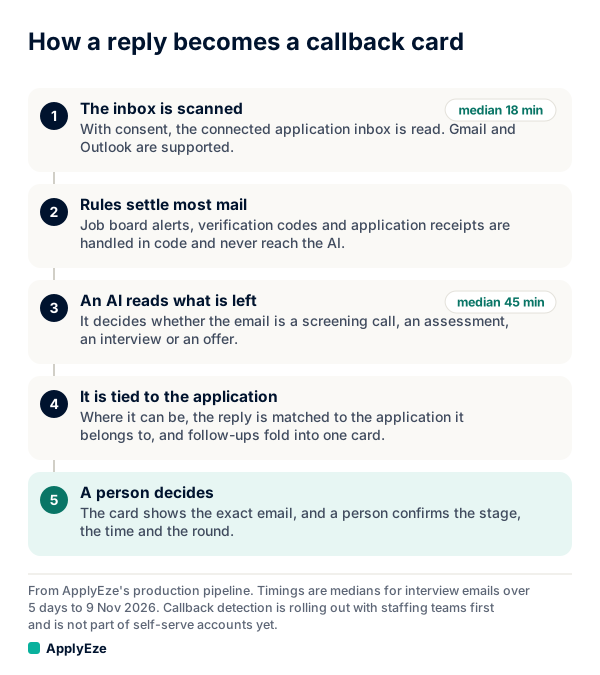
When an email looks like a callback, code scores it against the candidate's real applications: up to 200 submitted or maybe-submitted runs from the last 120 days, never dry runs. Signals include the same thread, a sender on that application's system, the company in the subject and the age of the application. An AI model then picks one of the top options, only when the company agrees and any named role agrees. With two applications at one company and nothing to separate them, it answers none. A pick outside the list is refused. The full scoring is in how we match an email to an application, and the other steps are in how a reply becomes a card.
This is what came out of it. We found these replies in candidates' application inboxes from email received 4 October to 8 November 2026, across about 29 candidates at one staffing team.
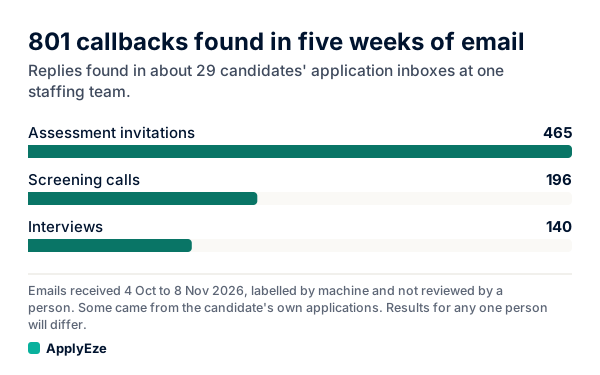
| Kind | Found | Tied to one ApplyEze application | Share (our arithmetic) |
|---|---|---|---|
| Assessment | 465 | 279 | 60.0% |
| Screening | 196 | 85 | 43.4% |
| Interview | 140 | 54 | 38.6% |
| All three | 801 | 418 | 52.2% |
| Screening and interview only | 336 | 139 | 41.4% |
Read these as found, not confirmed. They are machine labels from when the scanner first ran on 3 November and read back to 4 October, and no person reviewed them. On the rival pages we read on 9 November 2026, we found no one else publishing callback counts with their denominators.
The share drops as the reply gets more human. Our reading: an assessment invitation tends to arrive within minutes from a sender linked to the application, while a recruiter writes days later from their own address and may never name the role. When nothing ties, a card is still written. It reads "Not matched to an application yet", and a reviewer has to pick the application before confirming.
Replies from a candidate's own applications
A candidate can apply on their own, and a recruiter on the team can apply by hand. Those replies land in the same inbox and look the same. So the 197 human callbacks that could not be tied (336 minus 139) are neither a failure count nor a win. Some may have come from what we sent, and some from applications we never touched. Nobody can split them from this data.
The accurate way to say that is a range: between 139 and 336 of those human callbacks came from what ApplyEze sent. Reporting all 336 can overstate and reporting only 139 probably understates, so report both ends.
The same trap shows up in a rate. Suppose a reply arrives for an application nobody logged, and someone creates a row to hold it. That row is one application with one callback, a 100% rate. Enough of those and any rate is fiction. Leave those rows out of both sides of a comparison, along with candidates' own logged applications, as we do.
How to report results to a candidate
Six rules, each from a mistake these numbers make easy.
- Count assessments apart. They were 465 of the 801, or 58.1%, and the tied ones came a median of 0.2 hours after applying, because most are sent automatically. "801 callbacks" would be more than half machine mail.
- Give a range, from tied to found. The section above shows how.
- Group by the month of the application, and wait. Tied interview replies came a median of 126.8 hours after applying. In a fuller read of applications from 12 to 23 October, 74% of 58 human callbacks came within 7 days, so about a quarter took longer. We would close a month two weeks after its last application, and restate it if more arrive.
- Say what the inbox cannot see. Replies sent through a job board's own messaging, such as LinkedIn or Indeed, are not picked up, and a phone call never reaches an inbox. It can miss replies, so ask the candidate.
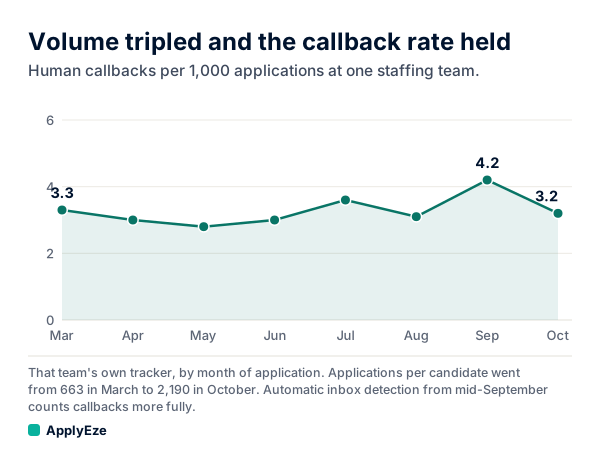
- Put rate and total side by side. For October applications, one staffing team's own tracker shows 63,508 applications, 204 human callbacks and 3.2 per 1,000. Each number means little without the others.
- Say when the counting changed. At that team, human callbacks per candidate per month rose from about 2 in spring to 7 for October applications, with volume more than tripled and the rate per 1,000 holding near 3. The tracker began logging inbox replies automatically in mid-September, so part of the rise is better counting, and a report should say so.
Here is the format those rules produce. It is a sample we wrote for this post, with blanks to fill, not a real report.
Sample report: applications made in October, as of 14 November
We submitted [A] applications for you in October. The list is attached, with the company, role, date and the documents sent.
[B] runs ended without an application, and each line says why. On [C], we could not tell whether the form went through.
We found [F] screening calls and interviews in your application inbox. We can tie [T] of them to an application we sent. The others could be ours or yours, and we cannot tell which, so our count is between [T] and [F].
Assessment invitations, counted apart because most are automatic: [X].
This does not include replies inside job board messages, or calls to your phone. Tell us about any you received.
Replies to October applications may still arrive. We will update this on [date].
Notice what it does not contain: a rate the candidate should expect. No team can promise one. These figures come from one team, and results for any one person will differ.
What to ask any vendor
Eight questions, each of which has a checkable answer.
- Show me one application's whole record. You want times, a status, and a reason if it failed.
- What are the possible end states? If "unknown" is not one of them, ask what happens to those runs.
- Can each application reach my system, signed? Ask how many retries you get, and how long until they stop.
- What share of replies do you tie to one application, by kind, with denominators? "All of them" means the ones it could not tie were left out of the count.
- What happens to a reply you cannot tie? It should stay visible, marked as unmatched.
- Do you count assessment invitations as callbacks? Ask for the number without them.
- Can a label change an application by itself? With us, the AI only suggests, and a person confirms each callback before the application changes.
- Are candidates' own applications in your rate? Ask how rows created from a reply are handled on each side of any comparison.
Bullhorn's buyer's guide offers a useful complement on data and rollout, such as asking for a reference who has used the AI features for six months or more. For the daily view a team should have once this is in place, see staffing agency software, and for how the choice of roles gets made, see AI recruiting agent.
Team plans are set up with us, not bought here: hello@applyeze.com. If you want to watch ApplyEze fill and submit a form before that conversation, your first 50 applications are free, no card needed: you queue the roles in the desktop app, which runs on your computer while it is on and awake, and every run leaves a receipt.