

An AI recruiting agent is software that carries out multi-step hiring work without a person operating each step, and the name covers two jobs that barely overlap. Most of these products work for an employer and decide which people move forward. A few work from the other side and decide which roles a represented candidate applies to. They answer to different people, read different things and fail in different ways. ApplyEze makes the second kind, so this post uses ours as the worked example: the rubric, the audits and the counts behind them, so you can check the reasoning yourself.
Employer-side and candidate-side agents
The pages that rank for this term describe the first kind. Pin defines agents as "autonomous software platforms that run the entire top-of-funnel hiring process", and offers a useful test: "If it needs a human click for each task, it is a workflow, not an agent." Workable says its agent "creates job briefs, sources passive candidates, screens applicants, and engages talent."
Pin's guide does not mention candidates running agents of their own. GoPerfect comes closest, noting that "Applications per posting surged with the rise of AI-assisted apply tools", and treats that as a problem for the employer to solve. A staffing team that represents candidates is standing at the other end of that sentence.
| Employer-side agent | Candidate-side agent | |
|---|---|---|
| Answers to | The hiring company and its recruiters | The candidate, or the team representing them |
| The decision it makes | Which people move forward | Which roles get an application |
| Reads | Profiles, applications, job criteria, hiring history | One posting, and a limited set of facts about one person |
| A wrong no costs | A qualified person, who never learns it happened | A role that might have worked, which nobody notices either |
| A wrong yes costs | A recruiter's time | The candidate's name on a weak application, and one more item in someone's pile |
| The outside check on it | Bias audits and, increasingly, courts | Employers' application limits and fraud checks |
Who each one answers to
An employer-side agent's customer is the employer. Vendors sell it on recruiter hours and interviews booked. The person it screens out is not the customer and usually has no way to appeal. Recruiters know this is a soft spot. In Greenhouse's November 2025 survey, covering 665 US recruiters and hiring managers, "Only 21% are very confident that their systems aren't rejecting qualified candidates."
A candidate-side agent answers to the candidate, or the team representing them, and it needs a different test. Anything sold by the application has a reason to send more applications. So on this side, "who does it answer to" comes down to how often it says no. An agent that never turns a role down is a mail merge with a good story. Ours turned down about 4 of every 5 roles on its shortlist, and the counts are below.
What each one reads
On the employer side, the reading list is long. Workable says its agent "reads from the same candidate database, the same job data, and the same hiring history your team already uses." Pin describes scanning "850M+ profiles", along with candidate replies, interviewer calendars and hiring outcomes, and says of screening that "No names, genders, or protected characteristics are used." Those are the vendors' own descriptions.
The candidate side can work from much less. Our example is the AI judge inside ApplyEze Autopilot, which scores each role on a candidate's rule-built shortlist and decides whether an application goes out.
ApplyEze Autopilot is set up today for staffing and recruiting teams that work with ApplyEze. If you are job hunting on your own, you can start with 50 free applications on sign-up, no card needed. You pick the matches and queue them in the desktop app, and ApplyEze fills and submits each form. No AI judge is involved on that path.
| The judge reads | The judge does not read |
|---|---|
| The title and the company | Resume bullets |
| The first 2,000 characters of the description | The rest of the description, apart from the sentences on the next row |
| Parsed years and level, plus up to three later sentences stating years of experience | Name or contact details |
| Target roles, role families, level, years, a new-grad flag, skills and past job titles | Location and visa status, which are never sent |
It is also told to ignore pay and company size. Citizenship, clearance and a strict location choice are handled by rule fences when the shortlist is built, so they are never a matter of the model's opinion.
That short list is deliberate. The judge decides without seeing a name, a location or a visa status, so none of them can sway it, and a model is sent far less about a person than an employer-side agent holds.
What can go wrong on each side
On the employer side, the failures are mostly invisible to the person harmed.
- Silent rejection. Besides the 21% above, Greenhouse found 25% of US recruiters not confident in their AI systems at all, and 8% who do not know what their algorithms prioritize.
- Bias. In a University of Washington lab test, three language models "favored white-associated names 85% of the time", against 9% for Black-associated names, across more than 500 real job listings. The researchers approximated real systems. It was not a test of a hiring product in use.
- Courts. In Mobley v. Workday, a federal judge granted preliminary collective certification on 16 May 2025 for applicants aged 40 and over. On 22 June 2026, Law360 reported that she "largely denied" Workday's motion to partially dismiss. These are allegations, not findings, and the merits are undecided in what we read.
- Local rules that name you. New York City's Local Law 144 covers employers and employment agencies. A tool must have "been subject to a bias audit within one year of the use of the tool", and candidates must get notice 10 business days before use. It has been enforced since 5 July 2023. Employment agencies are named in that rule, so a staffing firm should not assume the duty sits with its client. This is general information, not legal advice.
On the candidate side, the failures land on the candidate's name, so each one needs a control.
- Too many applications to one employer. Greenhouse lets employers cap applications per candidate, and those that break the rule move to rejected, marked "blocked by auto reject rule". Ashby's limits "automatically block excessive applications". An agent with no employer cap can use up a candidate's chances at a company before anyone reads a word. Ours has one, and it is built to stop double applications: each posting is checked against the candidate's history, and a lock stops two lanes applying to the same posting at once.
- Answers that did not come from the person. Hard facts come from the profile. When a required question is not covered by saved answers, ApplyEze still fills it rather than stopping the run, so that answer may not come from the candidate. Fill in saved answers, use dry run first, and read the receipts.
- A skills line the person has to defend. ApplyEze brings the posting's named skills and tools onto the skills line, even when the candidate's own record does not list them. There is no step to remove one before a live run, so use a dry run to see what it writes, and be ready to discuss anything on the page. A certification the posting asks for is not added unless the candidate holds it.
- Going where it is not wanted. Some employers ask applicants not to use AI or automation. Whether to apply there is your call, and on a team that means agreeing the answer with the candidate first.
- Nobody watching. Autopilot runs are applied or released, and they never wait for a person. That is the point of it, so the watching moves to the controls. Alerts are checked every 10 minutes for nothing going out, a low applied rate, deliveries behind and a candidate short of roles. Three independent switches must all be on.
A worked example: the published rubric and audits
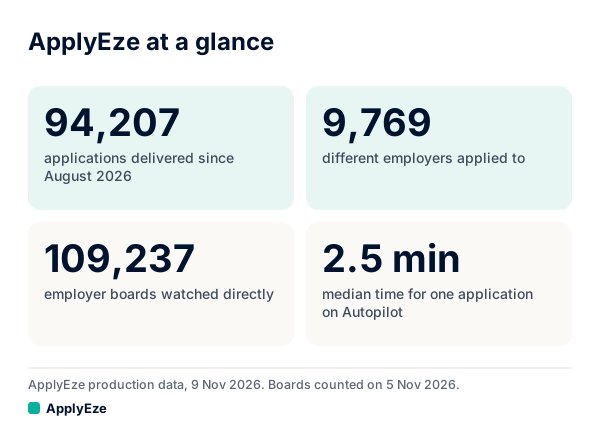
The system around this example is large enough to test it. ApplyEze polls more than 100,000 employer boards directly, holding about 900,000 active jobs, and 94,207 applications have gone through it since August, to 9,769 employers.
The judge is told to assess each role "as a careful recruiter who knows them would". It records a score and a one-line reason. This is the rubric:
| Score | Meaning |
|---|---|
| 10 | Squarely a target role at their level |
| 7 to 9 | A close neighbouring role they could do now |
| 5 or 6 | Plausible on paper, but short of that |
| 0 to 4 | A different field, or a level far above or below |
Asking 3 or more years beyond the person's own is a level gap, and 5 or more is far above them. One more instruction matters: "Read the description, not just the title."
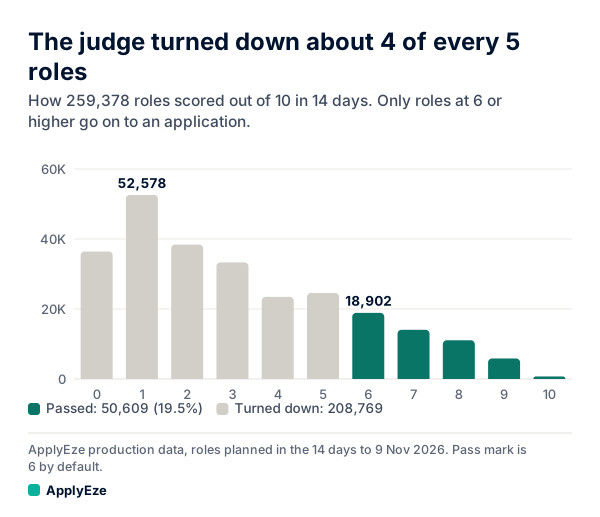
In the 14 days to 9 November 2026, the judge scored 259,378 roles. Most landed at 3 or lower, and 50,609, or 19.5%, reached the default pass mark of 6. So it turned down about 4 of every 5 roles the shortlist offered, at a median of 4.9 minutes from a role being planned to being judged (7 days to 9 November).
A default run therefore includes roles from the low end of the passing scores, and a team can raise the bar per candidate. Here is what each choice would have meant on those 14 days (our arithmetic from the same counts):
| Pass mark | Roles clearing it | Share of 259,378 |
|---|---|---|
| 5 | 75,207 | 29.0% |
| 6, the default | 50,609 | 19.5% |
| 7 | 31,707 | 12.2% |
| 8 | 17,650 | 6.8% |
Clearing the mark is not an application. Over the same period, 34,541 roles ended in a submitted one. Of the runs settled in those 14 days, 79.1% ended in a submission, and in the last 7 days the median was 2.5 minutes from a lane picking up the role to the application going in.
We then check the judge against a second reader, three ways.
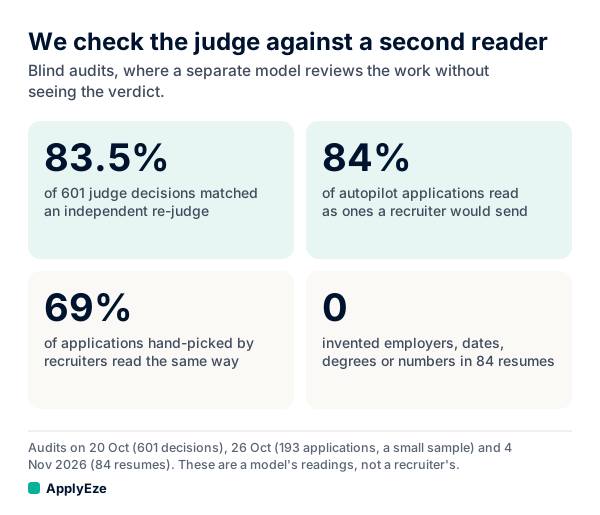
- 20 October. A separate, stronger model re-judged 601 decisions without seeing the verdict and agreed on 502, or 83.5%. It is one model checking another. Our audit post goes through what that shows.
- 26 October. On 193 applications, asked "would a recruiter have sent this?", the reader said yes to 84% of Autopilot's and 69% of those hand-picked by recruiters. The sample is small, and it is a model's reading, not a recruiter's.
- 4 November. 84 sampled resumes held 0 invented employers, dates, degrees or numbers. The skills line is the separate case covered above: it can list skills from the posting, so use a dry run to see what it writes.
Callbacks are the check that comes from outside, and at one staffing team they moved the right way through the fall. ApplyEze's callback rate rose from 1.5 per 1,000 applications in late September to 3.2 in late October. Across that team's whole book, human callbacks per candidate per month rose from about 2 in spring to 7 for October applications, with volume more than tripled and the rate per 1,000 holding near 3. It is one team, part of the rise is better counting, and results for any one person will differ.
What employers report about AI-written applications
Employers feel the volume, and a candidate-side agent should be built with that in mind.
| Source | Who was asked | What it found | How to read it |
|---|---|---|---|
| Robert Half, March 2026 | More than 2,000 US hiring managers, November 2025 | "67% of U.S. HR leaders say reviewing AI-generated applications has slowed the hiring process", 20% by more than 2 weeks. 84% report heavier workloads. | Robert Half sells staffing. Its release also reports that 89% of employers using staffing firms found them effective. |
| Greenhouse, 15 October 2026 | Not stated | "86% of U.S. recruiters say at least half of applications are AI-written" | A vendor claim in a product launch, with no method given. It records a belief, not a count. |
| Greenhouse, 20 October 2026 | 1,200 US job seekers, within 2,800+ overall | "69% would feel comfortable using an AI agent", but "only 5% would let one apply to jobs on its own". Most think candidates should disclose when one does. | Job seekers want control. On Autopilot that control is a team's settings and three switches, one of them the candidate's. |
Employers are responding with process. In Greenhouse's 2025 survey, 34% of US recruiters said they spend up to half their week filtering spam and junk applications. In the Robert Half survey they spend more time reviewing (42%), add interviews per candidate (38%) and update job descriptions (32%). ATS vendors ship limits and identity checks. We found no study measuring how employers treat a well-matched automated application differently from a typed one, so anyone who tells you either way is guessing.
For a staffing team, the practical point is smaller. Assume the hiring manager at the other end may hold these views, and be ready to say which role got an application and why. If you cannot, the agent is doing something your team cannot defend. On Autopilot, each role's record holds a score, a reason, its times and its status. AI in staffing covers how that record works.
How a staffing team should evaluate one
Eight questions, in the order we would ask them. Where we can, we give our own answer, so you have something to compare a vendor against.
- Whose decision does it make? Get one sentence naming the customer and the decision. "It helps with hiring" is not an answer.
- How often does it say no, out of how many? Ours is above, with the denominator. If there is no number, nothing checkable is being decided. The same goes for an employer-side tool: how many people did it screen out, and who looked at them?
- Can you read the rubric? Ask for the wording, and ask what the default pass mark lets through. Ours is above, and a team can raise the bar per candidate.
- What does it read, and what is left out? Get both lists. Then think about which of your candidates the omissions affect.
- Who checked it, and how? Ours was re-judged blind by a separate, stronger model. A panel of your own recruiters scoring a blind sample goes further, and you can run it on any vendor's output.
- What did employers do? Ask for callbacks per application, with the denominators and the dates. Ours are above, for one staffing team.
- What happens when a run fails? Ours retries only runs known not to have submitted, at most 3 tries, waiting 15 minutes, 1 hour, then 4 hours. A run with an unknown submit is never replayed. A vendor that resends on any error can send a candidate's application twice.
- Who can stop it, and who can see what? Autopilot has three independent switches, ApplyEze's, the company's and the candidate's, and all must be on. Each company sees only its own candidates, and every change made through the admin page or the portal is logged, with who made it and when. Recruiting automation goes through which tasks a team can hand off and which stay with a recruiter.
Team plans are set up with us, not bought here: hello@applyeze.com. Bring these questions. If you want to watch ApplyEze fill and submit a form first, your first 50 applications are free, no card needed: you queue the roles in the desktop app, which runs on your computer while it is on and awake.