

Recruiting automation is software that runs repetitive recruiting tasks without a person at each step, and nearly every guide that ranks for the term means the employer's side: sourcing, screening inbound applications, scheduling. A staffing team that represents candidates has a different pile. It has to find open roles for each person, decide which are worth sending, and fill in forms on employers' own sites. Much of that can now be handed off. At one staffing team using ApplyEze, from 14 September to 31 October 2026, software sent 62,832 applications and brought 171 human callbacks, about three times the 58 that recruiters' 13,311 by-hand applications brought.
ApplyEze makes software for that second kind of work. This post shows which tasks you can hand off today, what stays with a recruiter, what that team measured both ways, and how to run a pilot of your own.
Two kinds of recruiting automation, and three kinds of desk
Findem's guide defines the term as "the use of software to run repetitive recruiting tasks" and groups the tasks into sourcing, screening inbound applications, interview management and post-interview work. Bullhorn's staffing primer, from 2020, lists automated messages, record updates, candidate matching and data clean-up. Those are real jobs. Neither page mentions software sending applications for the candidate.
Staffing makes it more confusing, because "submission" means two things. A desk filling a client's job order submits a candidate to that client. A team marketing a candidate applies on an employer's public form. They look alike on a sales page and have different bottlenecks.
| Employer's talent team | Desk filling client job orders | Team marketing the candidates it represents | |
|---|---|---|---|
| Unit of work | An inbound application | A candidate submitted to a client | An application on an employer's own site |
| Bottleneck | Reading the pile | Finding the right person fast | Finding roles and typing forms |
| Automation that helps | Screening, scheduling, messaging | Matching, outreach, submittal drafts | Shortlisting, fit decisions, resumes, form filling |
| Does this page apply? | No | Partly | Yes |
If your desk fills client job orders, most of what follows will not move your numbers. Vendors such as Recruiterflow sell for that desk. Its time audit post claims a submission agent is "cutting submission time by 70%", with no baseline or method given, so treat that as a vendor claim.
A task by task table for a staffing team
This is what can be handed off today to ApplyEze Autopilot, our team product, and what stays with a person. Autopilot is set up today for staffing and recruiting teams that work with ApplyEze. If you are job hunting on your own, you can start with 50 free applications on sign-up, no card needed. You pick the matches and queue them in the desktop app, and ApplyEze fills and submits each form. The app runs on your computer, so keep it on and awake until your queue finishes, and Workday and Oracle roles need a connected inbox. The figures below are team figures.
| Task | Hand it off? | What happens | What to watch |
|---|---|---|---|
| Find open roles | Yes | More than 100,000 employer boards polled directly (109,237 on 5 November 2026), about 900,000 active jobs | It applies automatically on systems holding roughly 62% of them, with an inbox connected. The rest need a person |
| Build a shortlist | Yes | Rules every 10 minutes, fencing out roles already applied to, skipped companies, citizenship and clearance limits | A role doing the candidate's work under an unlisted title ranks low, so list several target titles |
| Decide if the role fits | Yes, and this is the big one | An AI judge scores each role from 0 to 10. In the 14 days to 9 November 2026 it turned down about 4 of every 5 | The default pass mark is 6, and a team can raise the bar per candidate. There is no approval step |
| Write the resume | Yes, with a dry run | Built per posting. Employers, titles, dates, schools, degrees and certifications come from the record. An audit of 84 sampled resumes on 4 November 2026 found 0 invented employers, dates, degrees or numbers | It brings the posting's named skills and tools onto the skills line, even when the record does not list them. There is no step to remove one before a live run, so use a dry run to see what it writes, and have the candidate ready to discuss anything on the page |
| Fill and submit the form | Yes | 79.1% of 45,376 runs across 14 systems ended in a submission, 14 days to 9 November 2026. Median 2.5 minutes an application, 7 days to the same date | Rippling reached 94.5%, iCIMS 55.5%. The rest include postings that closed |
| Answer form questions | Yes, with saved answers | Hard facts come from the candidate's profile. When a required question is not covered by saved answers, ApplyEze still fills it rather than stopping the run, so that answer may not come from the candidate | Fill in saved answers, use a dry run in the desktop app first, and read what was sent |
| Log what went out | Yes | A record per role, and a signed webhook into your own system | See staffing automation controls |
| Spot a reply in the inbox | Partly | See the note below | It can miss replies |
| Take an assessment | No | ApplyEze does not take assessments for you | Tell candidates to expect more of them |
| A form wanting a full Social Security or national ID number | No | That application stops | |
| Candidate calls, interview prep, offers | No | A person | |
| Decide whom to represent | No | A person |
A note on the inbox row. Here is how callback detection works where it is switched on. It is rolling out with staffing teams first and is not part of self-serve accounts yet. Code rules settle most mail, an AI labels likely callbacks, and a person confirms each one. Replies through a job board's own messaging are not picked up, so keep an eye on the inbox.
What stays with a recruiter
Crelate's guide on what to automate in staffing says to "keep the decisions themselves on a human's to-do list". Autopilot departs from that advice on purpose for one decision: whether a given role is worth an application. That is the trade you accept. You give up reading each role, and you get a volume no person can type. The decisions that stay yours sit one level up, and they matter more:
- Whom to represent, at what level, and for which target roles.
- How high to set the bar for each candidate, and which employers to skip.
- When to stop. A candidate deep in a final round should be paused by someone who knows that.
- Everything after a reply: the call, the preparation, the negotiation, and the bad news.
- The roles where a recruiter knows something a posting does not say, such as a referral route or a hiring manager they have placed with. Those are worth doing by hand.
What one staffing team measured, both ways
A human callback means a screening call, an interview or an offer. Only recruiters' own applications count as by hand. Rows that exist only because an inbox reply was found, and candidates' own logged applications, are left out of both sides, because they would inflate a rate.
| Applied in | ApplyEze applications | Callbacks | Per 1,000 | By hand applications | Callbacks | Per 1,000 |
|---|---|---|---|---|---|---|
| 14 to 30 Sep | 5,245 | 8 | 1.53 | 7,429 | 39 | 5.25 |
| 1 to 15 Oct | 17,619 | 35 | 1.99 | 3,844 | 12 | 3.12 |
| 16 to 31 Oct | 39,968 | 128 | 3.20 | 2,038 | 7 | 3.43 |
| Whole window | 62,832 | 171 | 2.72 | 13,311 | 58 | 4.36 |
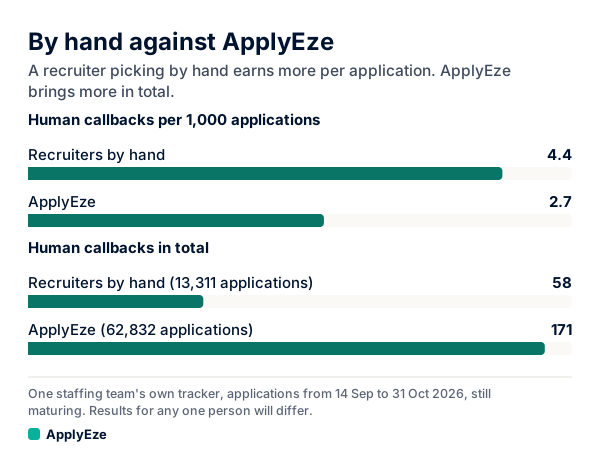
Across the whole window a recruiter picking by hand earned more callbacks per application, 4.4 against 2.7 per 1,000. In the last two weeks of October the rates were close, 3.2 against 3.4, though that by-hand figure rests on 7 callbacks and October applications are still maturing. This is one team, and results for any one person will differ. ApplyEze brought about three times as many callbacks in total, 171 against 58, and the gap narrowed as the fall went on. The full period-by-period reading is in hand-picked vs automated applications.
Volume did not wreck the rate
The fear with automation is that volume destroys the rate. The month-by-month record at the same team, counting every channel, says otherwise. Human callbacks per candidate rose from about 2 a month in spring to 7 for October applications, while callbacks per 1,000 applications stayed near 3 and volume more than tripled.
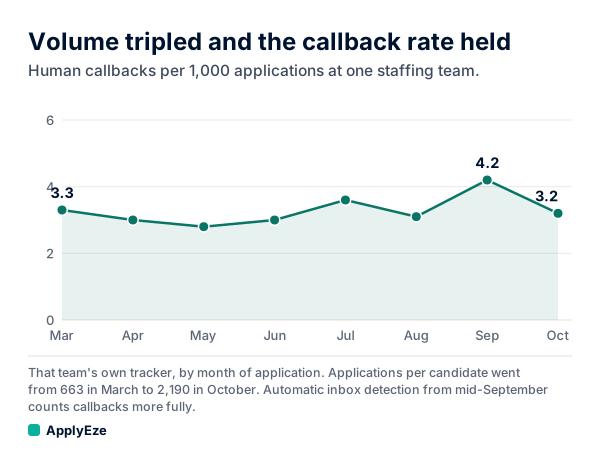
Part of the rise in counts is better counting, since automatic inbox detection in that team's tracker started in mid-September and screening calls were barely logged before about July. The practical reading for a desk is to split the work. Let software carry the volume, and keep recruiters' hands on the roles where they know something a posting does not say.
What employers think of automated applications
Employers are not banning automation in general. They complain about volume, and they are adding limits, fraud checks and more interviews. A team should plan for that.
- Robert Half, surveying more than 2,000 US hiring managers in November 2025, reported that 67% of HR leaders say reviewing AI-generated applications has slowed hiring, with 20% reporting delays of more than 2 weeks. Robert Half sells staffing.
- Greenhouse found in October 2026 that 69% of job seekers would feel comfortable using an AI agent, but "only 5% would let one apply to jobs on its own", and most believe candidates should disclose it. Greenhouse sells anti-spam products.
Employers are also building controls, and these affect a staffing team directly. Ashby's application limits "automatically block excessive applications". Greenhouse's rules let an employer cap how many applications a candidate can submit in a set number of days, and anything over is automatically rejected. So sending a candidate to one employer again and again can get later applications rejected unread.
ApplyEze is built around that. It limits how often it applies to the same employer, so one candidate does not look like spam to one employer, and in the 14 days to 9 November 2026 the judge turned down about 4 of every 5 shortlisted roles before any form opened. In a blind audit on 26 October 2026 of 193 applications, asking whether a recruiter would have sent each one, 84% of Autopilot's read that way against 69% hand-picked by recruiters. The sample is small, and it is a model's reading, not a recruiter's.
We found nothing that measures how employers treat a well-matched automated application differently from a typed one. Some employers ask applicants not to use AI or automation. Whether to apply there is your call and your candidate's, and we suggest you get the candidate's agreement in writing that software will apply in their name.
How to pilot it with one recruiter
The useful thing to know before you start: a one-recruiter pilot will settle hours and error counts well before it settles a callback rate. At about 3 callbacks per 1,000 applications, a 1,000-application pilot expects 3 callbacks, and anything from 0 to 7 is ordinary. To tell 4.4 from 2.7 with the usual 80% power at the 5% level takes about 20,000 applications per side (our arithmetic, using a two-sample Poisson approximation). So design the pilot around what you can learn.
- Write down the decision first. For example: "We keep it if recruiter hours on applying fall by half, callbacks per candidate do not fall, and we find no answers we would be embarrassed by."
- Bring the company admin in. On ApplyEze a recruiter can see, read and pause, and the company admin owns targets and fit levels. Whatever the tool, name one person who owns the settings.
- Pick a few candidates the recruiter knows well, with finished profiles and filled-in saved answers. Knowing the candidate is what lets the recruiter spot a wrong resume.
- Time 20 by-hand applications first. Use a stopwatch, at random, on normal days. Without this baseline you will never know what you got back.
- Keep applying by hand where a recruiter has an edge, and put those employers on the skip list so the two do not collide. Log every application by source in one sheet.
- Read everything for the first week. Every resume and every form answer you can see. Count problems by type. A pilot gives you that count long before it gives you a callback rate.
- Do not read the last week. On applications from 12 to 23 October at this team, 58 human callbacks had a median of 116 hours, with 38% in 72 hours and 74% in 7 days. So recent applications look worse than they will turn out to be.
- Decide on your written rule, not on the best-looking chart. If total callbacks rise and the rate falls, that may be fine or not. It depends on what a callback is worth to you and what an hour costs.
Team plans are set up with ApplyEze rather than bought online: hello@applyeze.com. The steps are in how a staffing team runs Autopilot, and the pilot above works with any tool.
A recruiter who wants to see the form filling before that conversation can open a personal account with 50 free applications, no card needed, and pick a few roles by hand in the desktop app.