
An AI job application bot is software that fills in and submits job applications for you, and employers have not answered it with a general ban. They have answered with slower review, more interviews per candidate and application limits that reject repeat submissions automatically, while LinkedIn and Indeed prohibit the automation on their own sites. What nobody has measured is the question a job seeker most wants answered: whether an employer treats a well-matched application differently because software sent it.
We build ApplyEze, software in this category, so we read these documents closely. This post stays on the far side of the form, because most pages on this keyword are lists of tools. For the tools themselves, our job bot guide sorts them by how they run.
What is meant by a bot
Three different things get called a bot, and the difference decides which evidence applies.
| What people call it | Who writes the answers | Who clicks Submit |
|---|---|---|
| AI-written application | A model, or a model and you | You |
| Autofill | Your saved details | You |
| Application bot | Rules, a model or both | Software |
The third row is the subject here. In October 2024 a 404 Media reporter ran a project called AI Hawk's Auto Jobs Applier. It opened Chrome, went to LinkedIn, clicked Easy Apply, filled in his details, generated a resume and cover letter, answered screening questions and submitted. It applied to 17 jobs in an hour while he ate breakfast.
Keep the table in mind, because almost every employer survey below asks about the first row. "AI-generated application" covers a letter someone drafted in a chatbot and sent by hand. So those numbers are evidence about bots only by inference.
What employers report
| Finding | Source | What it actually measures |
|---|---|---|
| 67% of US HR leaders say reviewing AI-generated applications has slowed hiring, and 20% report delays of more than 2 weeks | Robert Half, March 2026, more than 2,000 US hiring managers, surveyed November 2025 | A reported slowdown. Not whether software sent anything |
| 84% report heavier workloads, and 65% say verifying skills got harder | Same | Perception of workload and of verification |
| New steps: more review time 42%, more interviews per candidate 38%, job descriptions rewritten to discourage generic AI responses 32% | Same | What teams say they changed |
| 34% of recruiters spend up to half their week filtering spam and junk | Greenhouse, November 2025 | Time on junk, which is broader than automation |
| 86% of US recruiters say at least half of applications are AI-written | Greenhouse release, October 2026 | A vendor's claim about a belief. The release gives no method |
| "Many of the talent teams we speak with are seeing a rise in AI-generated applications submitted by automated tools" | Ashby, April 2026 | An anecdote, and the closest of these to the word bot |
Two details are easy to miss. Robert Half's headline figure names HR leaders, while its method section describes the respondents as hiring managers, and the release does not explain the difference. Robert Half also sells staffing, and Greenhouse and Ashby sell the products that respond to this problem. The data is real. The sellers have a stake in the alarm.
The complaint underneath all of them is volume and verification: too many applications that do not fit, and claims nobody can check. Both point at what a careful applicant controls, which is how well each application fits and whether every line on it holds up.
What employers have built
These are product documents, so they are firmer than the surveys. They say what the software does, though not how many employers switch it on.
| Control | What the documentation says | What it means for you |
|---|---|---|
| Ashby application limits | They "automatically block excessive applications". Rules limit how often a candidate can apply to any job within a scope over a set number of days, or stop rejected candidates reapplying | A stray application can use up your allowance at that company |
| Greenhouse application limits | An application that breaks a rule moves to rejected, marked "blocked by auto reject rule". A rejection email is optional. Referrals and internal candidates are not affected | A referral sits outside the rule |
| Ashby auto-reject | Rules run when the application is submitted, on conditions such as location | One wrong answer can end an application at once |
| Greenhouse Real Talent and Dream Job | Real Talent "verifies identity and flags fraud, spam and misrepresentation". A job seeker can "mark one application a month as their Dream Job" | One flag a month is a signal that volume cannot multiply |
| NHS Employers guidance, August 2025 | Recommends application forms with detailed sections tied to the criteria, and multi-stage assessment such as a phone interview first. Says it is "not recommended to automatically reject" on suspicion of AI use | Expect longer forms and earlier phone calls, not a flat refusal |
The limits deserve a worked example, because they change the arithmetic of a careless application. Here is a sample, with an invented rule. Neither vendor publishes a default, and each employer sets its own numbers.
Say a company allows two applications per candidate over 60 days across one department. On Monday a bot sends you to a junior support role and a contract role there, neither of which you would have chosen. On Thursday the role you actually want opens. Your application is blocked, or moved straight to rejected. You may see a generic message or get a rejection email, and nothing tells you the Monday applications were the cause.
So the cost of a poor match is larger than one wasted application. It can be your only shot at that employer for two months. You also cannot see the rule from outside. On Ashby the feature needs a Legacy Plus, Plus or Enterprise plan, on Greenhouse the Pro tier, and neither shows on a posting.
Software can at least learn from a refusal. When an employer on Ashby refuses because you hit its application limit, ApplyEze remembers and skips that employer until the window ends.
What platforms prohibit
The clearest rules come from job boards, and they fall on your account.
LinkedIn's help page says: "we don't permit the use of any third party software, including 'crawlers', bots, browser plug-ins, or browser extensions that scrape, modify the appearance of, or automate activity on LinkedIn's website." It adds that members who use them "risk having their accounts restricted or shut down". Your LinkedIn account is also where recruiters look you up, so that risk is larger than one lost tool. More on this is in does LinkedIn Easy Apply work.
Indeed's terms, last updated 29 September 2026, say: "Use of any automation, scripting, or bots to automate the Indeed Apply process outside of Indeed's official vendors and tooling is prohibited." The same section lets Indeed limit how many applications you can send a day.
ApplyEze applies on employers' own application systems, such as Workday, Greenhouse and Ashby, and not through LinkedIn Easy Apply. Career sites can carry their own terms, so read them.
Some employers go further, and they set the rule themselves. The US State Department's careers FAQ prohibits any AI tool in written application responses, and says it will discontinue a candidacy that breaks the rule. The UK Civil Service sits in the middle: AI may help you refine your ideas and check your spelling, and it must not inflate your experience, write generic answers or complete assessments.
Some employers ask applicants not to use AI or automation. Whether to apply there is your call, and you make it when you choose what to queue.
What nobody has measured
We went through every survey and document above looking for one measurement: how employers treat a well-matched automated application compared with a typed one. We found none. Three things come near.
What users say. Huntr's Q3 2026 survey found 68 of 329 respondents had used a tool that sends applications for them. Six got more interviews than when they applied themselves, 33 about the same, 17 fewer and 12 were not sure, and 40 have stopped. It is self-selected and self-reported, and it tells you what users noticed, not what employers did. We take it apart in what Reddit and the surveys say.
What AI writing did to callbacks. A 2025 working paper on one large freelance platform found that access to an AI cover letter tool raised callbacks, while the link between a well-matched letter and a callback fell by 51%. Those workers still sent their own bids, and employers could not see who used the tool. So it measures AI writing, not software sending.
What we can see ourselves. ApplyEze has delivered 94,207 applications since August 2026, to 9,769 employers, so we can watch what volume does to replies. At one staffing team using it, human callbacks per candidate per month rose from about 2 in spring to 7 for October applications. Applications per candidate more than tripled over that time, and the rate held near 3 per 1,000. A human callback means a screening call, an interview or an offer.
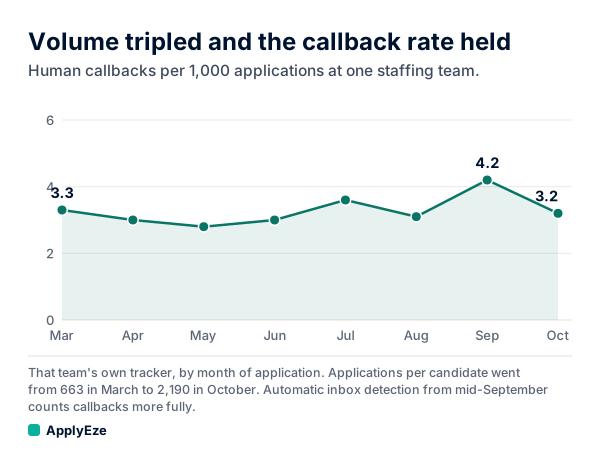
The chart shows that rate staying near 3 per 1,000 from March to October. Part of the rise per candidate is better counting, and results for any one person will differ. It is one team and cannot isolate how an employer reacts to automation, but at that team, more than tripling the volume did not lower the rate.
Fit is the other half of the question, so we audit it. In a blind audit of 193 applications on 26 October 2026, a model asked "would a recruiter have sent this?" said yes to 84% of ApplyEze Autopilot applications and 69% of those hand-picked by recruiters. The sample is small, and it is a model's reading, not a recruiter's. Autopilot is set up today for staffing and recruiting teams that work with ApplyEze. If you are job hunting on your own, you can start with 50 free applications on sign-up, no card needed. You pick the matches and queue them in the desktop app, and ApplyEze fills and submits each form.
A real test of employer reaction would take comparable candidates and comparable roles, assign each application to a method at random, and log the replies without anyone knowing which was which. Until someone runs it, a confident claim in either direction is a guess. That covers "employers throw these out" and "employers are fine with it as long as the fit is good".
Questions to decide for yourself
No survey can settle these for you, and each one has a practical test.
| Ask yourself | If the answer is yes | Why |
|---|---|---|
| Does the posting or careers page ask applicants not to use AI or automation? | Decide before you queue it. It is your call | The rule is theirs, and the consequence falls on you |
| Would you hate to lose your one shot at this employer? | Apply by hand and look for a referral | Limits can punish a stray application, and Greenhouse's do not touch referrals |
| Could a wrong answer end this application at once? | Set your work authorization, location and license answers first, then read what was sent | Auto-reject rules run at submission |
| Would the tool act through a job board account you rely on? | Do not use it there | LinkedIn and Indeed prohibit it, and the account is yours |
| Would you be uneasy saying so if an employer asked? | Apply by hand | In Greenhouse's survey, most believe candidates should disclose when an agent applies, and only 5% would let one apply on its own |
| Would you skip this role if you had to type the form yourself? | Skip it | It adds to the pile and can burn an allowance. Huntr's advice is to "send more applications only when you can still match each one to the job" |
How to use one with care
- See the output before anything goes out. Run a preview if the tool has one, and read every answer on the form. If a tool cannot show you what it sent, you cannot defend it in an interview.
- Fill in the questions that can end an application. Work authorization, sponsorship, location, licenses. These are the knockouts that auto-reject rules key on.
- Keep a by-hand list. Name the employers you care most about and do not queue them. Reach for a person there first. Our guide to how AI is used in hiring explains what you are up against at the screen.
- Space out applications to one employer. You cannot see a limit, so assume one exists.
- Read your first five records closely. Check the role, the answers and the resume. Most damage comes from a bad setting repeated many times, and you can catch it early.
- Run a small version of the missing test. Send similar roles both ways and log the replies by method. Fifty of each will mostly catch large failures and will not prove a small difference, so treat it as a smoke test.
ApplyEze is built for this way of working. You pick the matches from a ranked board and queue them in the desktop app, which fills and submits each form on your computer, so keep it on and awake until the queue finishes. Workday and Oracle jobs stay hidden until you connect an application inbox, because those sites email a code. Before a run it checks that the posting is still live, your employer limit and duplicates, and every run leaves a receipt: the result, the time taken, screenshots where taken and the documents sent.
Hard facts come from your profile. When a required question is not covered by your saved answers, ApplyEze still fills it rather than stopping the run, so that answer may not come from you. Fill in your saved answers, use dry run first, and read your receipts.
If you would rather save your own hours for the employers on your by-hand list, your first 50 applications are free, with no card, and a credit is used only when an application is confirmed as Submitted.