
AI in hiring is really four claims that get merged: how many employers use AI at all, what it does at the screen, how often it rejects someone with no human looking, and what employers have done about applications written or sent by AI. Reported use runs from 27% of organizations in recruiting (SHRM) to 87% of hiring managers in at least one stage (Resume Genius's panel). Polls on automatic rejection conflict more than any other figure here, and none has been audited. The clearest change is the one applicants feel: in one survey of hiring managers, 42% report spending more time reviewing applications, and 38% report more interviews per candidate.
Each claim has a different answer, and most statistics pages list them in one column. Here they are pulled apart.
How many employers use AI, and why the numbers differ
| Figure | Source and date | Who answered | What it counts |
|---|---|---|---|
| 27% | SHRM, April 2026 | More than 1,900 HR professionals | Organizations using AI in recruiting |
| 39% | Same | Same | Organizations using AI in HR at all |
| 51% | Resume Builder, October 2024 | 948 business leaders, Pollfish panel | Companies using AI in hiring |
| 58% | Resume Genius, June 2026 | US hiring managers, Pollfish panel | Using AI to review resumes and applications |
| 65% | TestGorilla, April 2025 | 1,084 hiring decision makers, UK and US | Employers using AI in hiring |
| 73% | MyPerfectResume, March 2026 | 1,000 US HR employees, Pollfish panel | Using AI in hiring decisions |
| 87% | Resume Genius, same survey as the 58% | Same | AI in at least one stage of recruiting |
| 93% | LinkedIn, January 2026 | 6,554 HR professionals in 13 markets | Recruiters who plan to increase AI use. A plan, not current use |
These are not sloppy measurements of one thing. They differ for four reasons.
The unit. SHRM asks what an organization's HR function has implemented. Panel polls ask a person what they use. A hiring manager who drafts a job ad in a chatbot is a yes at 87%, while her company may count as a no at 27%.
The task. The clearest proof sits inside one survey. Resume Genius's 87% is any stage, and its 58% is screening. Another 46% write job descriptions with AI, and 44% match candidates to roles. "Uses AI in hiring" and "AI reads your resume" are different statements.
The panel. Resume Builder, Resume Genius and MyPerfectResume all sell resume products and all report results from Pollfish panels. Resume Genius's report says "1,500" in its introduction and "1,000" in its method note. It also reports a jump from 35% to 58% in screening within about a year, and its companion report says such comparisons "should be interpreted as directional". A rise that steep deserves caution.
The seller. Every publisher above has something to gain from AI in hiring seeming large or alarming. Use numbers like these to learn the shape of things, not to win an argument.
So here is a working assumption. Some of your applications will meet software that orders or filters them, some will not, and you will rarely know which. Gartner found half of candidates believe AI screens their applications, which is as fair a guess as any published figure allows.
What AI screening actually does
"Screening" covers several mechanisms. Only some of them use AI, and only some can end an application.
| Mechanism | What it does | Usually AI? | Can it reject alone? | What you can do |
|---|---|---|---|---|
| Knockout question | Yes or no on work authorization, a required license, location | No, a rule | Yes | Answer exactly, and save your answer in any tool that fills the form for you |
| Auto-reject rule | Fires on form answers at the moment of submission | No, a rule | Yes | Same |
| Match or fit score | Orders the pile | Often | Usually not | Use the posting's real title and terms where they are true |
| Summaries and scheduling | Save recruiter time | Yes | No | Nothing |
| AI interview | Asks questions and records answers | Yes | It varies, and people often evaluate | Prepare as you would for a screening call |
Most automatic rejection comes from eligibility questions such as work authorization. Scoring is more often used to decide who gets looked at first (Enhancv, 25 recruiter interviews). In that small sample, 44% said their system includes an AI or fit score, and 8% use the score to reject. Our guide to what an ATS is walks through what each system does with an application.
Being sorted low is close to being rejected if nobody reaches you, so ranking still matters. But it can be changed by a true, specific application, while a knockout cannot. Employers are also not sure what their own software does. In Greenhouse's 2025 survey, 25% of US recruiters were "not confident in their AI systems at all", 8% had "no idea what their algorithms prioritize", and only 21% were very confident their systems were not rejecting qualified people.
Auto-rejection: the real picture
This is where confident claims have the least under them.
| Source | The finding | The weakness |
|---|---|---|
| Enhancv, 2025, 25 recruiter interviews | 23 said their systems do not auto-reject for formatting, content or design | Very small, and from a resume vendor |
| Resume Builder, October 2024, 948 business leaders | 21% auto-reject at all stages with no human review, 50% only at the initial resume screen, 29% keep humans for all rejections | Dated, and a vendor poll |
| MyPerfectResume, March 2026, 1,000 HR employees | 65% say AI automatically rejects candidates before a person sees them, and 47% say it may have filtered out people they would have advanced | A vendor poll on a Pollfish panel. Rules and models are not separated |
| Harvard Business School and Accenture, September 2021, 2,250+ executives | 88% believed qualified high-skills candidates were vetted out for not matching exact criteria | Employers' belief, before chatbots |
It is easy to pick one row. You can cite 21% and say only a minority auto-reject, but that same poll has another 50% rejecting at the first screen. You can cite 65% and say AI decides your fate. Neither reading holds up. None of these polls audits a system's logs, and none defines AI, so a respondent can count a knockout rule that fires on a work authorization answer as "AI rejected them".
Here is what we would stand behind. Rule-based rejection is common and documented in product manuals. Rejection by a model reading your resume content is reported in polls and denied by most of a very small interview sample. The claim "most companies let AI reject you with no human" is not established, and neither is the reverse.
The older myth is weaker still. "75% of resumes are rejected by ATS" traces to a defunct vendor, as our full trace of that claim shows.
What AI applications did to recruiters
This part has better data, because a recruiter can report on their own week.
- 67% of US HR leaders say reviewing AI-generated applications has slowed hiring, and 20% report delays of more than 2 weeks. 84% report heavier workloads, and 65% of hiring managers say verifying skills got harder (Robert Half, more than 2,000 respondents, a staffing company that sells the fix).
- Teams report spending more time on review (42%), holding more interviews per candidate (38%), and rewriting job descriptions to discourage generic AI responses (32%), in the same survey.
- 39% of US hiring managers are holding more in-person interviews, and 34% of recruiters spend up to half their week filtering spam and junk (Greenhouse, 2025).
- 82% of hiring managers are concerned about candidates using AI, and 58% of them use AI to screen resumes themselves (Resume Genius, which calls this a double standard).
The research adds a mechanism. On one freelance platform, an AI cover letter tool raised callbacks for users at first, and the correlation between a well-matched letter and a callback fell by 51%. Employers leaned more on past work. A companion paper found employers stopped paying a premium for customized applications. When writing gets cheap, employers look for evidence that still costs something, such as a track record or a live conversation.
So the cost lands on everyone. A careful applicant now also waits longer and sits through more rounds.
We can add a measured series, from applications going out at volume. ApplyEze has delivered 94,207 applications since August 2026, to 9,769 employers. At one staffing team using it, human callbacks per candidate per month went from about 2 in spring to 7 for October applications, while the callback rate per 1,000 applications held at about 3. The volume per candidate rose more than threefold, and the rate did not fall.
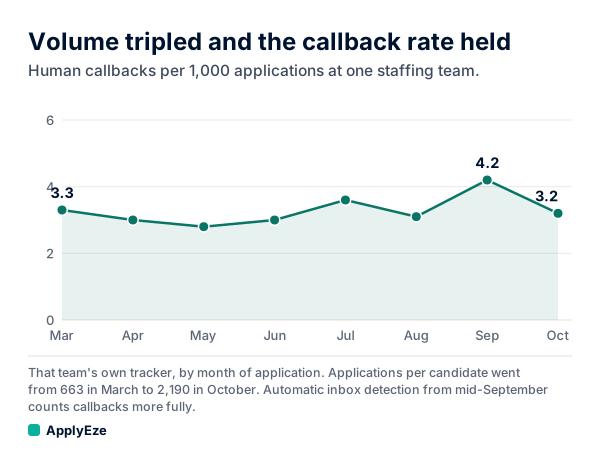
The chart shows the rate staying near 3 per 1,000 from March to October. A human callback is a screening call, an interview or an offer. Part of the rise per candidate is better counting, the series counts every callback the team logged, and results for any one person will differ. So in a market where recruiters report more review and more interviews, more applications did not lower the rate at this team.
What employers built in response
The responses fall into five groups. Our post on the AI job application bot goes through the product documents in detail.
- Slowing the flow. Ashby and Greenhouse both offer limits on repeat applications, and on Greenhouse a breach moves the application to rejected.
- Checking the person. Greenhouse's Real Talent "verifies identity and flags fraud, spam and misrepresentation". Gartner forecasts that by 2028 1 in 4 candidate profiles worldwide could be fake, and that is a forecast, not a count.
- Changing the signal. Greenhouse lets a job seeker mark one application a month as a Dream Job. NHS Employers recommends detailed criteria-based forms and an early phone interview, and says it is "not recommended to automatically reject" on suspicion of AI use.
- Putting AI on the employer's side of the interview. 48% of US job seekers in Greenhouse's 2026 survey took an AI interview in the past year. In a randomized study of about 70,000 applicants for customer service jobs in the Philippines, AI voice interviews raised job offers by 12%, with humans still evaluating. That is one narrow setting.
- Writing rules, and being held to them. The US State Department prohibits AI in written application responses. The UK Civil Service permits refining and forbids inflating. New York City's Local Law 144, enforced since 5 July 2023, requires a bias audit and notice to candidates 10 business days before an automated tool is used. In Mobley v. Workday, a judge in June 2026 largely denied Workday's motion to partly dismiss. These are allegations, not findings. In a University of Washington lab test, models favored white-associated names 85% of the time and Black-associated names 9%, which shows a risk, not a measure of real hiring.
Some employers ask applicants not to use AI or automation. Whether to apply there is your call.
What this means for you
- Treat eligibility answers as your highest-stakes text. This is where automatic rejection is documented, and one wrong answer costs the whole application. Write them down once, save them wherever a tool fills forms for you, and read them again after a run.
- Stop writing for an imaginary robot. No ATS exposes a score for you to chase. Use the posting's real terms where they are true, then write for the person who reads the pile. In Greenhouse's survey, 62% had tried tactics to get past automated screening, including 40% who added skills or keywords they do not have, and those are the claims that more interviews are there to test.
- Prepare to be checked. More interviews per candidate means more chances for a shaky line to surface. Keep one specific story behind each main claim.
- Spend effort on signals that cannot be mass-produced. Employers are moving toward work history and live conversation. A referral helps too, and on Greenhouse referrals are not touched by application limits.
- Use your rights where you have them. In New York City, you can look for the audit summary and the notice.
- If you use AI, keep it honest. Our guide to using AI for job applications goes through it stage by stage, with the evidence for each.
If you automate part of this, here is how ApplyEze fits those facts. It shows no ATS score, because no ATS exposes one, and you pick the matches yourself from a board ranked by rules on your target titles and the requirements it reads out of each posting. Sponsorship and work authorization questions use the answers you saved. Hard facts come from your profile. When a required question is not covered by your saved answers, ApplyEze still fills it rather than stopping the run, so that answer may not come from you. Fill in your saved answers, use dry run first, and read your receipts.
The desktop app runs on your computer, so keep it on and awake until the queue finishes, and Workday and Oracle jobs stay hidden until you connect an application inbox. If you would rather put your hours into the referral and the interview, your first 50 applications are free, with no card, and a resume is written for each posting.