
Using AI for job applications helps most where the task is writing clearly about things that are true, and it hurts where it replaces the proof that you can do the work. The best study available, a randomized experiment with nearly half a million jobseekers, found that writing help on resumes raised hires by 8%. Two 2025 working papers on one freelance platform found that AI cover letters raised callbacks while making the letter itself tell employers less. The most common risk is to your own record: in one small survey, 63% of people who use AI on a resume said it had added something untrue.
Here is the whole post in one table. The sections below show the evidence behind each row.
| Stage | Best evidence | Where AI helps | Where it hurts | Your check |
|---|---|---|---|---|
| Search | Field experiments on suggested occupations | Widening the titles you look for | Sending you after roles that are stale or do not fit | Open each posting on the employer's own site |
| Resume | One randomized experiment | Clarity and errors | False skills, numbers and results | Read every line against your record |
| Cover letter | Two working papers | A first draft matched to the posting | The edge fades, and letters signal less | Edit it, and add one thing only you could write |
| Form answers | No study we could find | Drafting open-text answers from your facts | Knockout questions and statements you sign | Answer eligibility questions yourself |
| Interview practice | No study we could find | Mock questions and follow-ups | Any help during the live interview | Practise out loud, and stop when the real one starts |
| Disclosure | Employer rules and one survey | Nothing | Breaking a rule you never read | Read the employer's policy |
A number to skip: "75% more likely to get an offer"
You will see this in advice pages on this topic. Marie Claire UK, in an article sponsored by a phone network that sells a plan including a chatbot, says that people who used AI for applications "were 75% more likely to receive a job offer". We traced it.
The source is Capterra's Job Seeker AI Survey. Capterra's own analyst, writing in Business Reporter in November 2024, gives the UK figures in one sentence, and that sentence gives the problem away: AI users "complete 42% more job applications on average", and they are 75% more likely to receive an offer.
Now do the arithmetic. If every application had the same odds, sending 42% more would by itself give you 42% more offers. Divide the two (1.75 ÷ 1.42) and about 1.23 is left, a 23% gap. That 23% then has to cover every other difference between the groups, such as age, field and seniority, as well as AI itself. Capterra's global release, with nearly 3,000 respondents, says 53% more likely and 41% more applications, which leaves about 8.5% (1.53 ÷ 1.41). A survey like this cannot separate those causes.
Search: where AI helps and where it does not
We could not find a good trial of asking a chatbot to find you a job. The nearest evidence tests software that suggests where to look, and it is modest and encouraging.
Belot, Kircher and Muller brought 300 job seekers in for 12 weekly sessions, and half got a tool suggesting other suitable occupations. Those suggestions broadened the jobs people considered, and those people were "invited to significantly more job interviews". The gain came mainly from people who had started out searching narrowly. A much larger French experiment, with about 1.2 million job seekers and 100,000 establishments, pointed people toward firms likely to recruit. In the 2022 working paper it raised job finding by 2% among women, which is real and small.
So the useful job for AI here is widening your list of titles. Here is a sample prompt:
Here are my last two roles and what I did in each: [paste]. List ten job titles employers use for work I could do now, including titles outside my own. For each, name the duties of mine it relies on. Leave out anything that needs a license or degree I have not listed.
The weak use is treating its output as a list of open jobs. Open each posting on the employer's own site before you spend time on it. A wider list of general uses is in ChatGPT for job search.
Resume writing: the best evidence
Wiles, Munyikwa and Horton ran the cleanest test: a field experiment on an online labor market with nearly half a million jobseekers. Those who got algorithmic writing help on their resumes were "hired 8% more often". When hired, their hourly wages were 10% higher. The authors found no evidence that employers were less satisfied with them, which suggests the writing helped employers read ability and did not disguise it.
Read it for what it is. The tool was not a chatbot: it found common errors, and a later paper describes it as non-generative and mostly correcting spelling and grammar. It is a working paper, on one marketplace that two of its authors consult for. It shows that clarity pays. It does not show that a model rewriting your history pays.
The second part is where the risk sits, and these numbers are worth taking as a warning:
- Huntr's Q3 2026 survey: of 297 respondents who use AI on their resume, 187 (63%) say it "has added something untrue, such as a skill, a number or a result", and 146 say it happened more than once. The group is self-selected.
- The same survey: 81 of 329 (25%) would use AI to exaggerate if it raised their odds of an interview, down from 42% in its Q1 survey.
- Greenhouse's October 2026 survey of 1,200 US job seekers: 62% have tried tactics to get past automated screening, including adding skills or keywords they do not have (40%).
Employers are responding. Robert Half reports that 65% of hiring managers find skills harder to verify, and 38% have added interviews per candidate. A claim you cannot back up now has more chances to surface. Our prompts for a ChatGPT resume include a fact check to run before you send.
Cover letters: what happened to the signal
This is the most interesting evidence and the least reported. Cui, Dias and Ye studied the launch of an AI cover letter tool on Freelancer.com, using about 5 million letters to over 100,000 jobs.
| What they found | The number | The catch |
|---|---|---|
| Using the tool raised the chance of a callback | 3.56 percentage points on a 7.02% base, a 51% rise | Significant at the 10% level but not at 5%, and it tapered off after two months |
| Letters stopped predicting callbacks as well | The correlation fell 51% for callbacks and 79% for offers | Consistent with letters signalling less |
| Employers looked elsewhere | The link between callbacks and past-work review scores rose 5% | This may favor established workers over newcomers |
| Editing mattered | One standard deviation more editing time went with a 0.31 point rise in offers, about 52% of the average offer rate on AI-assisted applications | A correlation within the same worker, not an experiment |
| Most people did not edit | Most AI letters went in with little or no change | |
| Total hiring did not move | No evidence of a change in hires | The authors call this preliminary |
A companion paper, Galdin and Silbert, reached the same place by another road. Employers paid more for customized applications before these tools existed, and not after. In their model, where writing stops revealing ability, the top fifth of workers get hired 19% less often and the bottom fifth 14% more. That is a simulation, not an observed result.
Both studies cover freelance bids in narrow fields, not corporate roles, so apply them with care. The direction still makes sense: when everyone can match a posting's words at no cost, matching stops telling an employer much. So a draft gets you to the same place as everyone else, and the part that still separates you is what you can prove happened. Here is a sample edit, with invented details:
AI draft: "I am excited to bring my strong analytical skills to your dynamic team."
Edited: "At my last job I rebuilt the weekly inventory report so store managers saw stockouts a day earlier. Your posting describes the same problem across a region."
Form answers
We could not find a study on AI-written form answers, so this section rests on how forms work. Some questions decide the application by themselves. In Enhancv's 25 recruiter interviews, knockouts are the main automated filter: yes or no checks on work authorization, a required license or location. Ashby's auto-reject rules run the moment the form is submitted.
So split the form in two. Answer the eligibility questions yourself, once, and keep them. Let AI help only with open text, working only from facts you supply. Here is a sheet to copy, with your own answers filled in:
- Legal name, and any preferred name.
- Work authorization, in your own exact words.
- Sponsorship needed now, and in the future.
- Willingness to relocate and to travel, with limits.
- Earliest start date and notice period.
- Salary range you will state.
- Years of experience with your five main tools, honestly counted.
- Licenses and certifications, with dates.
- Three work results you can describe in detail.
And a sample prompt for the open-text questions:
Answer this application question in under 100 words, using only the facts below. If the facts do not cover part of the question, write NOT COVERED for that part. Question: [paste]. Facts: [paste from your sheet].
The NOT COVERED line is the point. A model's habit is to fill the gap, and that gap is where false statements get in. Do not hand a chatbot your Social Security number or employer confidential figures, and treat any statement you sign at the end as yours, however it was drafted.
Interview practice
We found no controlled study of AI interview practice, so this is judgment. It looks like the lowest-risk use on this list, since nothing you practise goes on a record. The UK Civil Service, which bars generic AI answers in applications, explicitly permits mock questions and rehearsal, and forbids creating answers for questions during a live or pre-recorded interview.
Here is a sample prompt:
Act as the hiring manager for this posting: [paste]. Ask me one question at a time. After each answer, tell me which claims I made without evidence, then ask the follow-up a skeptical manager would ask.
Answer out loud, because the tool cannot judge how you sound and typing hides the problem. You may also face AI from the other side: in Greenhouse's survey, 48% had taken an AI interview in the past year, and 70% of those said it let them demonstrate their skills well.
Disclosure and honesty
Employers do not agree, so there is no single rule to learn.
| Employer or body | The rule |
|---|---|
| US State Department | Any AI tool is prohibited in written application responses, and a violation ends the candidacy |
| UK Civil Service | Yes to refining ideas, research and checking grammar. No to inflating experience, generic answers or completing assessments |
| Scottish Government | Similar, and no AI during live assessments at any stage |
| NHS Employers | Advice to employers: it is "not recommended to automatically reject" on suspicion of AI use, and a conversation with the candidate is recommended |
Some employers ask applicants not to use AI or automation. Whether to apply there is your call. Candidates are split on where the line sits: in Greenhouse's survey 39% have rewritten an application so it would not be mistaken for AI, even as most use it in their search.
A test that works everywhere: could you explain to the interviewer how you used AI on this application, and defend every line? If yes, you are probably fine. If a sentence makes you hope nobody asks, take it out.
A safe way to use it
- Write your fact sheet by hand first. Everything later draws on it.
- Read the employer's AI policy, if it has one.
- Use AI to find adjacent titles, then check each posting yourself.
- Have it pull the requirements out of the posting and rewrite your true bullets in clearer language. Do not let it add.
- Compare every number, title, date and skill with your record. If you could not discuss a skill for two minutes, delete it.
- Edit the letter, and add one specific thing no tool could know.
- Answer eligibility questions yourself, and practise out loud with mock questions.
If you hand the repetitive part to software, ask what it locks. In ApplyEze, your employers, job titles, dates, schools, degrees and certifications come from your own record. Code rejects a rewrite that adds a figure, employer, school or credential your record does not hold. In an audit of 84 sampled resumes on 4 November 2026, we found 0 invented employers, dates, degrees or numbers.
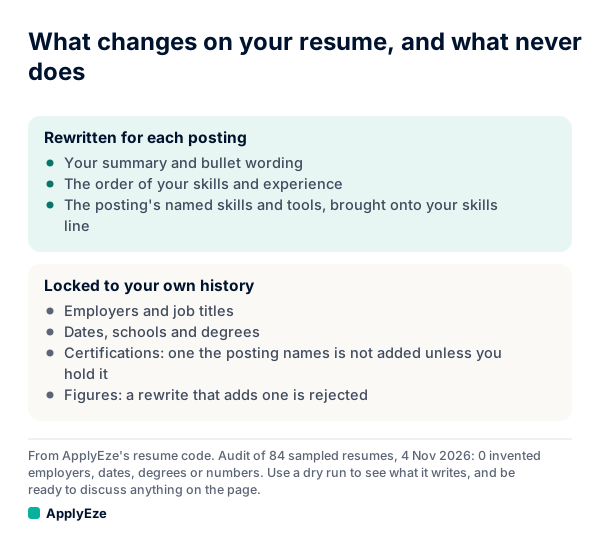
The chart sets out that split. ApplyEze brings the posting's named skills and tools onto your skills line, even when your own record does not list them. There is no step to remove one before a live run, so use a dry run to see what it writes, and be ready to discuss anything on the page. A certification the posting asks for is not added unless you hold it. What an AI rewrite changes goes through this in detail.
Forms work this way. Hard facts come from your profile. When a required question is not covered by your saved answers, ApplyEze still fills it rather than stopping the run, so that answer may not come from you. Fill in your saved answers, use dry run first, and read your receipts.
You choose which matches to queue in the desktop app, which runs on your computer, so keep it on and awake until the queue finishes. Workday and Oracle jobs stay hidden until you connect an application inbox, because those sites email a code. If you would rather spend your evenings on the letter and the interview, your first 50 applications are free, with no card, and ApplyEze builds a resume for each posting.