

ChatGPT for job search does one kind of work well: it reads text you paste in and reshapes it. A posting, your resume, a practice answer you typed. It is much weaker at anything that depends on the world outside the chat, such as whether a posting is still open, whether a number on your resume is true, or whether a form went through. This post gives you prompts that do real work, the way each one tends to fail, and a checking routine built around a figure worth taking seriously: in Huntr's October 2026 survey, 187 of the 297 people who use AI on their resume (63%) said it "has added something untrue".
We build ApplyEze, software that fills and submits job applications, and the last section covers it. Everything before that works with a chat account and none of our software. Every prompt here is a sample written for this post.
What a chat tool does well
Ask where the answer lives. That one question predicts how far to trust the output.
| Where the answer lives | Example questions | How far to trust it |
|---|---|---|
| In text you pasted | Which requirements are mandatory? Which of my bullets fits this line? | High, and you can check it in seconds |
| In general knowledge | What does a phone screen usually cover? What does this title usually do all day? | Fair for common roles, thin for unusual ones |
| On the live web | Is this role still open? What does this company pay? | Low until you open the source yourself |
| Only in your head | What did you actually do? How big was the team? | None. It can only guess, and it will |
Most people already use these tools for the top row. Huntr found 271 of 329 respondents (82%) had used a chatbot such as ChatGPT to write or improve a resume, and Greenhouse found 77% of 1,200 US job seekers used AI in their search in the past year. Trouble starts when a question from the bottom rows gets answered in the confident voice of the top row.
Prompts: reading a posting
These three stay in the top row. Each one forces a quote, so you can see where an answer came from.
Sample prompt: sort the posting.
Here is a job posting. Sort every requirement into three lists.
MUST: the posting says required, or lists it under qualifications with no softening.
NICE: the posting says preferred, a plus, or bonus.
NOISE: mission language, company history, benefits.
Beside each item, quote the posting's exact words.
If the posting does not state years or level, write NOT STATED. Do not estimate.

[paste posting]
How it fails: on a vague posting it promotes "nice to have" into "must". The quotes let you catch that at a glance.
Sample prompt: map your gaps.
Below are the MUST list from that posting and my resume.
Give one row per MUST item:
- The line from my resume that shows it, quoted word for word, or GAP
- Strength: DIRECT (same skill named), NEAR (related work), or GAP
Then name the two gaps most likely to sink this application, in one sentence each.
Do not suggest wording yet.

[paste MUST list]
[paste resume]
How it fails: it is generous, and NEAR stretches to cover almost anything. Read each NEAR row and ask whether a hiring manager would agree. A rule of thumb of ours, not a research finding: if fewer than half the MUST rows are DIRECT, your evening is better spent on a different posting.
Sample prompt: find what the posting leaves out.
Read this posting as a skeptical candidate. List what it does not tell me
and I should find out: pay, team size, who the role reports to, on-site days,
whether it replaces someone. For each, write one polite question for a recruiter.
Label anything you infer as INFERENCE and quote the line that made you infer it.

[paste posting]
How it fails: it tells a tidy story about a company it knows nothing about. The INFERENCE label lets you throw that away. Use the questions, and ignore the theory behind them.
Prompts: tailoring your resume
Our ChatGPT resume guide has the full tailoring sequence and a longer fact check. Two prompts here do something different. The first cannot introduce a false claim, because it writes nothing.
Sample prompt: rank, do not rewrite.
Here are my resume bullets and the MUST list for this posting.
Do not rewrite anything.
Rank my bullets from most to least relevant, with a one-line reason for each.
Then name the three you would cut to keep this to one page.
Sample prompt: rewrite with a ledger.
Rewrite only these three bullets to use the posting's terms where my experience
truly matches them. Return a table with three columns:
New bullet | My original line, quoted | Every word or figure you added
Add no number, tool, title, team size or result that is not in my original line.
If a bullet would need one, write NEED FROM ME and ask for the real value.
The third column is the part that earns its keep. Here is a sample row, invented for this post:
| New bullet | Original line | Added |
|---|---|---|
| Built weekly pipeline analytics for the regional sales team | "Ran weekly sales reporting for the region" | "Built", "pipeline analytics" |
Nothing there would stop you on a quick read. But "ran" became "built", and a report became analytics. If you were maintaining someone else's spreadsheet, you now hold a claim you cannot defend for two minutes in an interview. Rules in a prompt reduce this. They do not remove it, which is why the routine below exists.
Prompts: interview practice
Sample prompt: one question at a time.
You are the hiring manager for this role. The posting and my resume are below.
Ask me one question and wait. After my answer:
1. Say in one line what a strong answer would have had that mine did not.
2. Ask one follow-up that presses on the weakest claim I just made.
Do not praise me. After five questions, list the claims I could not back up.
"Do not praise me" has a reason behind it. In a study published in Science in March 2026, 11 AI models "affirmed users' actions 49% more often than humans" when reading personal dilemmas. That is not interview feedback, but it is the same habit. Our post on the AI career coach goes further into what that means for advice.
Sample prompt: rehearse the gap.
From the GAP rows above, write the three hardest questions an interviewer could
ask about what I am missing. Do not give me answers. Ask for mine, one at a time,
and tell me plainly if I dodged the question.
Sample prompt: find the "we".
Here is a story I plan to tell in an interview. Do not add details.
Mark each sentence SITUATION, MY ACTION, TEAM ACTION or RESULT.
Count the MY ACTION sentences. Flag every "we".

[paste story]
How these fail: the feedback sounds firmer than it is. Paste the same answer into a new chat. If the two critiques disagree, trust only the overlap.
What it cannot do
See live postings reliably. With search on, ChatGPT answers from what its queries bring back, with links, and those links can be stale or wrong. That matters here because postings do not last. In a study of 125 million applications on Dice, the median posting stayed active for seven days, and "only 26 percent" lasted more than two weeks. That is one tech-heavy board from 2012 to 2017, so read it for scale. Run your own test: ask for ten postings that fit you and open every link. Count how many are open, fit you, and lead to the employer's application. That count is how far to trust the list.
Submit a form. A chat window has no way to press a button on another site. ChatGPT Work is a different product: OpenAI Support wrote on 7 September 2026 that it "now has a separate cloud browser that can navigate interactive sites" and can "pause for sign-in or takeover on supported accounts". Check the date on any guide you read, since this has moved quickly. We walk through a real application step by step in can Claude apply to jobs for me, and the same limits matter for any browser agent.
Verify what it writes. It has no access to what you did. Huntr's full numbers are more uncomfortable than the headline: 187 of 297 said AI added something untrue, 146 (49%) said it happened more than once, and 110 (37%) "say they have not noticed it happen". Not noticing is different from it not happening. The survey is 329 self-selected respondents, 71% in the US, with answers not checked against Huntr's tracker data, and Huntr sells resume tools. Some of the untruth is also deliberate. Greenhouse reports that 62% of US job seekers tried tactics to get past automated screening, among them "adding skills or keywords they don't have (40%)". Either way, you are the one who answers for it in the interview.
Know your history or your market. It knows what you pasted. It does not know who got interviewed at this company last month, or how your last manager would describe your work.
How to check its work
Huntr's question names three kinds of untruth: "a skill, a number or a result". Check them separately, and do not ask the model whether it made anything up, because then it is grading itself.
- Plant a canary first. Before trusting a prompt with your real resume, run it on a posting that asks for a tool you have never used. If that tool shows up in the output, the rules in your prompt are not holding. Tighten them and run it again.
- Skills: read the ledger. Every added word gets a yes or no from you. Yes means "I did that and can show it".
- Numbers: hunt every digit. Search your master resume for each one. A digit you cannot find comes off, or gets replaced with a real one from your records.
- Results: ask who would confirm it. Words like "reduced", "grew" and "drove" need a report, a review or a manager who would agree. With none of those, rewrite the line as what you did.
- Web facts: open the link. Check the page's date and that it says what the chat says it says.
- Feedback: ask twice. New chat, same input. Act on the overlap.
- Say it aloud. Anything you cannot talk about for two minutes comes off, however well it matches the posting.
The canary is the one step that tests the prompt and not the output. It takes one extra paste.
Where a chat tool stops and software starts
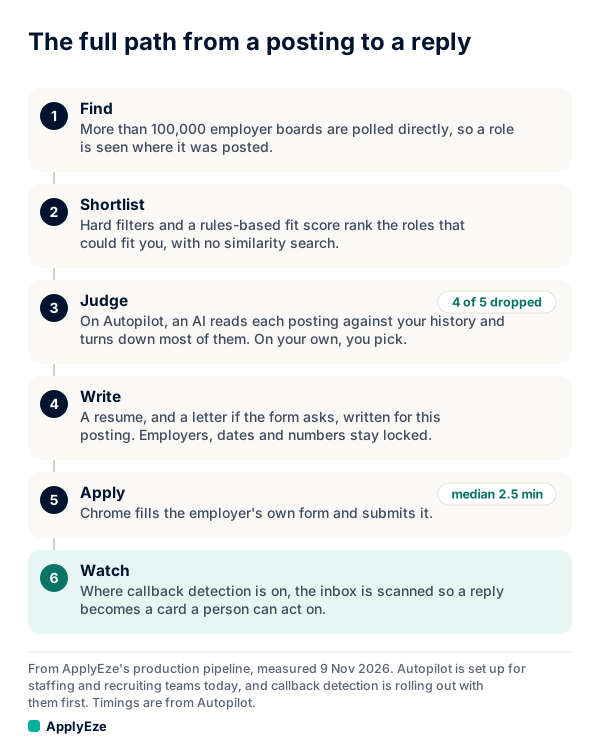
The chart shows the path in ApplyEze's own system, in six steps: finding postings on employer boards, building a shortlist, an AI judge, writing a resume, applying in a real browser, and watching the inbox for replies. A chat window helps with one of those, the resume, and only when you bring the posting and the facts.
What software adds is reach and hands. ApplyEze polls more than 100,000 employer boards directly (109,237 on 5 November 2026), and it applies automatically on systems holding roughly 62% of about 900,000 active jobs with an application inbox connected, roughly 23% without one. It has delivered 94,207 applications since August 2026, to 9,769 employers. On ApplyEze Autopilot, 79.1% of runs ended in a submission in the 14 days to 9 November 2026, at a median of 2.5 minutes an application over the last 7 of those days, and the AI judge turned down about 4 of every 5 roles on the shortlist.
Autopilot is set up today for staffing and recruiting teams that work with ApplyEze, so those are team numbers. If you are job hunting on your own, you can start with 50 free applications on sign-up, no card needed. You pick the matches and queue them in the desktop app, and ApplyEze fills and submits each form. Applications run in Google Chrome on your computer, so it has to stay on and awake until your queue finishes, and Workday and Oracle jobs stay hidden until you connect an application inbox. Callback detection is rolling out with staffing teams first and is not part of self-serve accounts yet, so on your own account you record replies yourself.
The checking routine carries over, because it is what makes this work. For each application, an AI model reads that posting and your real history and writes a resume for it. Your employers, titles, dates, schools, degrees and certifications come from your own record, and code rejects a rewrite that adds a figure, employer, school or credential your record does not hold. An audit of 84 sampled resumes on 4 November 2026 found 0 invented employers, dates, degrees or numbers. ApplyEze also brings the posting's named skills and tools onto your skills line, even when your own record does not list them. There is no step to remove one before a live run, so use a dry run to see what it writes, and be ready to discuss anything on the page.
Forms work like this. Hard facts come from your profile. When a required question is not covered by your saved answers, ApplyEze still fills it rather than stopping the run, so that answer may not come from you. Fill in your saved answers, use dry run first, and read your receipts.
So here is a working split. For a short list of roles you care about, a chat tool and your own hands are a good setup: you see every word, and nothing leaves until you send it. Where the work is repetitive, software pays for itself in time, as long as you check what it does. Using AI for job applications covers where each helps and hurts. To try the second half, your first 50 applications are free: a credit is used only when an application is confirmed as Submitted, and dry runs use none as long as you have one left.