

On Reddit, AI job application threads are mostly complaints: answers that were wrong, filters that did not hold, money that was hard to get back, and high counts with few interviews. The two surveys that ask directly lean the same way and are less bleak. Huntr asked 68 people who used a tool that sends applications for them: 6 got more interviews than when they applied themselves, 33 about the same, 17 fewer and 12 were not sure. Greenhouse asked 1,200 US job seekers, and 69% would be comfortable using an AI agent, but only 5% would let one apply on its own.
We build ApplyEze, one of these tools, and our own numbers come later. This post sets the threads beside the surveys and shows where they agree, where they part, and why the most common answer in the data barely appears on Reddit at all.
What the threads keep saying
These threads date from 2026. All of it is paraphrased, and each claim is one person's account. The companies' side mostly is not in the thread.
You cannot see what went out. A laid-off poster in r/jobsearchhacks tried many of these tools and said the worst part was having no view of what they submitted: an old job title, a wrong number, a wrong description.
Wrong answers on the questions that decide things. In r/Tsenta, a user said the agent answered No to a willingness-to-relocate question, a knockout, and the application was rejected. Another said details stayed wrong after repeated corrections. The company's reply conceded that AI does tend to make things up.
Filters that do not hold. In a thread on AIApply, the poster had excluded jobs in French and was then put forward for a role requiring French. A commenter there set out the minimum they want: a review step, exclusions that really block, and a clear reason each job matched.
Volume with nothing to show. In another r/Tsenta thread, users described 350 to 400 applications with 6 interviews, and more than 622 applications with no calls. The company's CEO has said on Reddit that 300 to 400 applications on one profile means recruiters are not picking that profile.
Money. In the same AIApply thread, commenters describe refunds they could not get and a cancel button that seemed to do nothing.
The recruiter's view. A corporate recruiter's post in r/recruitinghell says applications from these services arrive with education and work history incomplete, a stock resume in place of the candidate's, and throwaway email domains that may never reach the person. Popular replies pushed back. One said people will stop using these tools when employers stop using ATS and AI. Another pointed out that the recruiter still called the candidate.
And some wins. A poster in r/AIJobApplications comparing about ten tools said free autofill saves a lot of time. Off Reddit, an AIApply reviewer on Trustpilot reported 7 interviews in a week from over 200 automated applications, along with a refused refund.
What Huntr asked 68 tool users
Huntr's Q3 2026 survey ran from 13 to 26 October 2026 and kept 329 respondents. Of those, 68 (21%) have used a tool that sends applications for them. This is the most direct question anyone has published, and here are the answers with the width of the error shown, which Huntr does not print.
| Compared with applying themselves | People | Share | Rough 95% range (our arithmetic) |
|---|---|---|---|
| More interviews | 6 | 9% | 4% to 18% |
| About the same | 33 | 49% | 37% to 60% |
| Fewer interviews | 17 | 25% | 16% to 36% |
| Not sure | 12 | 18% | 10% to 28% |
Shares add to 101 because of rounding. Three things follow.
"Fewer" beats "more" by a real margin. Among the 23 people who noticed a change, 17 said fewer. A split that lopsided would turn up by chance only about 3% of the time (a sign test, our arithmetic), so inside this group it is unlikely to be luck.
"Inside this group" is doing a lot of work, though. Huntr recruited through LinkedIn, its own newsletter and a link shared by a team member, with a gift card draw as the prize. It says respondents "do not represent all job seekers". Huntr sells resume tools too. And the comparison is self-reported, against the person's own earlier search, in a market that kept moving.
Forty of the 68 (59%) have stopped, and the report does not say why. That is easy to read as disappointment, but finding a job also ends tool use.
Huntr's own platform cannot help here. Its method notes say: "We see when a user marks a job applied, not how they applied. We cannot measure mass-apply or auto-apply tools."
What Greenhouse asked 1,200 candidates
Greenhouse's October 2026 report surveyed 1,200 US job seekers. It found that "69% would feel comfortable using an AI agent", but "only 5% would let one apply to jobs on its own". Most also believe candidates should disclose when an agent applies for them. Separately, 39% have rewritten an application so it would not be mistaken for AI.
This is a larger sample, and it measures a different thing: what people say they would accept, not what happened to them. It also has an interested publisher. Greenhouse sells Real Talent, which it says flags fraud and spam in applications.
Put the two side by side and they look at odds: 5% would let an agent apply alone, and 21% have used a tool that applies. They are different questions, put to different people. Huntr's respondents reached the survey through a job search company's channels, and using a tool is not the same as trusting it to run unwatched. Do not average them.
Where anecdote and survey agree
| Claim | In the threads | In the surveys | Our reading |
|---|---|---|---|
| Most people see no lift | Common | 6 of 68 got more interviews | Agree |
| People give up on these tools | Cancellation stories | 40 of 68 stopped | Agree, cause unknown |
| People want to stay in control | Calls for a review step | 5% would let one run alone. 260 of 329 would rather send 20 tailored applications than 100 with one resume | Agree |
| AI puts untrue things on the page | Wrong titles and answers | 187 of 297 people who use AI on a resume say it added something untrue | Agree, though Huntr's figure covers AI on resumes generally |
| These tools actively hurt you | A common verdict | 17 of 68 got fewer, 33 about the same | Partly. A quarter of a small group |
| Nothing ever works | The mood of many threads | 6 of 68 got more, and wins get posted | Threads overstate it |
The largest number in the table is the one you will not find on Reddit. About half of Huntr's tool users said "about the same", and nobody writes a post to report that a subscription changed nothing. Threads collect the two tails. So a thread can tell you what the failures look like, and the surveys suggest that plain disappointment is more common than disaster.
Why neither settles it
Six problems sit under both kinds of evidence.
- No denominators in threads. "Thousands of applications" and "zero interviews" are rarely attached to a role, a field or a date.
- Selection on both sides. Angry and delighted people post. People who follow a job search brand answer its survey.
- Tools get averaged. "A tool that sends applications" covers browser extensions, cloud agents and services run by people, at many prices. A lowest-tier plan with no tailoring and a costly plan that writes a resume per posting land in one bucket.
- Nothing is controlled. Nobody in either source compared the same person on similar roles at the same time.
- Sellers are in the room. In the recruiter's thread, a popular reply said these companies try hard to advertise in that subreddit.
- "Interview" is undefined. One person's interview is an automated screen, and another's is a final round.
The famous anecdotes show how wide the range can run. Entrepreneur reported in January 2025 that a Reddit user claimed 1,000 applications and about 50 interviews in a month. The article does not verify it, and it notes that other Redditors said the code no longer worked. Futurism reported in November 2023 on a man who sent 5,000 applications with LazyApply for about 20 interviews, roughly what several hundred manual applications had brought him. Our arithmetic puts those at 5% and 0.4%, twelve and a half times apart. Our LazyApply review has more on the second case. Neither number tells you what you would get.
Pages that rank for this topic often quote tidier figures. Jobscan gives "roughly 1 to 6%" as an estimated callback rate for fully automated tools and says the figures "come from vendor and platform research, not independent audits". Jobscan is candid about that, and it also sells a tool in the category it rates higher. Read the range as a vendor's estimate.
What our own numbers show
Threads rarely have a denominator, so here is ours. ApplyEze has delivered 94,207 applications since August 2026, to 9,769 employers, and we can follow what happens to them. At one staffing team using it, human callbacks per candidate per month rose from about 2 in spring to 7 for October applications. Applications per candidate more than tripled, and the rate held near 3 per 1,000. A human callback is a screening call, an interview or an offer.
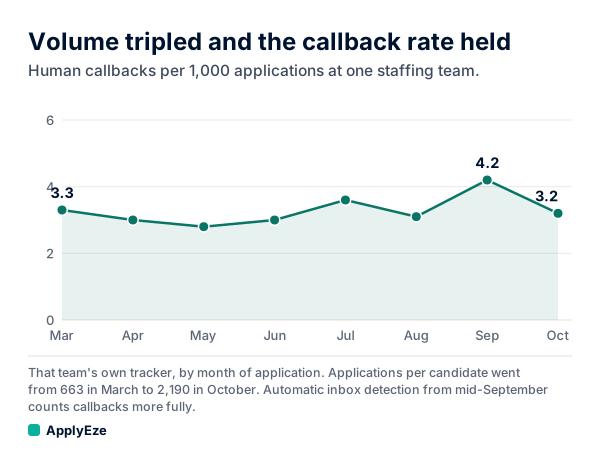
The chart shows that rate staying near 3 per 1,000 from March to October. Within that, the rate on ApplyEze's own applications rose through the fall, from 1.5 per 1,000 in late September to 3.2 in late October. That speaks to a theme in the threads, that volume brings nothing. At this team, volume more than tripled and the rate did not fall.
Part of the rise per candidate is better counting, and results for any one person will differ. These are numbers from one team, not a self-serve result, and they use different people and definitions from Huntr's survey, so do not set one against the other. Our post on callback rates at volume has the full table.
How to read a thread
Here are six questions, worked through on the recruiter's post, because it is the most useful thread here and also easy to overread.
| Ask | Why | The recruiter's post |
|---|---|---|
| Is there a denominator? | A count without a base is a mood | It describes failures, not how often they happen |
| Who is speaking, and what do they sell? | Promotion looks like advice | A self-described corporate recruiter. The subreddit does get pitches, a reply says |
| Compared with what? | Without a baseline, a bad result proves little | No baseline in the passages we quote |
| Which tool, plan and settings? | The category hides large differences | "These services", unnamed in the passages we quote |
| Can you check the failure yourself? | This is the part you can use | Yes: blank sections, a stock resume, an unknown email domain |
| What do the replies dispute? | The top reply can be better than the post | Whether employers can complain while using ATS and AI themselves, and whether the candidate was really hurt, given the call |
Threads are good for failure modes and poor for rates. So use them to write a test list, whichever tool you pick:
- Read the actual file and answers that went out, for at least your first five applications.
- Check that replies reach an inbox you read, and see which address the tool puts on the form.
- Set one exclusion, such as a language or a job family, and see whether it holds.
- Find the cancel button and read the refund terms before you pay anything.
- Write down applications and interviews per week, by method, so you have a denominator of your own.
Here is how ApplyEze answers each of those complaints.
| The complaint | What ApplyEze does |
|---|---|
| You cannot see what went out | Every run leaves a receipt: result, time taken, screenshots where taken and the documents sent. Dry run fills the form and stops before Submit |
| Wrong answers on the questions that decide things | Sponsorship and work authorization questions use the answers you saved, and code re-reads the form before the final click for answers that contradict your saved citizenship, sponsorship and address |
| Filters that do not hold | Hard filters run first: work authorization, blocked companies, location. "Why this fits" shows the factors behind each match, and you pick the matches yourself |
| Old titles and wrong numbers on the page | Your employers, job titles, dates, schools, degrees and certifications come from your own record. In an audit of 84 sampled resumes on 4 November 2026, we found 0 invented employers, dates, degrees or numbers |
| Blank sections and lost replies | Code audits required fields before a run can report success, and employer replies arrive in the inbox you chose. The product advises a new Gmail kept only for applications |
| Money | 50 free credits with no card, and nothing is charged when they run out. A credit is used only when an application is confirmed as Submitted |
Two lines belong beside that table. Hard facts come from your profile. When a required question is not covered by your saved answers, ApplyEze still fills it rather than stopping the run, so that answer may not come from you. Fill in your saved answers, use dry run first, and read your receipts. And ApplyEze brings the posting's named skills and tools onto your skills line, even when your own record does not list them. There is no step to remove one before a live run, so use a dry run to see what it writes, and be ready to discuss anything on the page.
For the wider choice of tools, see auto-apply to jobs, and for AI short of submitting forms, see using AI for job applications. You queue the roles in the desktop app, which runs on your computer, so keep it on and awake until the queue finishes, and Workday and Oracle jobs stay hidden until you connect an application inbox. If you would rather test than read one more thread, your first 50 applications are free, once per email address.