

A career change at 40 is a bet with a long payoff window and a tight cash window. Someone who is 40 in 2026 is 27 years from Social Security's full retirement age of 67, which gives almost any retraining time to pay back. The same person often has less room to go without income than they had at 28. So the useful question is not whether it is too late. It is whether you can test the move before you pay for it. This post gives you a way to do that, using pay and supply by field from the roughly 900,000 active jobs we track, shows what your experience proves and what it does not, and sets out what application forms actually ask and how titles decide what you see. For the general plan, including a skills gap worksheet, start with our career change guide. This post is about what is different at this age.
What is different at 40
The time left is longer than it feels. People born from 1957 to 1964 held 2.9 jobs from ages 35 to 44 and 2.2 from ages 45 to 54, so they kept moving well past this point. Among workers aged 35 to 44 in January 2026, median time with their current employer was 4.7 years. Twenty-seven years holds several jobs of that length.
The law starts here. The Age Discrimination in Employment Act protects people who are 40 or older, at employers with 20 or more employees. It does not stop bias from happening, but it does shape what forms ask, as covered below.
Age bias is real, though the evidence at 40 is mixed.
- In Sweden, Carlsson and Eriksson sent over 6,000 fictitious resumes with ages from 35 to 70 to low- and medium-skilled vacancies. The callback rate "begins to fall substantially for workers in their early 40s", more steeply for women. Employers' stereotypes concerned "the ability to learn new tasks, flexibility, and ambition".
- In the US, Neumark, Burn and Button compared ages 29 to 31, 49 to 51 and 64 to 66 across more than 13,000 positions. For women in administrative jobs, callbacks were 14.4% for the youngest group and 7.6% for the oldest, with a weaker and less consistent pattern for men. There was no 40-year-old group.
- Another US audit by Farber and colleagues found a hump: younger and older applicants both drew fewer callbacks than prime-aged ones.
None of these tested career changers. The reading we would take: 40 is not a cliff, and the stereotypes named in the Swedish study (can this person learn, adapt, still want it) are exactly what a career change application can answer with recent evidence.
The search is a little longer, not a different world. In United Way NCA's survey of 1,000 recent and current US job seekers (February and March 2026), people self-reported average searches of 5.9 months for Gen Z, 6.8 for Millennials and 7.2 for Gen X. The survey does not state birth years. On Pew's definition (Millennials born 1981 to 1996), someone who is 40 in 2026 is a Millennial, and Gen X starts at about 46. That is about a month between Gen Z and Millennials and less than that between Millennials and Gen X, all self-reported.
What your experience proves, and what it does not
Experience is good evidence of how you work and weak evidence of what you know today. Sort yours honestly before a hiring manager does.
| What you can show | What it proves to a new field | What it does not prove |
|---|---|---|
| You led people | You can hire, coach and hold others to a standard | That you can judge good work in this field yet |
| You owned a budget or a target | You understand trade-offs and being measured | That you know this field's numbers |
| You dealt with difficult customers or stakeholders | Judgment under pressure | That you know this buyer or this product |
| You ran a process for years | Reliability and attention to detail | That you know this field's tools |
| You stayed current in an old field | You can learn on the job | That you have started learning this one |
The right-hand column is your to-do list. Most of it closes with a tool, a small project or a conversation. A license does not close that way: the BLS says registered nurses must graduate from an approved program and pass a qualifying exam, and no resume wording gets around that.
Experience also reads as cost. A hiring manager may wonder whether you will accept the pay and the junior title, or whether you will leave once something better comes along. Say what you have decided about that, in one sentence, in the cover letter or on the first call.
Test a move before you pay for it
Run these in order, lowest cost first, and stop as soon as one fails.
- Ten postings. Copy every requirement from ten current postings for one target title and count them, using the worksheet in our career change guide. What appears in most of them is real. What appears in one or two is noise.
- Supply and pay. Check the table in the next section, then check pay in your own ten postings.
- Three conversations. Ask people in the role what the week is like and how a newcomer gets in.
- One piece of the work. Build the sample, run the analysis, write the brief. If you dislike doing it, that was cheap news.
- Payback math. Only if the move needs paid training.
Payback in years = (tuition + pay you give up while training) ÷ yearly raise in the new field
Three samples with invented salaries and raises, starting at age 41. Tuition uses the College Board's 2026-27 average of $12,290 for a public four-year college, in state. The math ignores taxes, interest, aid and later raises.
| Sample move | Tuition or course | Pay given up | Yearly raise | Payback | Paid back at about age |
|---|---|---|---|---|---|
| Short course while still employed | $2,500 | $0 | $8,000 | About 4 months | 41 |
| Two years out of work, $62,000 salary | $24,580 | $124,000 | $25,000 | 5.9 years | 49 |
| The same two years, smaller raise | $24,580 | $124,000 | $5,000 | 29.7 years | 73 |
The table shows what really decides this at 40. Age barely matters in the first two rows. The size of the raise decides the second and third, since the same program pays back by 49 or never within a working life. And in the second row, 83% of the cost is lost pay rather than tuition (our arithmetic: $124,000 of $148,580), so a part-time or evening route changes the result more than a lower tuition does. If the new field would pay less than you earn now, there is no payback at all. That can still be a good decision, but make it knowingly.
Supply and pay by field
These figures come from a 1% sample of the roughly 900,000 active jobs in our pool on 9 November 2026 (9,474 rows). Open-role counts are rough, and a second sample differed by up to about 15% per field. Pay is the median midpoint of the advertised range, and only about 15% of postings state pay, so it describes those postings and is not a market wage. Fields with few rows rest on very few pay figures, and we mark those as thin.
| Field | Open roles, roughly | Fully remote | Median advertised pay |
|---|---|---|---|
| Clinical healthcare | 140,000 | 3% | $86,000 |
| Sales | 100,000 | 12% | $77,000 |
| Operations | 75,000 | 5% | $66,000 |
| Finance and accounting | 54,000 | 5% | $95,000 |
| Marketing | 49,000 | 8% | $80,000 |
| Customer success | 35,000 | 5% | $48,000 |
| Supply chain and logistics | 30,000 | 2% | $72,000 |
| Construction management | 30,000 | 5% | $85,000 |
| Security | 27,000 | 13% | $141,000 |
| Legal and compliance | 25,000 | 9% | $83,000 |
| Software engineering | 20,000 | 24% | $161,000 |
| Project and program management | 19,000 | 11% | $118,000 |
| Machine learning | 15,000 | 25% | $183,000 |
| Administrative | 17,000 | 2% | $50,000 |
| HR and recruiting | 12,000 | 6% | $105,000 (thin) |
| Education | 12,000 | 6% | $48,000 (thin) |
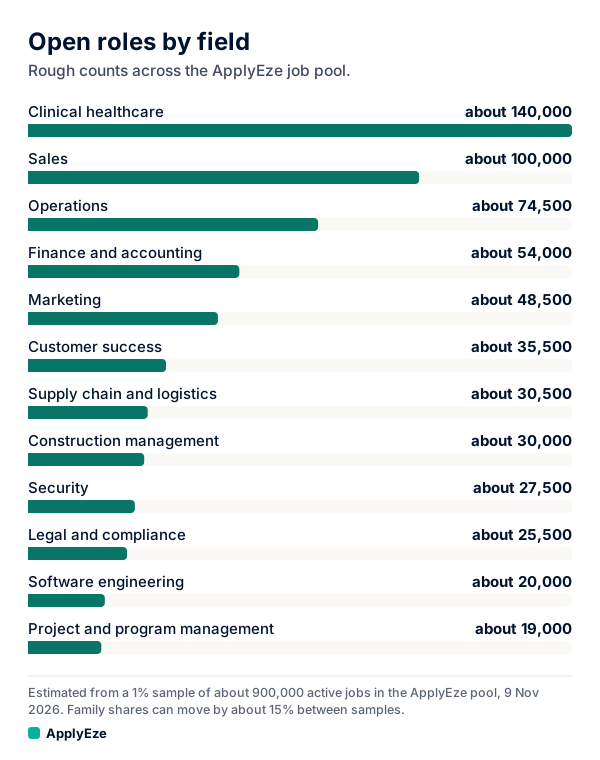
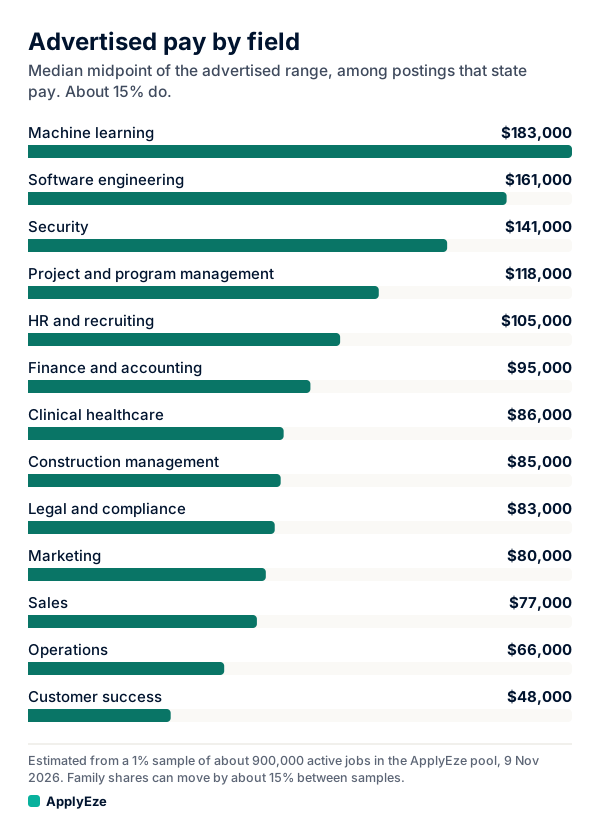
Read the two charts together, and four things stand out.
- The biggest field is the hardest to walk into. Clinical healthcare is the largest line, and many of its roles require a license, as nursing does, so for a changer it is a retraining decision first.
- High pay comes with fewer doors and tougher competition. Software engineering shows about 20,000 roles at a $161,000 median. Challenger, Gray & Christmas counts 171,501 announced cuts in technology companies through October 2026, and United Way's respondents in tech self-reported a 9.7 month search against 6.6 overall. A beginner there competes with experienced people who were just cut. Those two counts measure different things, so read them as direction only.
- The common teacher move may not be a raise. Customer success shows a $48,000 median, the same as education, on thin education data. Check it against your own ten postings before you plan around a pay rise.
- Senior postings pull a median up. Project and program management's $118,000 likely includes many experienced roles. An entry point at "coordinator" level will not pay that, so read the level as well as the field.
Cross-check any field against the BLS for the specific occupation. It reports, for example, a $97,550 median for registered nurses in May 2025, measured across workers, against our $86,000 for a broader clinical group measured across postings. The two are different kinds of number.
What forms ask, and how to answer
Here is where a career change meets the software.
| The form asks | Why it matters at 40 | Honest handling |
|---|---|---|
| Job title, company, from and to dates | Charlotte's Workday guide lists "Job Title*, Company*, and From* and To* date" as required. Your old title stays visible. | Enter the real title. Let your summary explain the move. |
| Years of experience in the new field (sample: "How many years of customer success experience do you have?") | A low number can filter you out. | Give the true number for what is asked. If a note box exists, add related years there, labelled as related. |
| A required license or certification | Often a hard yes or no. | Answer truthfully. Say "in progress" with a date only if it is. |
| Graduation year | It reveals your age. | Charlotte's guide stars school, degree and field of study, so leave any optional year blank. |
| Why this change (free text) | This is your best chance to explain it. | Sample: "After 15 years running stores, the part I do best is scheduling and inventory. I took a logistics course this year and want to do that work full time." |
On age questions, the EEOC says the law "does not specifically prohibit an employer from asking an applicant's age or date of birth", but such requests "will be closely scrutinized". Its hiring guidance adds that such inquiries "may be used as evidence of an employer's intent to discriminate". Colorado goes further: since 1 July 2024, an employer "shall not request or require" age, date of birth, or dates of attendance or graduation on an initial application. Our post on how far back a resume should go covers Connecticut's similar rule. This is general information, not legal advice.
Dealing with age on a resume
Three things help, and none requires hiding anything.
- Trim the old end. Show your recent roles in full and summarize or drop much older ones.
- Drop the graduation year where it is optional. Keep real dates on your recent jobs, since a resume with none reads as evasive and forms ask for them anyway.
- Add one dated piece of recent learning near the top. "Completed a logistics certificate, 2026" answers the learn-new-tasks stereotype from the Swedish study directly. That link is our reading, not something the study tested.
Avoid "seasoned", "30 years of experience" and a summary that describes the past. For the rewrite itself, our career change resume post shows before and after samples.
Titles to list
Your old title steers your searches back to your old field, because a saved search only finds the words you give it. Titles also vary more than you would guess. O*NET's Project Management Specialists page shows the spread, with reported titles including Fiber Project Manager, Implementation Project Manager and Project Management Consultant.
Titles decide rankings too. ApplyEze does not rank by text similarity. It ranks on your target titles and the requirements it reads out of each posting, so a role doing your work under a title you did not list ranks low, however well your skills fit. That makes your title list a changer's most valuable edit, because the new field's titles are the ones you know least. List several. Our target job titles post explains how the order works: the first title listed ranks first. These are sample lists.
| Moving from | Titles to try, in order |
|---|---|
| Teacher | Instructional Designer, Training Specialist, Learning and Development Specialist, Customer Education Manager, Implementation Specialist |
| Retail store manager | Operations Manager, Operations Supervisor, Logistics Coordinator, Facilities Manager, Customer Success Manager |
| Military team leader | Project Coordinator, Operations Manager, Logistics Manager, Program Coordinator, Security Manager |
| Registered nurse | Clinical Informatics Analyst, Utilization Review Nurse, Clinical Educator, Healthcare Project Coordinator |
A free ApplyEze account lets you run the supply test on your own profile against more than 100,000 employer boards polled directly. You answer the setup questions, upload your resume and list titles, then see a board ranked by fit. "Why this fits" shows skills matched and missing, and zero matches show as zero. Workday and Oracle jobs stay hidden until you connect an application inbox, and roughly 4 in 10 of the open jobs we track are on those two, so connect one before you read a low count as a verdict. If you go further, a dry run fills a form and stops before Submit, so you can see what would be sent. ApplyEze brings the posting's named skills and tools onto your skills line, even when your own record does not list them. There is no step to remove one before a live run, so use a dry run to see what it writes, and be ready to discuss anything on the page.
A 90 day plan
Stay employed through as much of this as you can. Your income is what makes the bet affordable.
| Days | Do | Done when |
|---|---|---|
| 1 to 30 | Read ten postings for two titles. Check supply and pay. Talk to three people in the role. Run the payback math. | One target title chosen, or the idea dropped at low cost |
| 31 to 60 | Close the top gap with a course or project. Build one work sample. Rewrite your summary, skills and first bullets. List your titles. | One dated proof you can show and discuss |
| 61 to 90 | Apply to about 5 well-chosen roles a week, and hold a conversation a week with someone in the field. Track applications and interviews. | About 20 applications sent, and a first read on what is working |
These counts are our rule of thumb. If nothing has moved by day 90, look first at which step is failing. No replies point to titles and the top of your resume. Interviews with no offers point to your story or to skill gaps. A move can take much longer than 90 days, and this plan tells you early whether it is worth continuing.
Your next step is the first row: pick one title and read ten postings this week. When you reach day 61, ApplyEze can take over the forms: you queue the roles you want, and it runs on your own computer, which stays on and awake until the queue finishes. Your first 50 applications are free, with no card, and it builds a resume for each posting, which leaves you the work sample and the conversations.