

A career change resume does not need a new format or a new history. It needs a rewritten top third: a summary that names the move, a skills line in the new field's words, and the first bullets under your latest job reordered so the overlap comes first. Your employers, titles, dates and numbers stay exactly as they are. Most guides tell you to "highlight transferable skills" and stop there. This one shows the actual lines, before and after, for three moves, marks the line in each that goes too far, and gives you a fact check to run on your own draft. Every person, employer and number in the samples is invented for this post.
What to change and what to leave
| Rewrite | Reorder | Leave exactly as it is |
|---|---|---|
| Summary | Bullets within each job | Employer names |
| Skills line | Which sections come first | Job titles |
| The wording of your first bullets, using the new field's nouns | Dates | |
| Schools, degrees, certifications | ||
| Every number |
Why the top third does the work comes down to where a reader's eyes go. TheLadders, a company selling resume rewrites, put 30 recruiters through an eye-tracking study in 2012 and reported about 6 seconds for the first fit or no fit glance, with almost 80% of that time on names, titles, companies, dates and education. It is old, small and has a commercial interest, so treat it as a hint. The hint still fits: your old title will be read. The lines above it are your one chance to tell the reader how to read it.
The right column stays because it gets checked. Application forms pull your history straight in: Charlotte's Workday guide tells candidates to "Review any job history that has been pre-populated" and requires "Job Title*, Company*, and From* and To* date". A rewritten title will disagree with your references and your record.
Wording matters more for a changer than for anyone else. In Harvard Business School and Accenture's Hidden Workers report (September 2021), 88% of employers believed qualified high-skills candidates "were vetted out of the process because they did not match the exact criteria established by the job description". That is what employers believed, and it predates current AI tools. But it describes the changer's main risk, which is being qualified in words the reader does not recognize.
ApplyEze uses the same division when it writes a resume for a posting. The chart lists it: the summary, bullets, order and the posting's named skills get rewritten, while employers, titles, dates, schools, degrees, certifications and figures stay locked to your record.
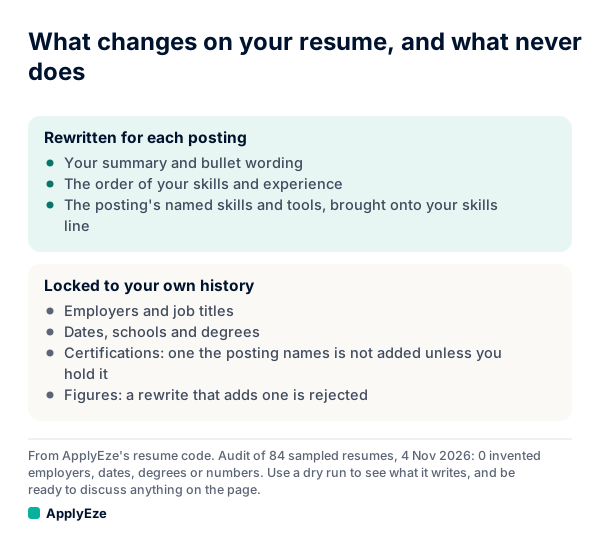
The summary that explains the move
Two or three lines, with three parts: the role you want, your related work described in that field's terms, and one piece of proof that you have already started. Leave out "seeking", "passionate" and the phrase "transferable skills", which tells the reader to do the translation. Our resume summary examples show the general form. A changer's summary differs in one way: it has to name the new role, because nothing below it will.
Ordering and bullets
Same facts, new order, new nouns. Take the vocabulary from two places: ten real postings for your target title, and the target occupation's task list on O*NET, a free database sponsored by the Department of Labor. Its Project Management Specialists page lists tasks such as "Plan, schedule, or coordinate project activities to meet deadlines." Its General and Operations Managers page lists "Prepare staff work schedules and assign specific duties." and also names Store Manager among reported titles, which is a useful thing for a retail manager to know. Those are ready-made nouns, written by someone other than you.
The fact check is simple. Print your old and new versions side by side. Every employer, title, date and number on the new page must appear on the old one, or in your records. If a number is new, you need to be able to prove it. If the verb has moved from something you did to something near what you did, change it back.
Skills you can actually discuss
Sort every skill you might list into three piles.
- Used at work. List it plainly.
- Learned and built something with. List it, and name the course or sample so that a reader sees how you got it.
- Read about or watched a video on. Leave it off.
The test for the second pile: could you answer two follow-up questions? A hiring manager reading a changer's resume will often start with the new skills, since those are the claims in doubt.
Sample: teacher to customer success
Customer success work centers on what Gainsight, a software company in that market, describes as onboarding, adoption and renewal, reviewing "health scores and usage data", and running Quarterly Business Reviews. A teacher has done versions of some of these and none of the commercial side. Our post on teachers changing careers covers the wider decision.
Before (sample):
SUMMARY
Dedicated English teacher with 9 years of experience creating a
positive and engaging classroom environment.

SKILLS
Lesson planning, classroom management, differentiated instruction

Cedar Hill High School, Tacoma, WA              Aug 2016 to Jun 2025
English Teacher
- Taught 5 sections of 10th grade English, about 140 students a year
- Created lesson plans aligned to state standards
- Communicated with parents about student progress
- Led the department's move to Google Classroom for 11 teachers
- Raised on-time assignment completion from 71% to 88% in two years
After (sample):
SUMMARY
Moving into customer success after 9 years of training people on new
tools and tracking whether they use them. Led an 11-person software
rollout. Built a sample onboarding plan and health score in 2025.

SKILLS
Onboarding and training, adoption tracking, progress reviews,
Google Classroom, Google Sheets, Salesforce (self-taught, sample
account plan available)

Cedar Hill High School, Tacoma, WA              Aug 2016 to Jun 2025
English Teacher
- Led the department's move to Google Classroom: trained 11 teachers
  and answered their questions through the first year
- Raised on-time assignment completion from 71% to 88% in two years
  by tracking weekly data and following up with at-risk students
- Held progress conversations with families of about 140 students a year
- Taught 5 sections of 10th grade English, about 140 students a year
What changed: the summary, the skills line and the order. The rollout moved to the top, since it is the closest thing to a customer onboarding. What did not: the school, title, dates, 11, 140, 71% and 88%. The added detail about weekly data has to be true of your classroom.
The line that goes too far: "Reduced churn by 17 points." Students are not customers, and that figure is a completion rate. Say what it was.
Sample: retail to operations
O*NET's task list for General and Operations Managers covers reviewing performance data, preparing schedules and handling budgets. A store manager has done most of that under a retail title, which makes this one of the shorter translations. The title stays.
Before (sample):
SUMMARY
Results-driven retail professional with a passion for customer service
and 8 years of experience in fast-paced environments.

Northgate Outfitters, Boise, ID                 Mar 2017 to Sep 2025
Store Manager
- Delivered excellent customer experiences for a high-volume store
- Managed 24 associates and $4.2M in annual sales
- Created weekly staff schedules and cut overtime 18%
- Cut inventory shrink from 2.1% to 1.4%
- Opened 2 seasonal locations on schedule
After (sample):
SUMMARY
Operations candidate with 8 years running a 24-person, $4.2M site:
scheduling, inventory control, weekly performance reviews and vendor
receiving. Cut overtime 18% and shrink from 2.1% to 1.4%.

Northgate Outfitters, Boise, ID                 Mar 2017 to Sep 2025
Store Manager
- Cut inventory shrink from 2.1% to 1.4% through cycle counts and
  receiving checks
- Built weekly schedules for 24 associates and cut overtime 18%
- Opened 2 seasonal locations on schedule
- Reviewed sales and performance data weekly for a $4.2M site
- Delivered excellent customer experiences for a high-volume store
What changed: process and numbers moved up, customer service moved down. Notice the customer line was not deleted, only placed last, and it can go if you need the space. What did not: the employer, title, dates, 24, $4.2M, 18%, 2.1% and 1.4%. The new detail on cycle counts and weekly reviews has to be true of your job, so write only what you did.
The line that goes too far: changing the title to "Operations Manager". You ran operations, and your title was Store Manager. Let the summary carry that.
Sample: military to project management
Here the problem is the reverse: the work is close, and the language hides it. Two free tools do the translating. O*NET's Military Crosswalk takes a branch and a code or title and suggests civilian occupations. The Defense Department's VMET document, DD-2586, lists your training and work history and translates your military occupations into civilian terms, for those separating from service.
Before (sample):
SUMMARY
Dedicated NCO with 12 years of service and a proven record of mission
accomplishment.

U.S. Army, Fort Stewart, GA                     Jun 2013 to Jul 2025
Platoon Sergeant, E-7
- Responsible for H&W, training and readiness of 38 Soldiers
- Maintained accountability of equipment valued at $6.4M
- Served as NCOIC for a network installation at 3 sites over 9 months
- Wrote NCOERs and counseled subordinates
After (sample):
SUMMARY
Moving into project coordination after 12 years planning and delivering
time-bound work with teams of up to 38. Ran a 9-month, 3-site network
installation that finished 2 weeks early. Completed 35 hours of project
management training in 2025.

SKILLS
Scheduling, resource planning, risk tracking, stakeholder updates,
equipment accountability, MS Project (course, 2025)

U.S. Army, Fort Stewart, GA                     Jun 2013 to Jul 2025
Platoon Sergeant, E-7
- Led a 9-month network installation at 3 sites, as the senior enlisted
  lead, and finished 2 weeks ahead of schedule
- Tracked equipment valued at $6.4M with no unaccounted losses
- Planned training and schedules for a team of 38
- Wrote performance reviews and coached team members
What changed: abbreviations became plain words, and the project moved to the top. What did not: the rank, title, dates, 38, $6.4M, 3 sites and 9 months. The new phrases "2 weeks ahead" and "no unaccounted losses" must come from your records.
The line that goes too far: "PMP" after your name, unless you hold it. PMI asks for a bachelor's degree or higher plus 3 years of experience managing projects, 35 hours of training, and a passed exam (or 5 years with a high school diploma). Note that those 35 hours in the sample are training, not a certification, and the resume says only that.
Functional format: when it helps
All three samples above use a combination format, which puts a summary and skills first and then a full work history. CareerOneStop, sponsored by the Department of Labor, says a combination format "works well for most people" and can "refocus your experience for a career change". It warns that with a functional format, "without a detailed work history, the resume may be misinterpreted by employers, or rejected by applicant tracking systems (ATS)".
| Your situation | Format |
|---|---|
| Applying through a company career site or any online form | Combination |
| Applying with a recruiter who will pass your resume on | Combination |
| Handing a printed page to a person who already knows your story, such as at a networking event | Functional can work, as long as you also have a combination version |
| Trying to hide an old title or a gap | Neither helps. The form asks for each job and its dates. |
A functional resume feels right to a changer because it pushes the old title down the page. It also cuts your achievements loose from the jobs that produced them, which is what a skeptical reader most wants to see. Our functional resume post has a parse test that shows what happens to those lines.
If you want this done per posting
Rewriting a top third for every application is real work, and ApplyEze does it for each one. For each application, an AI model reads that posting and your real history and writes a resume for it, as PDF and DOCX, aiming for one page. Each file is read back the way a parser reads it, and a failed read stops the run before the form. Your employers, job titles, dates, schools, degrees and certifications come from your own record, and code rejects a rewrite that adds a figure, employer, school or credential your record does not hold. An audit of 84 sampled resumes on 4 November 2026 found 0 invented employers, dates, degrees or numbers.
Skills work differently, and a changer should plan for it. ApplyEze brings the posting's named skills and tools onto your skills line, even when your own record does not list them. There is no step to remove one before a live run, so use a dry run to see what it writes, and be ready to discuss anything on the page. A certification the posting asks for is not added unless you hold it. Read each dry run against your three piles above, so that no line reaches an interview unprepared.
Your next step is the fact check above, on your own draft. To test the move before you rewrite anything, see our post on a career change at 40. ApplyEze can then carry the per-posting work: you queue the roles you want, it runs on your own computer, which stays on and awake until the queue finishes, and Workday and Oracle jobs need a connected application inbox. If you would rather spend your evenings on the sample project than on a new top third for every posting, your first 50 applications are free, with no card, and a credit is used only when an application is confirmed as submitted.