

A career change for teachers works best into jobs that pay for what a classroom already proves: instructional design and training, customer success, HR and project management. The move does not automatically raise your pay. The Bureau of Labor Statistics put high school teachers at a median of $72,040 in May 2025, and training and development specialists at $69,280. This post compares four destinations using our own job pool and BLS, lists the credentials each asks for, flags the contract and loan dates to check before you resign, and shows how to rewrite a teacher's resume lines.
What the numbers say about education
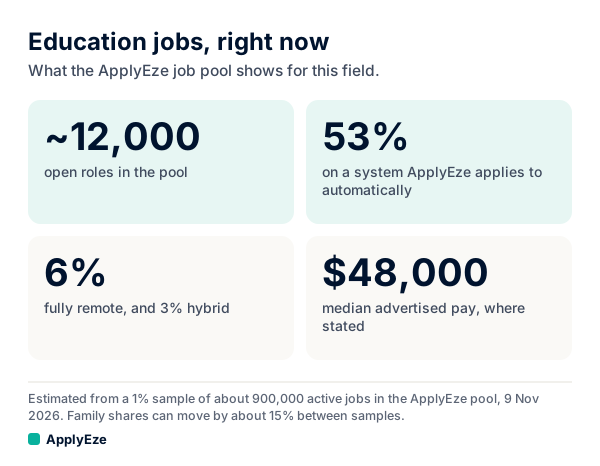
Our job pool shows roughly 12,000 open education roles, from a 1% sample of about 900,000 active jobs on 9 November 2026. Roughly 6% are fully remote, and the median advertised pay is $48,000. Three things to keep in mind when you read that:
- It is not teacher pay. BLS puts elementary teachers at $63,970 and high school teachers at $72,040. Our figure covers any education posting that states pay.
- It rests on few postings. About 15% of postings state pay. If education runs at that rate, that is fewer than 20 of our 118 sampled rows (our arithmetic).
- Classroom jobs sit largely elsewhere. Districts can hire through K-12 systems such as Frontline's, outside the employer boards this sample covers.
So the number says little about teaching. At most it hints that education jobs outside the classroom, on these hiring systems, do not pay more than teaching does. BLS expects teaching employment to show little or no change from 2025 to 2035, so the jobs are not disappearing. Whether to leave is a question about the work and the money, and the rest of this post is about both.
Four destinations, compared
Most lists of jobs for former teachers skip the supply question. Here is what our pool and BLS show. Pool counts are rough, from that same 1% sample, and a field's count can move by about 15% between samples.
| Destination | Rough open roles | Fully remote | Median advertised pay, where stated | BLS median, May 2025 | Starter credential |
|---|---|---|---|---|---|
| Customer success | Roughly 35,000 | Roughly 5% | $48,000 | No direct match we could find | No standard one |
| Project and program management | Roughly 19,000 | Roughly 11% | $118,000 | $102,320 | CAPM |
| HR and recruiting | Roughly 12,000 | Roughly 6% | $105,000 | $75,940 | aPHR |
| Instructional design and training | No separate row in our data | $69,280, or $77,440 for instructional coordinators | A portfolio |
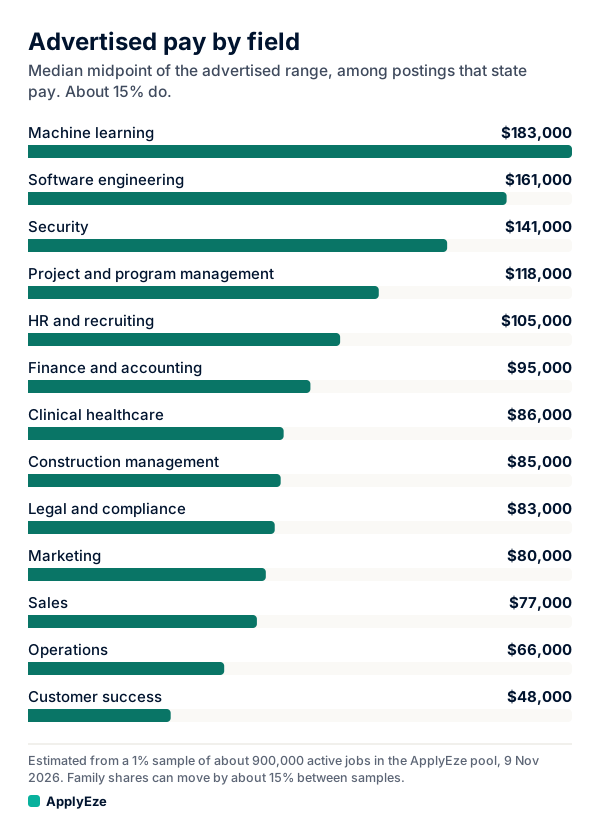
The chart shows customer success at the bottom of the fields it lists, at $48,000, the same as education. Four things stand out:
- Customer success may not be the pay raise it is sold as. The advertised median matches education's. We suspect the family includes a lot of support-style work, since ChurnZero's career guide cites averages for the customer success manager title of about $77,900 (PayScale) and about $114,000 (Salary.com), with no collection date. The title you land matters more than the field name.
- HR's $105,000 is not a starting salary. It is about $29,000 above the BLS median (our arithmetic), and it rests on a small number of postings that state pay. For an HR coordinator's first job, trust neither. Read the local postings.
- Project management has the largest gap, and the highest bar. More on that below.
- Remote is rarer than the pitch. Across all jobs in our pool, roughly 8% are fully remote. Customer success and HR sit below that. If working from home is the goal, project management is the only one of these three above the average, and it is not by much.
Then do the math on the calendar. BLS notes that many teachers work a 10-month year. At the medians above, $72,040 over 10 months is $7,204 a month worked. An HR specialist's $75,940 over 12 months is $6,328 a month worked. You would gain $3,900 a year and give up the summer. That may still be a good trade, but make it knowingly.
Skills that really transfer
"Communication" and "patience" are true and useless, because every applicant claims them. What transfers is evidence with a noun attached. Here is the map, with what is missing:
| What you did | What employers call it | Where it counts | What you still lack |
|---|---|---|---|
| Planned units backward from an assessment | Learning objectives and design | Instructional design, training | An authoring tool, adult learners |
| Reworked teaching after test data | Measuring and iterating | Instructional design, customer success | A spreadsheet or BI tool |
| Hard parent conferences | Managing expectations, difficult conversations | Customer success, HR | Revenue, renewals |
| Ran a new curriculum rollout | Project coordination, change management | Project management | A budget owner's view, scheduling tools |
| Mentored first-year teachers | Onboarding and coaching | HR, training | Employment law |
| IEP or 504 paperwork on legal deadlines | Compliance documentation | HR, project management | The rules of the new field |
"Classroom management" does not transfer by name. Adults do not need managing the way 30 ninth graders do, and a hiring manager may read it that way. Describe what you ran, in numbers.
Before you resign: contract, loan and pension dates
Most career change lists stop at job titles. These are the dates that can cost you. This is general information, not legal or financial advice, and rules differ by state and plan.
Your contract. Leaving at the wrong time can touch your license. In Texas, under 19 TAC 249.17 (current version effective May 18, 2025), abandoning a contract 44 to 30 days before the first day of instruction brings an inscribed reprimand where mitigating factors do not apply. Less than 30 days before, or during the school year, brings at least a one-year suspension, though good cause and mitigating factors such as helping find a replacement can reduce or remove it. In California, Education Code 44420 lets the commission suspend a credential for up to one year if you leave without good cause or the district's consent. A suspension matters if you might ever return. Ask your district about a release first.
Your loans. Federal Student Aid's teacher forgiveness guide says Teacher Loan Forgiveness needs five complete and consecutive years at a qualifying school, for up to $17,500 for certain math, science and special education teachers and up to $5,000 for others. Leaving in year four can forfeit that. Public Service Loan Forgiveness needs 120 qualifying payments while working for a qualifying employer, which can include government and 501(c)(3) nonprofits. So a move to HR at a nonprofit hospital may keep that clock running, and a move to a software company will not. Check on StudentAid.gov.
Your pension. Education Next reported in 2017 that about half of states vest teachers at five years and most of the rest at 10. That article is old, so get your own date from your plan. Ask what you can withdraw and what you would give up.
Social Security. If your school job did not pay into Social Security, the news here got better. The Social Security Fairness Act, signed January 5, 2025, ended the Windfall Elimination Provision and the Government Pension Offset. SSA says about 72% of state and local public employees were in covered work and unaffected anyway.
Destination: instructional design and training
This is the closest match, and the most crowded with former teachers making the same pitch. BLS says training specialists typically need a bachelor's degree and related work experience, and projects 11% growth from 2025 to 2035.
- What they ask for. A portfolio. Devlin Peck, who sells instructional design training and so has an interest, says employers want proof "through a portfolio" and that you do not need a master's degree. Two sample modules beat a lesson plan archive. Build them in the authoring tool your target postings name, such as Storyline 360.
- Staying in schools? An instructional coordinator earns more, at $77,440, but BLS says those in public schools are required to have a master's degree in education.
- Credentials. ATD's APTD asks for three years of professional work experience and its CPTD for five, so neither is a way in.
- Titles to list. Instructional designer, learning experience designer, training specialist, learning and development specialist, curriculum developer, enablement specialist.
Destination: customer success
The job is keeping a customer's account healthy. Kustomer lists guiding new customers to adoption, preparing and negotiating renewals, and spotting churn risk. That last part is the gap for a teacher. You have explained things to anxious people for years. You probably have not owned a renewal number.
- Where to aim first. Education technology companies, where knowing how a school buys and how a teacher thinks is the actual skill. Your district's software vendors are a starting list.
- Titles to list. Customer success manager is often a step up. Add onboarding specialist, implementation specialist, customer education specialist and customer support specialist.
- What to check. Read the pay. With an advertised median of $48,000, some of these jobs pay less than teaching.
Destination: HR and project management
HR. BLS points to a bachelor's in human resources, business, communications or a related field, and projects 6% growth. HRCI says "No HR experience is required" for its aPHR, and SHRM-CP is aimed at people doing HR work or pursuing a career in it. Your school's own HR office is a real bridge, because it is a place where teaching experience reads as an advantage. Titles to list: HR coordinator, HR assistant, recruiting coordinator, talent acquisition coordinator.
Project management. The BLS median is $102,320, with 7% projected growth, and certification is "not always required". PMI's CAPM needs 23 hours of project management education and no experience. Its PMP needs at least 36 months leading projects in the past 10 years with a bachelor's degree, plus 35 hours of training. So start as a coordinator, and count that $118,000 in our pool as a figure for people well past where you are starting. Titles to list: project coordinator, program coordinator, assistant project manager, program manager at a nonprofit.
Rewriting a teacher's resume lines
Your job title and dates stay true. The words around them change for the reader. Here is one hypothetical seventh-grade math teacher, with invented figures, written for this post:
| Before | Rewritten for | After |
|---|---|---|
| Taught 7th grade math to 130 students in 5 sections | Instructional design | Designed and delivered 5 sections of a grade 7 math course for 130 learners, rebuilding 2 units after assessment data showed a 20-point gap |
| Used Google Classroom daily | Customer success | Moved 130 families onto a new parent portal in 3 weeks, running training sessions and resolving login issues |
| Member of curriculum committee | Project management | Led a 6-month curriculum adoption for 9 teachers across 3 grades, managing the schedule, training plan and $18,000 materials budget |
| Mentored new teachers | HR | Onboarded and coached 3 first-year teachers through a 10-month induction program, tracking required observations |
The after column only works if the facts behind it are yours. Count your own numbers, and leave out anything you did not do.
Keep your license too, but move it. Licensed Secondary Mathematics Teacher, [State], expires [MM/YYYY] belongs under certifications near the bottom, where it reads as evidence and not as your identity. Use your summary line to name the role you want. Our
career change resume guide covers the format, and our career change plan has a worksheet for sizing the skills gap from ten postings.
Listing target titles so the right roles show up
Searching one title can make a whole field look empty. Titles are how these jobs get found, on any tool. The same work can be posted as "learning specialist" at one company and "enablement partner" at another.
That is also true of our own board. ApplyEze does not rank by text similarity. It ranks on your target titles and the requirements it reads out of each posting, and the order of your target roles is real: first listed ranks first. A role doing your work under a title you did not list ranks low, so list several, using the lists above, and read our post on target job titles for how the order changes what you see.
With that list in hand, ApplyEze can test a new direction at some scale. It polls more than 100,000 employer boards directly, about 900,000 active jobs. Across all fields it applies on systems holding roughly 62% of the jobs we track with a connected application inbox, and roughly 23% without one. For these destinations the with-inbox share runs from roughly 56% in project management to roughly 66% in HR. Workday and Oracle jobs stay hidden until you connect that inbox, because those sites email a code. You pick the matches and queue them in the desktop app, with your computer on and awake, and a credit is used only when an application is confirmed as Submitted.
For each application, an AI model reads that posting and your real history and writes a resume for it, which suits a career change. Your employers, job titles, dates, schools, degrees and certifications come from your own record, while the summary, bullets and order are rewritten for the posting. ApplyEze also brings the posting's named skills and tools onto your skills line, even when your own record does not list them. There is no step to remove one before a live run, so use a dry run to see what it writes, and be ready to discuss anything on the page.
Your next step is the title list. Write it tonight, rewrite two resume lines from the table above, and test the market before you hand in any notice. Your first 50 applications are free, with no card, and you record employer replies yourself on each application, so you can see which direction answers.