

FastApply vs ApplyEze comes down to two questions: where the work runs, and what tailoring costs you. FastApply leads on the first. Its Apply for Me mode runs on its servers with your laptop closed, it names more application systems, and it sells a Max plan with 2,000 credits a month. ApplyEze's ground is the second. Its list price of $19 a month covers 700 applications with a resume written for each posting, while FastApply Starter comes to $21 a month for 200 once you add its tailoring add-on.
We make ApplyEze, a competing product. Every FastApply figure below comes from its pricing page and its supported sites page, read on 9 November 2026, where the prices are labelled "accurate as of October 2026". Those are FastApply's claims, and we did not test them.
What each costs at your volume
A plan-by-plan comparison hides the useful part. The two price ladders have different steps, so the answer flips several times as volume rises. This table takes the smallest monthly plan that covers each volume, as of November 2026, in US dollars. The figure in brackets is the cost per application at that volume (our arithmetic).
| Applications a month | FastApply, your own resume | FastApply, tailored | ApplyEze, resume per posting included |
|---|---|---|---|
| 100 | $14 (14 cents) | $21 (21 cents) | $19 (19 cents) |
| 200 | $14 (7 cents) | $21 (10.5 cents) | $19 (9.5 cents) |
| 500 | $29 (5.8 cents) | $41 (8.2 cents) | $19 (3.8 cents) |
| 700 | $49 (7 cents) | $68 (9.7 cents) | $19 (2.7 cents) |
| 1,000 | $49 (4.9 cents) | $68 (6.8 cents) | $99 (9.9 cents) |
| 2,000 | $89 (4.5 cents) | $118 (5.9 cents) | $99 (5 cents) |
| 3,000 | No monthly plan | No monthly plan | $99 (3.3 cents) |
Read it this way:
- Tailored, up to 700 a month: ApplyEze costs less at every row. The gap runs from $2 at 100 to $49 at 700.
- Tailored, 701 to 1,000 a month: FastApply costs less, $68 against $99, because ApplyEze has no plan between $19 and $99.
- Tailored, 1,001 to 2,000 a month: ApplyEze costs less again, $99 against $118.
- With your own resume: FastApply costs less at 200 or under ($14 against $19) and from 701 to 2,000 ($49 or $89 against $99). If you do not want a different resume per job, FastApply's low end is the smaller bill.
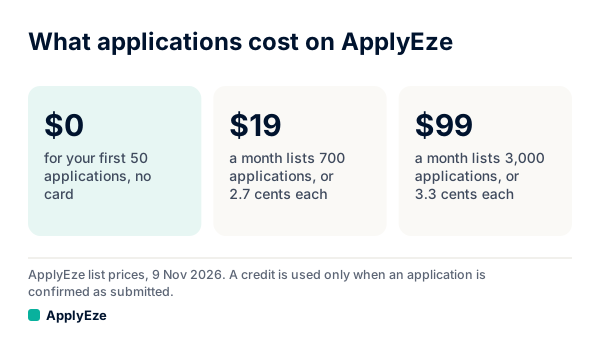
ApplyEze's column uses the three prices in this chart: $0 for the first 50 applications with no card, $19 a month for 700, and $99 a month for 3,000.
FastApply also sells two longer commitments that lower its numbers, and ApplyEze has no equivalent. A 90-Day Sprint is one payment of $38, $75, $132 or $240, and the add-on costs less on it. Starter with tailoring then works out to $19.00 a month ($12.67 plus $6.33), the same as ApplyEze Starter's list price, for 200 a month where ApplyEze lists 700. Elite with tailoring works out to $61 a month for 1,000, or 6.1 cents.
Yearly billing goes further. Pro is $17.34 a month billed yearly, with a cap of up to 170 a day in place of 500 a month. Used every day for 30 days without tailoring, that is about 0.34 cents an application (our arithmetic). Treat that as a ceiling on volume, not a forecast. You also pay for the year up front, under a refund policy that says subscription fees are non-refundable except where the law requires a refund.
Both charge only for what went in. FastApply's wording is "Only applications actually submitted use a credit". ApplyEze's is "A credit is used only when an application is confirmed as Submitted." That is a tie, not a reason to choose.
What "laptop closed" covers
This is FastApply's clearest lead, and the part most summaries flatten. It has two modes, and they differ in what they reach.
| FastApply Browse & Apply | FastApply Apply for Me | ApplyEze, self-serve | |
|---|---|---|---|
| Runs | Chrome extension. "Keep the tab open while it runs." | Its servers. "Close the tab, close the laptop." | Desktop app and Chrome on your computer, kept on and awake |
| Reaches | Job boards, plus the systems below | Employer career pages and 10 named systems | 12 named systems |
| Who picks the job | You, or a search you start | A match score threshold you set | You, from a ranked board |
| Free start | Up to 5 a day for 7 days | Paid plans only | 50 credits, once |
| Running at once | Not stated | 1 to 5 background searches, by plan | Up to 10 lanes, default 3 |
Three consequences are easy to miss:
- Job boards are outside the laptop-closed mode. FastApply says Apply for Me "runs on our servers against employer career pages". LinkedIn, Indeed, Glassdoor and ZipRecruiter stay in the extension.
- Some systems appear to be extension only. BambooHR, Rippling, JazzHR and Recruitee sit under "Also supported", described as "platforms the extension handles". The page does not claim Apply for Me for them.
- You cannot try Apply for Me free. The free plan is Browse & Apply only, and paid fees are not refunded. If server mode is your reason for choosing FastApply, one month of Starter at $14 is the price of finding out. Check one thing while you are there: its plan finder says each search "watches one role and location", while its plan table says each has "its own roles, locations and match threshold". Starter includes one search, so the difference matters.
ApplyEze's limit is simple. "Applications run on your computer while the app is open, so keep it on and awake until your queue finishes. You can use the computer in the meantime." Nothing runs from a phone, and a self-serve account does not run on our servers. If your only computer spends the day in a bag, FastApply's server mode solves a problem ApplyEze does not.
The other real difference is who decides. Apply for Me applies to whatever clears the score you set, with nobody queueing anything. On ApplyEze you pick from a board ranked by rules on your target titles and each posting's requirements, drawn from more than 100,000 employer boards we poll directly, and nothing goes out until you queue it. You keep control of the list. FastApply's matching has drawn complaints: a Trustpilot review from 17 September 2026 reports mostly irrelevant results. Eight reviews is a thin sample, so test it on your own titles.
Systems: claimed and measured
| Where it appears | Systems |
|---|---|
| Both FastApply modes, and ApplyEze | Workday, Greenhouse, Lever, Workable, Ashby, SmartRecruiters, Oracle |
| Both FastApply modes, not on ApplyEze's self-serve list | iCIMS, Taleo, Personio |
| FastApply's extension list, and ApplyEze | Recruitee, BambooHR, Rippling, JazzHR |
| FastApply's extension list, not ApplyEze | Breezy, Paylocity, Jobvite, Zoho Recruit, Comeet, Teamtailor and others, plus boards such as LinkedIn, Indeed, Glassdoor and ZipRecruiter |
| ApplyEze, not named on FastApply's page | Pinpoint |
FastApply's list is longer, and that counts. Of the about 900,000 active jobs we track, roughly 38% sit where a self-serve ApplyEze account has no automatic path. Roughly 4 in 10 of those open jobs are on Workday and Oracle, and those "stay hidden until you connect an application inbox, because those sites email a code."
A list is still a claim. FastApply says "iCIMS is fully supported". We found no completion figure on the pages we read, so nobody outside the company can say how often that works.
We measure ours, on our team product. In the 14 days to 9 November 2026, ApplyEze Autopilot submitted 12,488 Workday applications, and 2,830 Workday runs ended without one, for any reason including a closed posting. That is an applied share of 81.5%. Across all 14 systems it was 79.1%, at a median of 2.5 minutes an application over the last 7 days, and we publish every system, including the weak ones: iCIMS was 55.5%. Those are team numbers, not a free user's result, and a free account does not include iCIMS. Autopilot is set up today for staffing and recruiting teams that work with ApplyEze. If you are job hunting on your own, you can start with 50 free applications on sign-up, no card needed. You pick the matches and queue them in the desktop app, and ApplyEze fills and submits each form.
A test you can run this evening, whichever tool you lean toward. Open the last 20 postings you would apply to, click through to the actual form, and note the web address.
myworkdayjobs.comis Workday,greenhouse.iois Greenhouse,lever.cois Lever,ashbyhq.comis Ashby.oraclecloud.comis Oracle,smartrecruiters.comis SmartRecruiters,workable.comis Workable.bamboohr.com,rippling.com,recruitee.comandpinpointhq.comname themselves, andapplytojob.comis JazzHR.icims.comis iCIMS,taleo.netis Taleo,paylocity.comis Paylocity.
Count them against the table. If many land on the last line, a self-serve ApplyEze account cannot apply there and the price table stops mattering. If most land on the first two lines, either tool names them, so decide on cost and where it runs. If most stay on a job board's own form, ApplyEze is the wrong tool.
Where else FastApply is ahead
- Tailoring with a stated limit. FastApply says its add-on writes "using only what your profile verifies". We have not tested how that holds in practice. ApplyEze's employers, titles, dates, schools, degrees and certifications come from your record, and in an audit on 4 November 2026 of 84 sampled resumes we found 0 invented employers, dates, degrees or numbers. ApplyEze brings the posting's named skills and tools onto your skills line, even when your own record does not list them. There is no step to remove one before a live run, so use a dry run to see what it writes, and be ready to discuss anything on the page.
- Replies. FastApply's tracker claims to hold "any employer reply", and its how-it-works page promises a notification when companies respond. It does not say how replies are read. On a self-serve ApplyEze account you record replies yourself on each application.
- Written refund terms. FastApply's policy mostly says no, but it is written down. ApplyEze has no published policy. Our line is: "For anything else, a refund included, email hello@applyeze.com and we will sort it out."
- Public reviews exist. On 9 November 2026 FastApply showed 2.4 from 8 reviews on Trustpilot and 3.2 from 29 ratings in the Chrome Web Store, with 10,000 users. Recent Trustpilot complaints include a refund refused after stalled applications and a support wait of over 48 hours. ApplyEze has no public reviews.
Where else ApplyEze is ahead
- A record at volume. 94,207 applications have gone through ApplyEze since 14 August 2026, to 9,769 employers, as of 9 November 2026.
- A longer, fuller free start. 50 credits against at most 35 applications in FastApply's 7 days (5 times 7, our arithmetic). The free credits include a resume per posting, where FastApply's free plan uses "your own resume". They have no expiry date today.
- Each resume is read back. A resume is built per posting, as PDF and DOCX, and each file is read back the way a parser reads it. A failed read stops the run before the form.
- It stays on employers' own systems. LinkedIn Easy Apply is on no ApplyEze list. FastApply's extension "drives the job boards you are signed in to", and LinkedIn's help page says it does not permit browser extensions that automate activity on its site, and that members "risk having their accounts restricted or shut down". That is a risk to weigh. It does not make any tool safe, and some employers ask applicants not to use AI or automation. Whether to apply there is your call.
- What it shows. Team Autopilot's completion by system, counted, including the weak ones. On the rival pages we read on 9 November 2026 we did not find a figure like that. That puts us ahead in what is shown, and it is not a claim about results.
Neither one should go out unread
FastApply's FAQ asks "Can I see the tailored resume before it is sent?" and answers that each one "is saved in your tracker next to the job it was sent to". So you read it afterward. ApplyEze has no approval step before Submit either. It has a dry run, which fills the form and stops before Submit, and uses no credit as long as you have one left. Our guide to reading a dry run shows what to check.
Answers need the same care. Hard facts come from your profile. When a required question is not covered by your saved answers, ApplyEze still fills it rather than stopping the run, so that answer may not come from you. Fill in your saved answers, use dry run first, and read your receipts.
Who should pick which
| Your situation | Lean toward | Why |
|---|---|---|
| Your computer cannot stay on and awake | FastApply | Apply for Me runs on its servers |
| Your employers use iCIMS, Taleo, Personio or Paylocity | FastApply | A self-serve ApplyEze account does not apply there |
| You apply mainly through job boards | FastApply | ApplyEze does not touch them |
| Up to 200 a month with one resume | FastApply | $14 against $19 |
| 701 to 1,000 a month, tailored | FastApply | $68 against $99 |
| 201 to 700 a month, a resume per posting | ApplyEze | $19 against $41 or $68 |
| You want to choose each role yourself | ApplyEze | Nothing goes out until you queue it |
| You want to test tailoring before paying anyone | ApplyEze | FastApply's free plan does not include it |
Neither of us can show that our tool gets you more interviews. Auto apply to jobs covers the category, and our Tsenta alternatives post compares more of the field.
To start, install the desktop app, connect an application inbox if your targets are on Workday or Oracle, queue a few matches and begin with a dry run. If you want a resume for every posting without an add-on to price, your first 50 applications are free, once per email address and with no card.