
How long does a job application take? It depends on which clock you mean, and the answers differ by a factor of more than 30. Software on a real form takes a median of 1.2 to 4.5 minutes, depending on the application system, in our own production data. Researchers with a stopwatch averaged 4 minutes 52 seconds on Fortune 500 forms. A person doing the whole job, including reading the posting and tailoring a resume, reports about 44 minutes. Plan your week on the last number, since that is the one you will live. The first two tell you how little of it is the form. Many pages that rank for this phrase answer a different question, how long until you hear back. This one is about the time it takes to apply.
Three clocks
| Clock | Figure | Who measured it | Inside the clock | Outside the clock |
|---|---|---|---|---|
| Software on a real form | Median 2.5 minutes overall, 1.2 to 4.5 by system | ApplyEze Autopilot production data, November 2026 | From a lane picking up the role to the application going in | Finding the job, deciding to apply, and runs that never submitted |
| Researcher with a stopwatch | Average 4 minutes 52 seconds, 51 clicks | InFlight audit of the Fortune 500, reported by SHRM, February 2022 | First click to submission confirmation | Reading, deciding and tailoring |
| Person doing the whole job | About 44 minutes | United Way NCA survey of 1,000 US job seekers, published May 2026 | "Filling out forms, uploading resumes, and tailoring materials" | Not timed: it is what people recall |
Each number is true of what it measures, and they measure three different jobs.
Software on a real form, by system
Across all systems, in the 7 days to 9 November 2026, ApplyEze Autopilot took a median of 2.5 minutes from a lane picking up a role to the application going in, on 17,994 applications, and 4.9 minutes at the 90th percentile. By system, over the 14 days to the same date:
| System | Median minutes | Applications in the window |
|---|---|---|
| Pinpoint | 1.2 | 111 |
| Ashby | 1.5 | 5,944 |
| Rippling | 1.5 | 671 |
| Recruitee | 1.5 | 118 |
| JazzHR | 1.6 | 1,076 |
| Lever | 1.6 | 903 |
| Workable | 1.7 | 1,329 |
| BambooHR | 2.1 | 569 |
| Greenhouse | 2.2 | 7,445 |
| iCIMS | 2.8 | 1,468 |
| Dayforce | 3.2 | 789 |
| Oracle | 3.3 | 1,428 |
| SmartRecruiters | 3.4 | 1,535 |
| Workday | 4.5 | 12,488 |
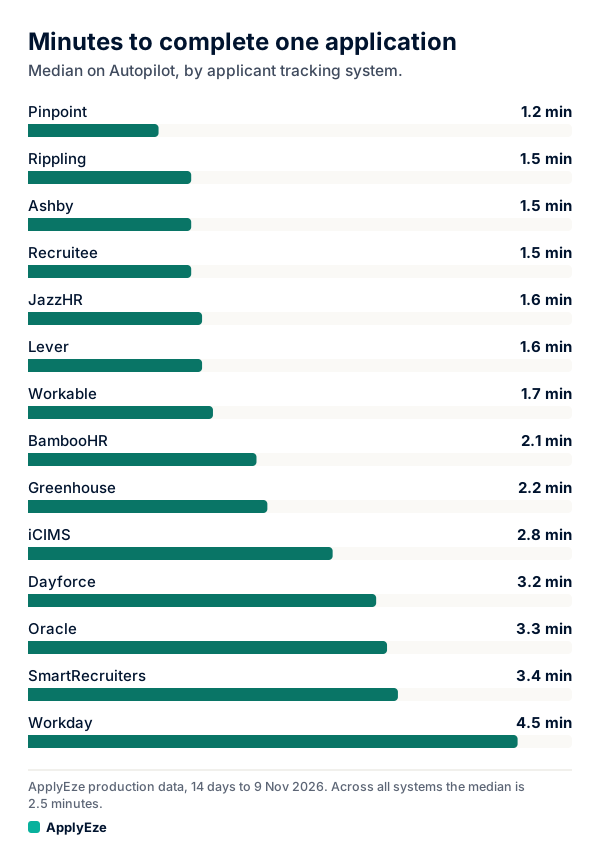
The chart and table show the same spread: Workday's median is nearly four times Pinpoint's, and most systems sit under 2.5 minutes. Pinpoint and Recruitee rest on small counts, so do not read much into a tenth of a minute there.
Read these for what they are. They cover applications that went in, which was 35,874 of 45,376 runs in the same two weeks, or 79.1%, and our completion rate post has those counts. They start after the deciding is done: on Autopilot, finding and judging roles happens earlier and elsewhere. And they are team numbers, from ApplyEze servers, not the speed of a free account on your own computer.
Autopilot is set up today for staffing and recruiting teams that work with ApplyEze. If you are job hunting on your own, you can start with 50 free applications on sign-up, no card needed. You pick the matches and queue them in the desktop app, and ApplyEze fills and submits each form.
A researcher with a stopwatch: 4 minutes 52 seconds
InFlight, a company that sells apply flow technology, had researchers apply to open jobs at Fortune 500 companies and timed each one from first click to submission confirmation. The average was 4 minutes 52 seconds and 51 clicks, nine of them after clicking Apply and before reaching the application at all. The audit also found "the large, legacy ATSs returning the longest application completion times and the newer, more-flexible systems delivering faster results."
Treat this as close to a floor for a human. The researchers had no reason to hesitate, nothing riding on the answers, and no resume to tailor. It is also from 2022, the number of forms is not stated, and there is no newer stopwatch study we could find. The same article carries the often-quoted claim that 92% of people never finish. The article gives no method for that figure and does not show that forms are the reason.
A person doing the whole job: about 44 minutes
United Way NCA surveyed 1,000 current and recent US job seekers from 26 February to 7 March 2026. They reported 62.6 applications at about 44 minutes each, 46.2 hours in total. People who had been laid off reported 95.3 applications at about 32.6 minutes each, which is about 52 hours (our arithmetic). They spent less on each application and more overall, which fits what pressure does to a search.
A UK survey landed nearby. Totaljobs reported 42 minutes per application from 3,000 UK workers, with 53 minutes seen as too long. And Huntr's Q3 2026 survey isolates one piece: of 317 people who tailor, 43% spend 10 to 30 minutes per job on it and 19% spend more than an hour. Self-selected respondents, but it shows where a large part of the 44 goes.
One figure to drop: "51 hours". It comes from Zippia, which estimates 31 minutes per application on entry-level roles and multiplies by 100 applications with no source for the 100.
Why you cannot subtract these
The tempting sum is 44 minus 2.5, or about 41 minutes saved per application. We do not make that claim, and no one can from these sources:
- Different tasks. The 44 includes reading and tailoring. The 2.5 starts after the decision. Reading a posting does not vanish because a form got faster, and you should still check what goes out.
- Different method. One is a machine log. The other is what people recall, and recall of small repeated tasks is rough.
- Different statistic. A median and an average answer different questions when a few forms take far longer than the rest.
- Different forms. Our mix of 14 systems, the Fortune 500 in 2022, and whatever a thousand job seekers happened to apply to.
- Completed runs only. Ours counts applications that went in.
The same trap works in reverse. Set Workday's 4.5 minute software median beside the researcher's 4 minutes 52 seconds and software looks barely faster than a person. That is just as wrong, for the same reasons.
Why Workday takes longest
Our data gives the ranking. The mechanism is visible from the outside, and it fits.
A Workday application is a fixed run of pages. The step bars we read at eight employers on 18 October 2026 ran from 6 to 8 steps, from account through resume parse, My Experience, questions, disclosures and review. Where an account is required, it exists only at that employer. Workday and Oracle sites email a code, so part of the median is likely spent waiting on an inbox. Oracle (3.3 minutes), Dayforce (3.2) and iCIMS (2.8), also multi-step, sit at the slow end as well. SmartRecruiters is second slowest at 3.4.
Workday says as much about the friction. Its October 2026 announcement names "another account, a new password, and the same work history" as the roadblocks, and promises a reusable profile, expected in early 2027, that it expects to make applying "about 40% faster". That is Workday's own forecast, not a measurement, and employers' screening questions stay.
It matters because Workday is also the system you will meet most: roughly a third of open jobs in our sample. The slowest form is the most common one.
What this means for your week
At about 44 minutes each, 100 applications is about 73 hours. But the average tells you little about you. Time your next five applications with three splits. It takes no tool beyond your phone.
| Split | Sample minutes | Your five, averaged | What a high number means |
|---|---|---|---|
| Reading and deciding | 6 | You may be reading roles you would never take. Tighten your search titles. | |
| Tailoring resume and letter | 18 | Useful up to a point. Set a cap and tailor the top of the resume first. | |
| The form | 12 | Accounts and retyping. Fix this one with preparation. |
The sample column is invented for illustration, not anyone's real data. At those figures, 15 applications a week is 9 hours.
If the form is your largest split, three habits cut it. Use one email address for every application, so codes land in one place. Keep a password manager entry per employer on Workday and iCIMS. Keep a plain text file with each job's employer, title, dates and your work authorization answers, ready to paste. Our guide to filling out a job application goes through every field.
If tailoring is your largest split, that may be fine. It is the part of the 44 minutes an employer actually reads. Batch Workday applications for when you have energy, and do the shorter forms when you do not.
If you would rather keep the reading and hand off the rest, your first 50 applications are free, no card needed. You pick the matches and queue them, and ApplyEze builds a resume for each posting and fills the form in the desktop app while your computer stays on and awake. Workday and Oracle roles need a connected inbox, for those emailed codes.